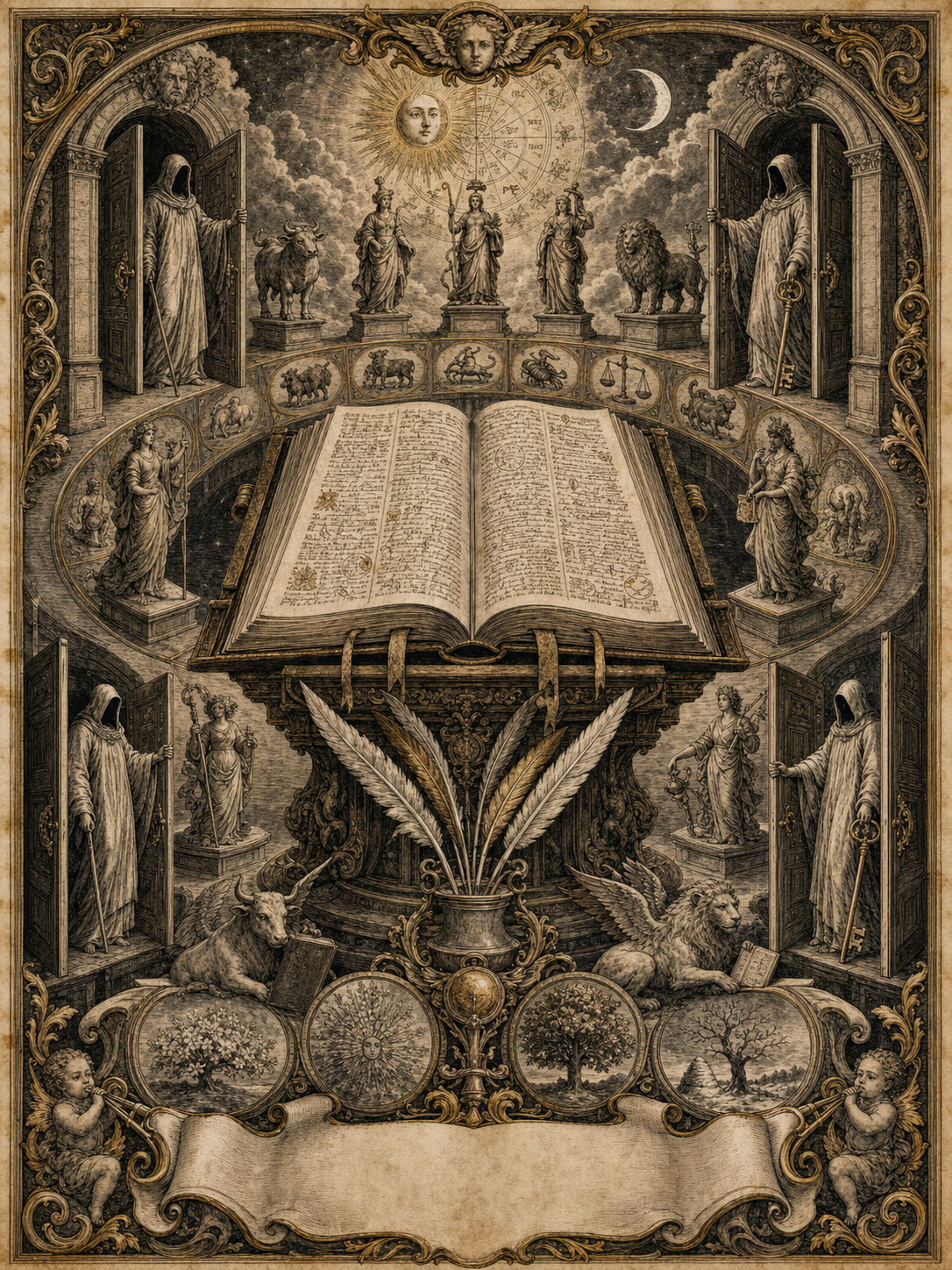
ATEM (Archivo Total de Escritura Manuscrita, “Total Archive of Manuscript Writing”) is the glossary of a shared cosmos recorded across handwritten notebooks. This is its English reference edition: one article per Spanish entry, written as plain encyclopedic summaries — facts first, no narrator.
| Articles | One per Spanish entry, same name: /<Entry> ⇄ /en/<Entry> |
| Switch language | the Español · English link under each title |
| Search | searches the edition you are reading |
| Concordance | /en/concordance.json · /en/concordance.tsv |
| Spanish home | El Archivo |
| The world | The World — the world before the gestas: Terra and Antiterra, dual magic, the zodiacal platforms, the guardians and the history counted in A.D.A. |
| Chronicles and method | Canon · Recordings · Notes · Memories — the 29 chronicles with their decks and English comics, and the pipeline that turns a table into this archive |
How the English edition works
- The Spanish entry is the source. Each English article summarizes only what its Spanish entry states. Nothing is added from outside the Archive.
- Disagreements are kept. Where the Archive records two versions, the article lists both under Conflicting accounts; what the Archive does not know is listed under Open questions.
- Names stay as the Archive spells them. In-world names are not translated (Ariadna, Ärsvan, Torregrises); real places and historical persons use their usual English forms (Paris, Constantinople, Alexander VI).
- Entries not yet written in Spanish appear as short pages listing the articles that mention them.
- The concordance lists every entry with its English and Spanish titles, aliases, chronicle code, era and opening sentence — a lookup table for any other document that refers to the Archive.
Hierarchy of sources
The Archive is built in layers. When they disagree, the older layer prevails:
- The notebooks — the handwritten originals. They prevail over everything else.
- The transcription — first copy of the notebooks; it may expand abbreviations but not add names.
- The Calendar — the chronological consolidation of the shared cosmos, begun by Amitlai and continued by Clarisa. It prevails over the glossary.
- The glossary — the curated entries.
- The marginal gloss of the Chronicler of the Plata — commentary, not a source.
A later layer may overwrite an earlier one only if it says so.
The Platonic eras
The Archive orders events in fourteen eras (00–13); native calendars are kept inside each. See Platonic Eras and the Chronicle of the Archive.
| # | Era | Frame | Native calendar |
|---|---|---|---|
| 00 | Primordial Era | before all record | — |
| 01 | Age of Empires | classical and late antiquity | AD, 270–378 |
| 02 | Age of the Forgotten Realms | cosmogonic era of the trunk cosmos | DR, 348–1375 |
| 03 | the Hiatus | the fifteen veiled years | — |
| 04 | Age of Crystal | Caldero, Vala, the gem-world | AE, c. 1824 |
| 05 | Templar Age | Constantinople to Tyre | AD, 1051–1120 |
| 06 | Age of the Renaissance | Invisible Cities | A.D.A., 1494–1520 |
| 07 | Age of Revolutions | Les Libertateurs | A.D.A., 1717–1820 |
| 08 | Belle Époque | the long nineteenth century | A.D.A., 1820–1888 |
| 09 | Age of the Apocalypse | the event of 1888–1901 | A.D.A., 1888–1901 |
| 10 | Sinterra Age | Uchronic Paris, NEO-PARIS | A.D.A., 1901– |
| 11 | Age of the Descent | Inferno, Ante-Inferno | inverted time |
| 12 | Age of the New World | the Northern Crown, alternate America | own calendar |
| 13 | Age of Archontos | Archontean Empire, Ardis Vala | AEP, 1–2993 |
The Houses of the Cycle
Thirteen recurring tropes by which the Archive groups its entries (the Wheel):
- ☯ House of the Twin Cosmos — the world is a pair of twin hemispheres.
- ☷ House of the Descent — descent through numbered layers; space is stacked time.
- ⏳ House of Carnal Time — time is travelled, lent and spent as matter.
- △ House of the Crossing Object — a composite object, often in three pieces, crosses chronicles.
- ◑ House of the One Kept in Store — the antagonist is not defeated but kept, waiting for the cycle.
- ⛧ House of the Pact — the rule against pacts is always broken, and it condemns.
- ※ House of the Name — shared names reveal a prior cosmic identity.
- ⛓ House of the Band — the named company becomes a subject of the cosmos.
- ⟳ House of the Rotating Office — whoever kills the guardian becomes the guardian.
- ✦ House of the Apotheosis — the heroes of one chronicle are the gods of the next.
- ⌖ House of History — real history is inscribed verbatim.
- ✒ House of the Chronicler — the voice that glosses the world is a character in it.
- ⛎ The Throne That Is Not Named — the house of the unattached.
Voices of the Archive
- Paulus of Alexandria — chief chronicler; cosmology.
- Arkos, archivist of the Plata — marginal gloss.
- the Decadian — doctrinal voice.
- Mascor Blancarba — bard-chronicler of Caldero.
- the chronicler of the Choir of the Descent.
- Federico, King of Storms — Torregrises.
Major articles
Cosmology — The Supremes · Arian · The Unnameable · Akala · Lotario · Vala Cristalis · Zodiacal Platforms
Places — Ardis Vala · Uchronic Paris · Caldero · Torregrises · Sigil · Antiterra · Ante-Inferno
Characters and companies — Paulus of Alexandria · Arkos · La Jabalina · Time Bandits · Pope Alejandro Sixto · Graz’zt · Ariadna
Sources inside the Archive — Calendar · Paris of the Arcades · Eisagogika
Reading path — The Sixteen Positions of the Game: sixteen positions that every gesta passes through, from the Summons to the Deposit and the Transmigration.
End of Antiterra — Anurio · Ilio · Tariq · Salim Nassif · Jim Trueblood · Jean Bull · Rosetta Stone — CFA artifact · Belt of Fallen Heroes · Buckingham — End of Antiterra