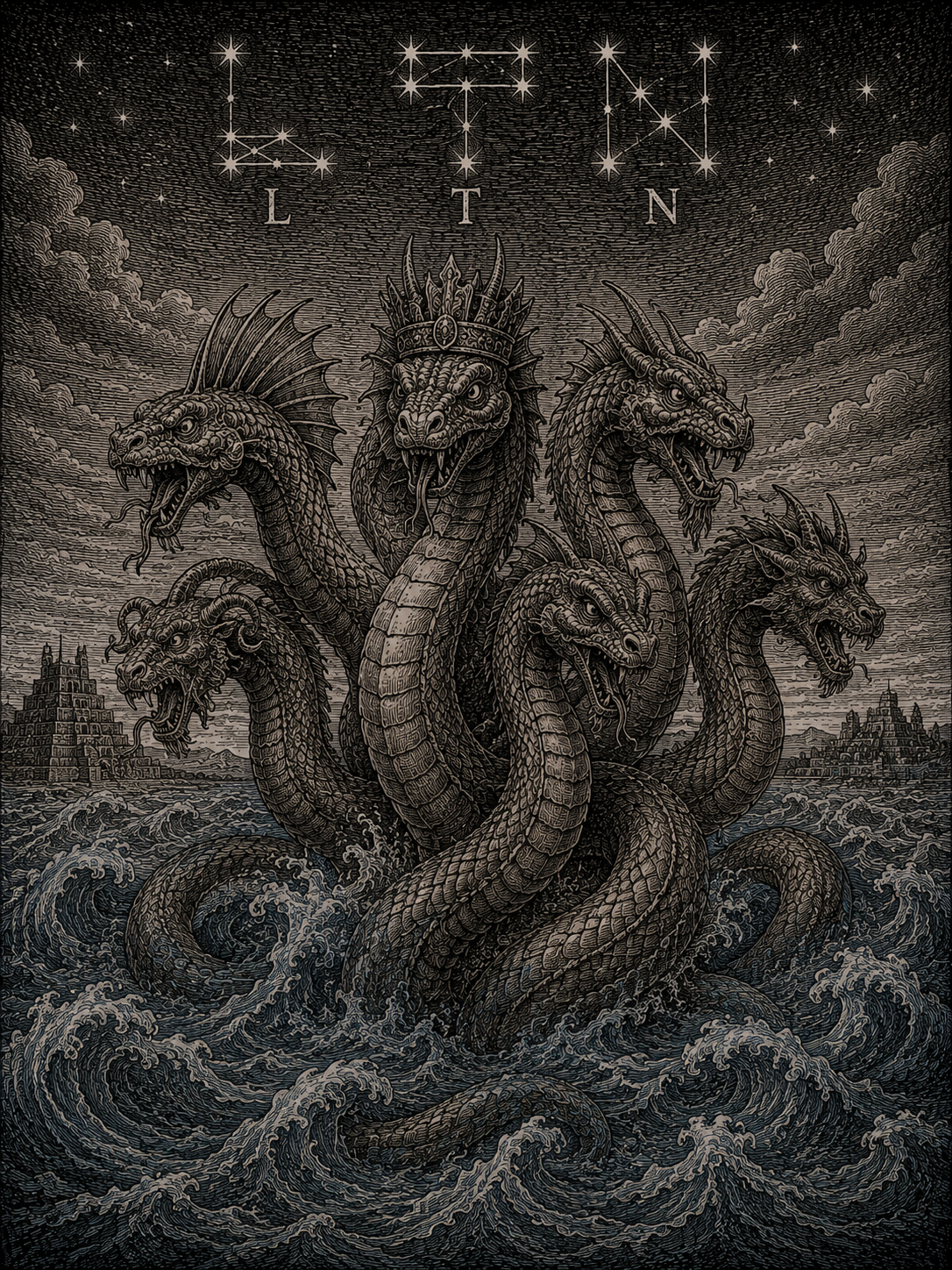
Lotan (LTN, Litanu) is the Ugaritic name of what Mesopotamia calls Tiamat: the seven-headed serpent of the Baal cycle, whom Baal defeated, chaining chaos in favor of the coastal kingdoms. Kronamon hypothesized that Lotan, not Tiamat, destroyed Andgara.
| Type | Deity |
| Sigil | LTN |
| Spanish entry | Tiamat ugarítica |
Description
The plate shows seven distinct heads (crowned, finned, open-jawed, longest, one-eyed, twist-horned, crest-scaled) rising from one coiled body over a stormy sea, two sunken cities on the horizon, and the sigil LTN in proto-cuneiform stars, repeated below in Latin letters. The Ugaritic myths give it a neck so long the hero must strike several times to reach the last head. Its parallel with the Tiamat beheaded by Marduk is shared memory, not borrowing.
History
Lotan destroyed Andgara, the first great pre-cosmic divine kingdom, and trapped its gods without killing them. Kronamon’s hypothesis, set out in the Skronamon document, would place the enemy’s origin in the eastern Mediterranean rather than the Tigris.
Relationships
Lotan approaches the Dark Queen without fully coinciding: hers is the modern archive’s name, Lotan the archaeological one. The LTN sigil appears in Ugaritic reliefs and in later tablets that the Chronicler of the Plata reads as the Dark Queen disguised as Lotan. Marcos the Mage translated several Ugaritic passages. The conflict belongs to the Contest and to Chaoskampf.
Open questions
- How the gods of Andgara were trapped is not recorded; the Chronicler of the Plata suspects one per head, hence seven. Kronamon left it open.