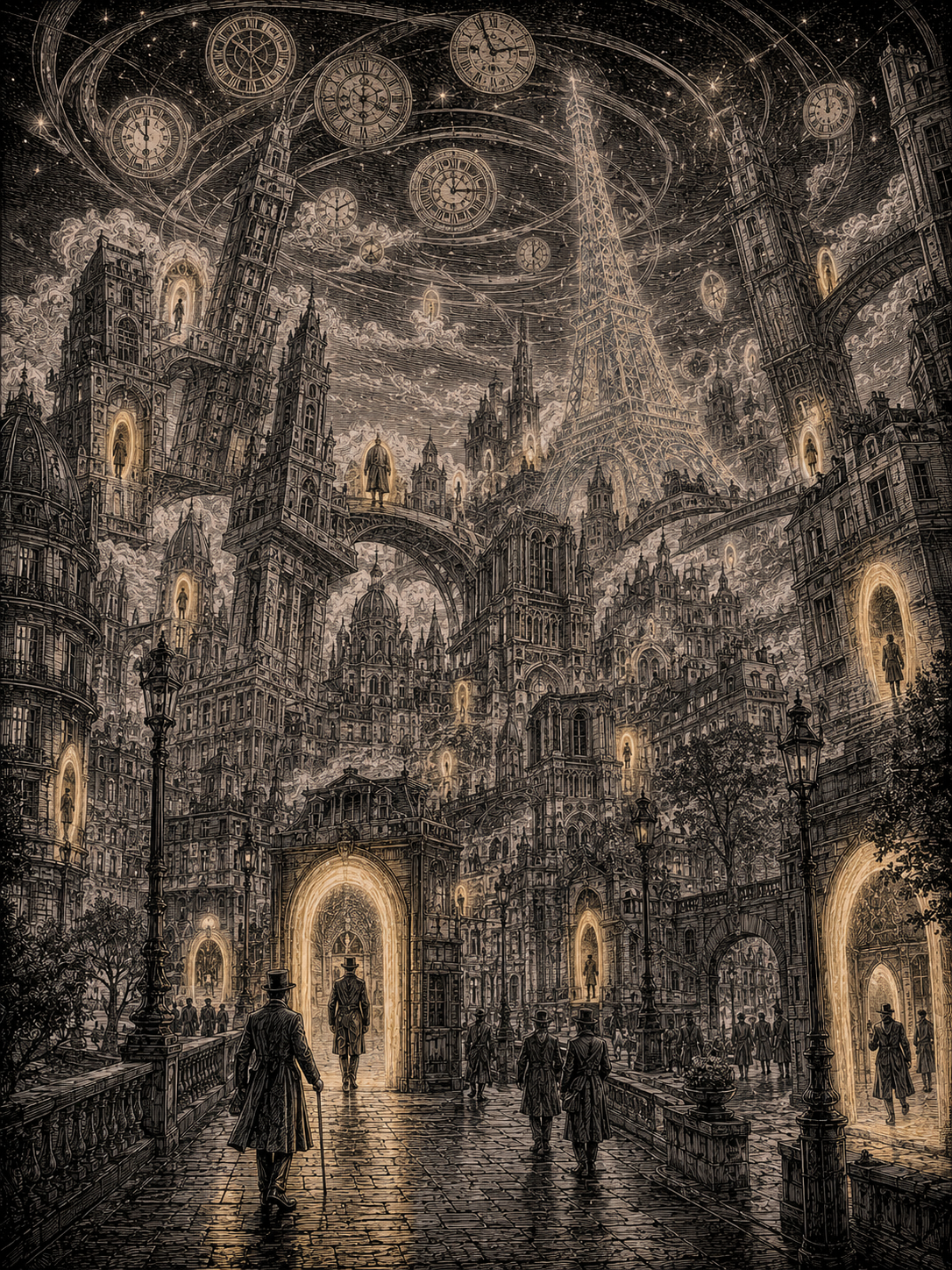
NEO-PARIS, City of Times is Paris refounded outside linear time after the implosion of the Cathedral, triggered by the Temporal Apocalypse of 1889. Its portals open onto other times as well as other places.
| Type | Place (city) |
| Model | Sigil, the City of Doors |
| Spanish entry | NEO-PARÍS — Ciudad de los Tiempos |
Description
The sky is a vault of suspended clocks, each showing a different hour. The Eiffel Tower stands remade in gold, now semi-transparent; cathedrals that never existed rise like stone mushrooms. Arcaded streets carry glowing oval portals on building fronts; people step into one and come out dressed in another era.
The explosion did not destroy the site; it opened it. Buildings coexist with their past and future versions — superposition, which newcomers mistake for fog.
Portals
Known portals lead from the Rue de Rivoli to a 19th century without the Revolution, from the Quai d’Orsay to 2089, and elsewhere to Alexandria in 415. They switch on and off with no known pattern; residents learn to read the night lights and not to enter the first one offered.
Government
Government presumably rests on the Guardians of Time, as a silent council. The Palace of Time of Subprefect Iriarte still operates administratively, but the city’s doctrinal body lies outside it: in the Guardians, the portals and the clock sky.
Role
The gestas of Uchronic Paris, the Templars, the Northern Crown and the Descent converge here as a central plane of passage. By a tradition Marcos the Mage transcribed, Paris was founded by Trojans fleeing Troy, making NEO-PARIS a refoundation of a refoundation.