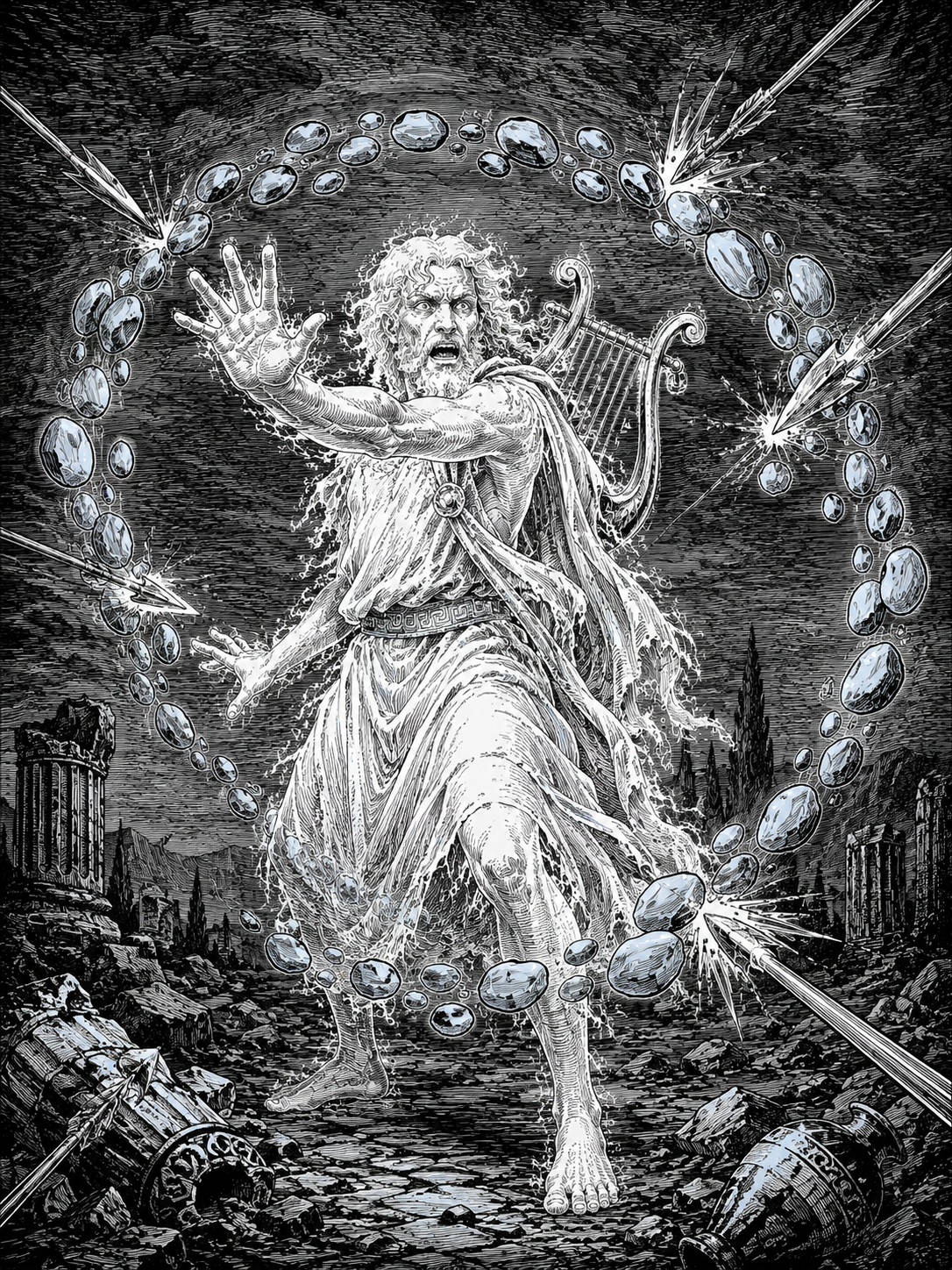
Orpheus (Orfeo) is an armed poet and musician who descends into Hell to bring Eurydice out. His lyre, broken and stringless, still sounds with angelic music.
| Type | Character |
| Goal | To rescue Eurydice from Hell |
| Instrument | A stringless lyre, smashed by Cerberro |
| Spanish entry | ORFEO |
Description
Before the company reached the place, there was already talk of Orpheus, along with “a mad Valkyrie”. When he appears he states it plainly: «Mi nombre es Orfeo» (“My name is Orpheus”). He is described as a “poet/mage who knows ancient legends of the infernal world”, and his one declared motive is «quiero sacar a Eurydice de aquí» (“I want to get Eurydice out of here”). The world grants him a privileged sight: “you who are here, now you can see completely what is happening”. His body, clothing, age and voice are not described.
The lyre
He has a single lyre, damaged: he appears “with a lyre that has no strings”. It was smashed in the fight with Cerberro, the guardian of Hell, and stayed caught at a specific point in Hell, where he smashed it. Lost and stringless, it still sounds: Orpheus begins to hear the music of his lost lyre, angelic music that acts as praise and worship and invokes the true name of God as celestial music.
In combat
He is recorded “punching the air” and holding door positions. When two clerics of the Eclipse come out of the door to his left, he recognizes them as allies and calls “To the rear!“.
The mirage of the Third Circle
In the Third Circle, a ghostly apparition repeats his founding gesture: “Orpheus guiding Eurydice, trying to leave the underworld”. Whether it is a promise, a mockery or a memory of the place is not recorded. His figure thus appears three times: the acting Orpheus, the spectral one of the Third Circle, and the one spoken of before he arrived.
Conflicting accounts
- One record states «Sería Orfeo que era Clisandra» (“It would be Orpheus who was Clisandra”): the same entity, or manifestations of the same person.
- Other records set Orpheus and Adán as a double figure, two faces sharing the same soul.
- Whether this is a double or triple splitting, or two incompatible versions, is not established.
Open questions
- Whether the lyre is lost in Hell or carried stringless by Orpheus: the records say both; whether he recovered it, or these are two successive states or two lyres, is unknown.
- In which circle the lyre stayed caught, and how far from Orpheus.
- What the angelic music does to those who hear it (creatures, doors, the damned).
- “Is Orpheus a god, a mage, a power? Ally or adversary?”