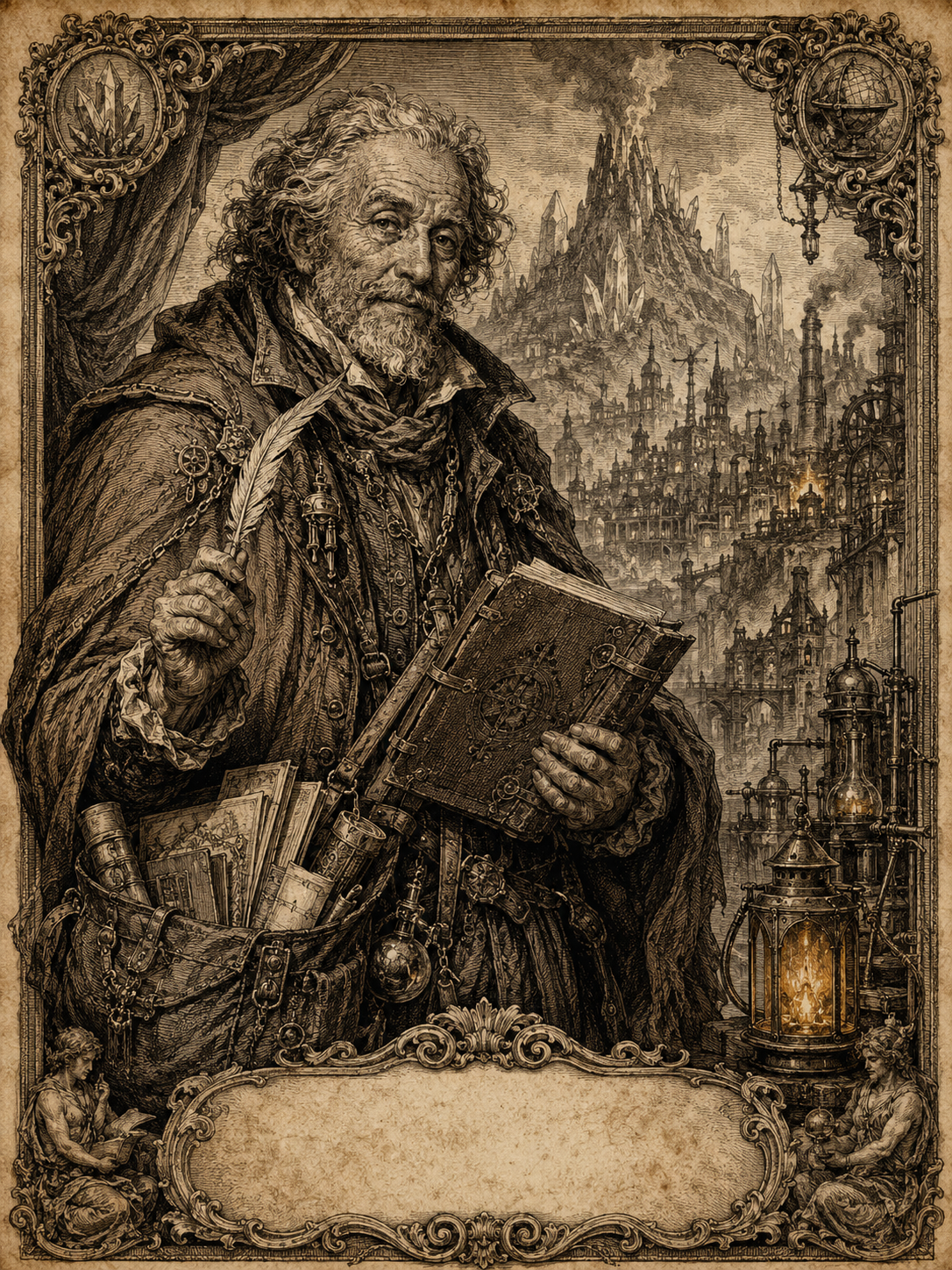
Mascor Blancarba is an old itinerant bard from Star City and the author of the Caldero Gazette, a compilation of tales, chronicles, founding myths and tabloid pieces dated December 1824 AE. It is a primary source on the present cycle of Caldero and Star City.
| Type | Character (bard, chronicler) |
| Origin | Star City |
| Era | Present cycle (1824 AE) |
| Known work | Caldero Gazette |
| Spanish entry | Mascor Blancarba |
History
- He lived in Star City in his youth and in maturity was struck by its magic-driven machines, alchemy-and-steam workshops and artifact-forging guilds.
- The cult of the Borg Popes blocked all progress until the justice of the Sword of the Giantess (the Ancient Giantess) ended it. Star City threw off theocracy after twelve cycles and became known for its magical-industrial revolution.
- After the fall of Pope Borg (around 1812 AE), already mature, he began writing gazettes about the people involved in the birth of a new society.
- About a year before writing (around 1823 AE) he left Star City to visit sister cities.
- In December 1824 AE, during his stay in Caldero, he finished the compilation.
The compilation
The Caldero Gazette has four parts:
- Chronicle of events — tales of La Jabalina (“the Javelin”) in the present cycle: the first mission (Bazaar of Life), the Path of Drakthar, the Flood Season, Antagonists of Caldero, Roads Traveled.
- Chronicle of a Curious Visitor — his own first-person account of entering Caldero from Star City. It opens: “My name is Mascor Blancarba, and more than a year ago I left my home in Star City.”
- Tabloids — Caldero press notes from Forbes Caldero, Gossip & Style: Caldero Edition, City Star and Indie Magazine, recording La Jabalina’s fame and the rumors around it.
- Appendices — “Appendices & Assorted Ravings: the Founding Myths of Caldero”: the myths of the Eagle, the Serpent-Moon, the Phoenix, the Goddess of the Deck of Many Things, the Embassy of the Devils with Pablo the Chronomancer, and the Myth of the Lovers and the Lunar Serpent.
He records dialogue verbatim and keeps nicknames, such as “Gostoso” for Belicio. He signs the work as “by a bard who takes no responsibility”. Arkos, the archivist of the Plata, glosses his chronicles.