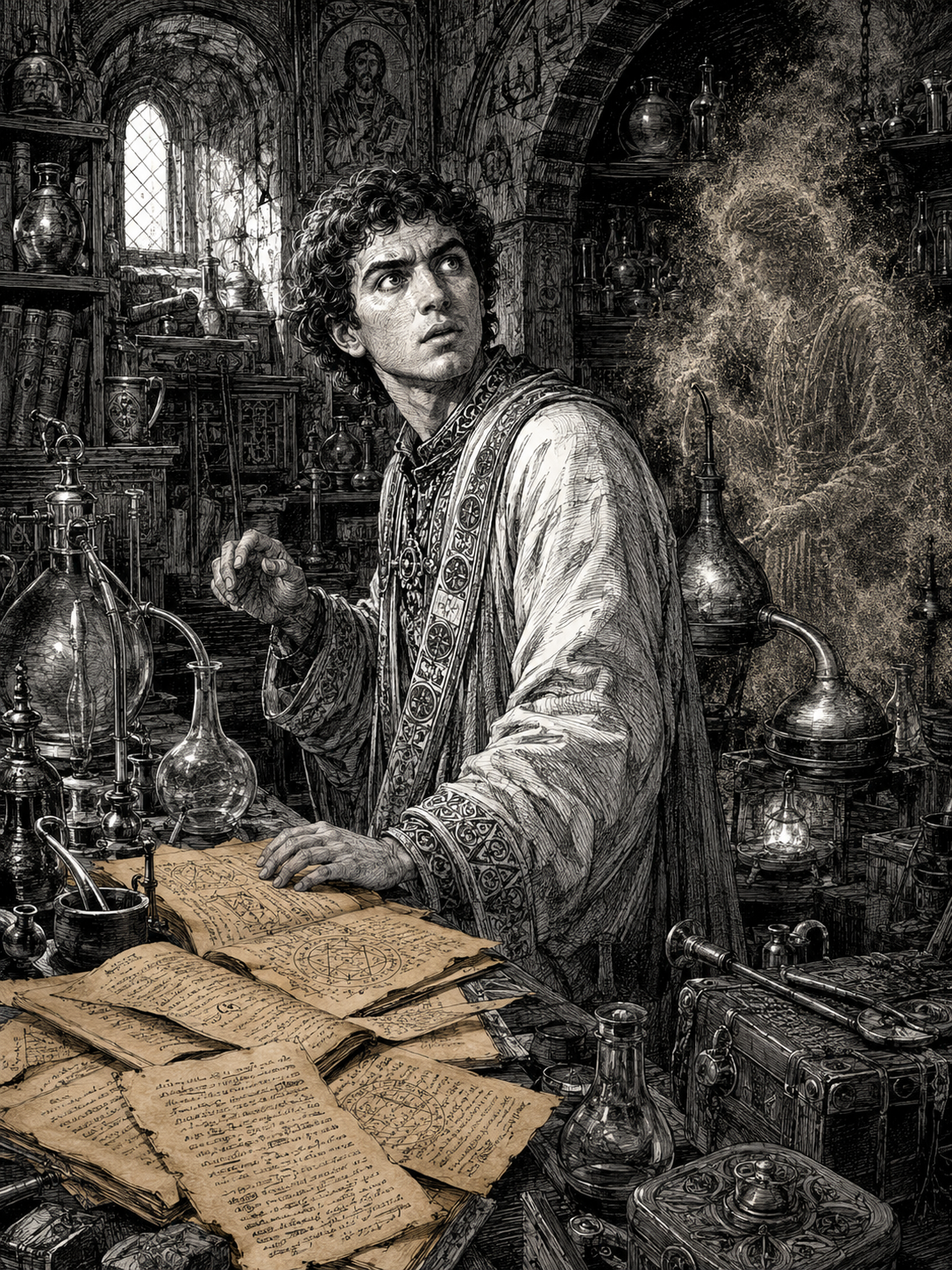
Olaus Wormius, also called Theodorus in Greek, is a sorcerer-chronomancer of Uchronic Constantinople who copied the Blue Book between 1051 and 1055, giving rise to the Necronomicon. The Hombre Variable (“Variable Man”), he began as an ally of the Time Bandits and ended as a necromancer made of worms under a yellow cloak.
| Type | Character |
| Era | Templar Age, 1050–1055 AD |
| City | Constantinople |
| Other identity | Teófilo the Bactrian |
| Spanish entry | Olaus Wormius |
Description
Wormius lives among alembics and not-yet-forbidden books. In his laboratory an invisible servant stirs strange winds like desert sands. He is a chronal sorcerer whose power moves along the axis of time, which makes him an anomaly: he appears younger or older depending on the moment of the crossing. In 1055 he was persecuted for translating into Greek a strange compilation of blasphemous spells.
The copy of the Blue Book
His defining act is the copy or translation he made of the original book, the Blue Book / Eisagogika, in Byzantium-Constantinople between 1051 and 1055. It produced the Black Book of the Law of the Dead, or Necronomicon, the most faithful copy of the original, later multiplied into five colored books (blue, green, red, white, black) circulating through clandestine libraries. Theodoras Philetas’s Greek translation of 950 AD is an earlier link. The original’s author is Paulus of Alexandria.
This is the same period in which Swan governs Byzantium as a Time Bandit; the overlap is a node of the cycle.
History
- 1050: the Time Bandits travel five years into the past and find him younger. He has just received a message he wrote to himself from the future. He shelters them, helps them present themselves at the imperial court, and prepares an ivory-marble liquid that petrifies and halts death, used in the pits of the Valley of Death. This first version is philosophical and helpful.
- Middle period: remote temporal guide, consulted through Tetraxis.
- Revelation: “I am the variable man, but I see that you are a constant in my life.” He exists as a variable across time; his companions are fixed anchors. He urges “let us avoid all wars, boys”, smiles for the first time, hands four books of the chromatic set to the Venerables and lowers his power. He confirms that a hundred years later he wrote the Greek version of the Al Azif in Byzantium.
- Corruption: he appears in the Tranquil Tower of the Valley of the Yellow Serpent, his body made of worms, wearing the yellow cloak of the King in Yellow. He reveals that he kept Philippe in indefinite lethargy as bait, and that he made a pact with Death: if the companions alter history by preventing the First World War at Sarajevo in 1914, the promised souls are lost. He is burned and beaten until he dissolves into worms, overwhelmed by the Time Bandits and the Psychopomp Dragon.
- Final incarnation: he returns as a necromancer of worms and faces Swan in a final confrontation that closes his arc as an antagonist.
Other identities
Teófilo the Bactrian is the same character at another point in time; Olaus, Theodorus, Teófilo, Teododetes and Teófides are names of the same Variable Man. The archive also gives him a role shared with the historical Byzantine scholar Michael Psellos (1018–1078), author of De Operatione Daemonum, persecuted by church censorship in the same period.
Conflicting accounts
- His copy is described as a translation into Latin; elsewhere he is persecuted for a translation into Greek, and he himself claims the Greek version of the Al Azif, written “a hundred years later”.
- The chromatic set numbers five books; he distributes four.