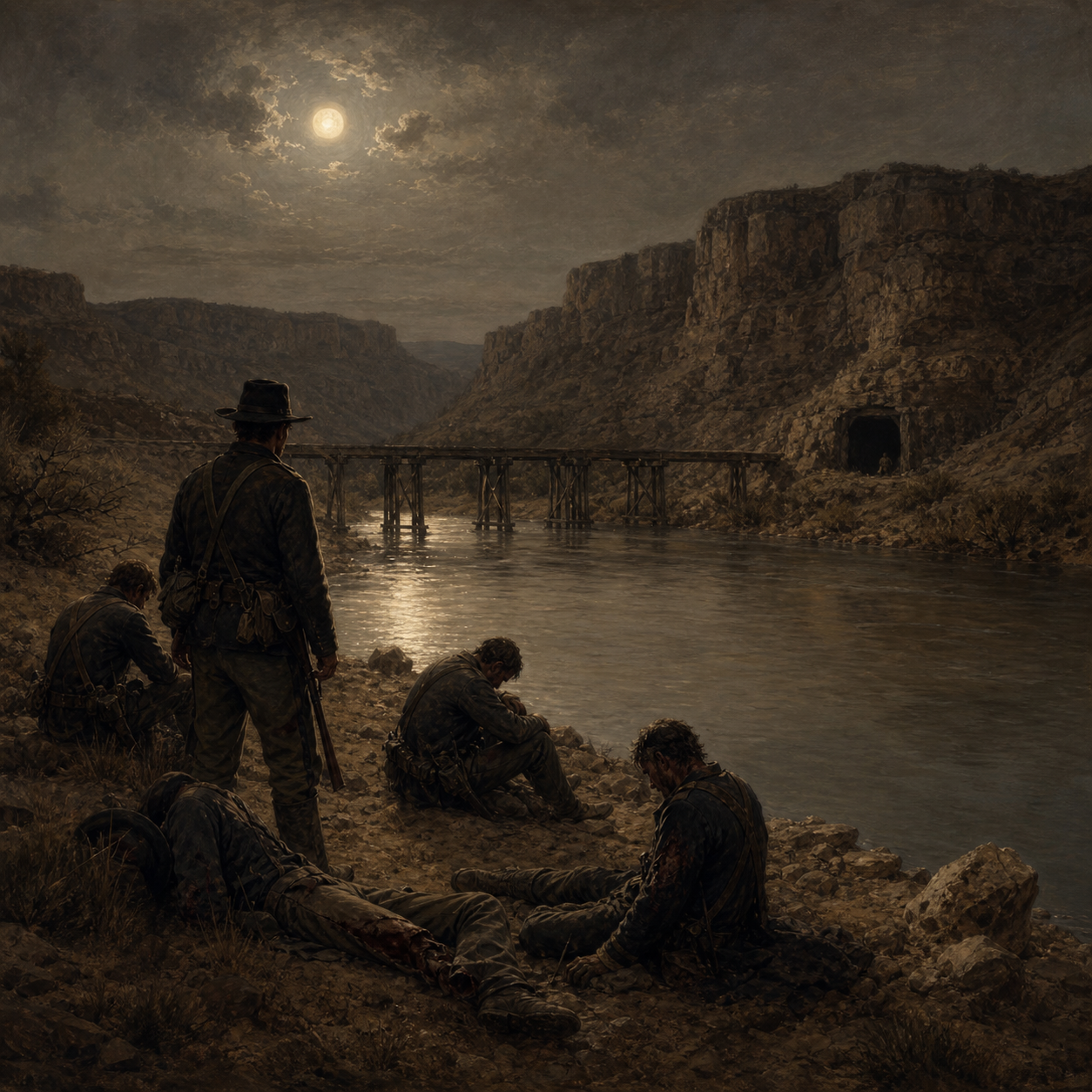
The Río Bravo, also called Río Grande or Río Bravo del Norte, is the river that runs along the whole border between Mexico and Texas in Antiterra, 1888. It is the line that must be crossed to reach the other side, and a chest is sought on its bed.
Description
Thirty meters from bank to bank — forty in the bad stretches — “with a strong current”. Mexico lies on one side, Texas, United States, on the other. “It’s a good river… it’s not just any river.” It is smaller than the Mississippi.
Its depth is uneven: some stretches are “very wide, but very shallow”; elsewhere the bed lies eight to ten feet down, where the water swallows the light. For those with eyes made for darkness, that depth is “exactly perfect”.
Crossing zone
- A crossing point: the Paso de la Frontera.
- Nearby, “a place called Bravos”, named after the river.
- Beyond, a chain of border mining communities: Zaragoza, Morelos and Río Bravo, there because of the mines, not the river.
The crossing is a long stretch of bank rather than a fixed point: those who stray “don’t know at what height they will come out”, and the exit point decides which town they reach.
The chest
On the riverbed, eight to ten feet down, beyond ordinary sight, a chest is sought.
Open questions
- How the river is crossed (bridge, raft, ferryman, swimming or on horseback), and whether either bank is guarded.
- Whether the mining town of Río Bravo stands on the river or only shares its name; where Zaragoza and Morelos lie.
- Why the chest is on the bottom, and who sank it.
- The water’s color, its sound, floods and low water.