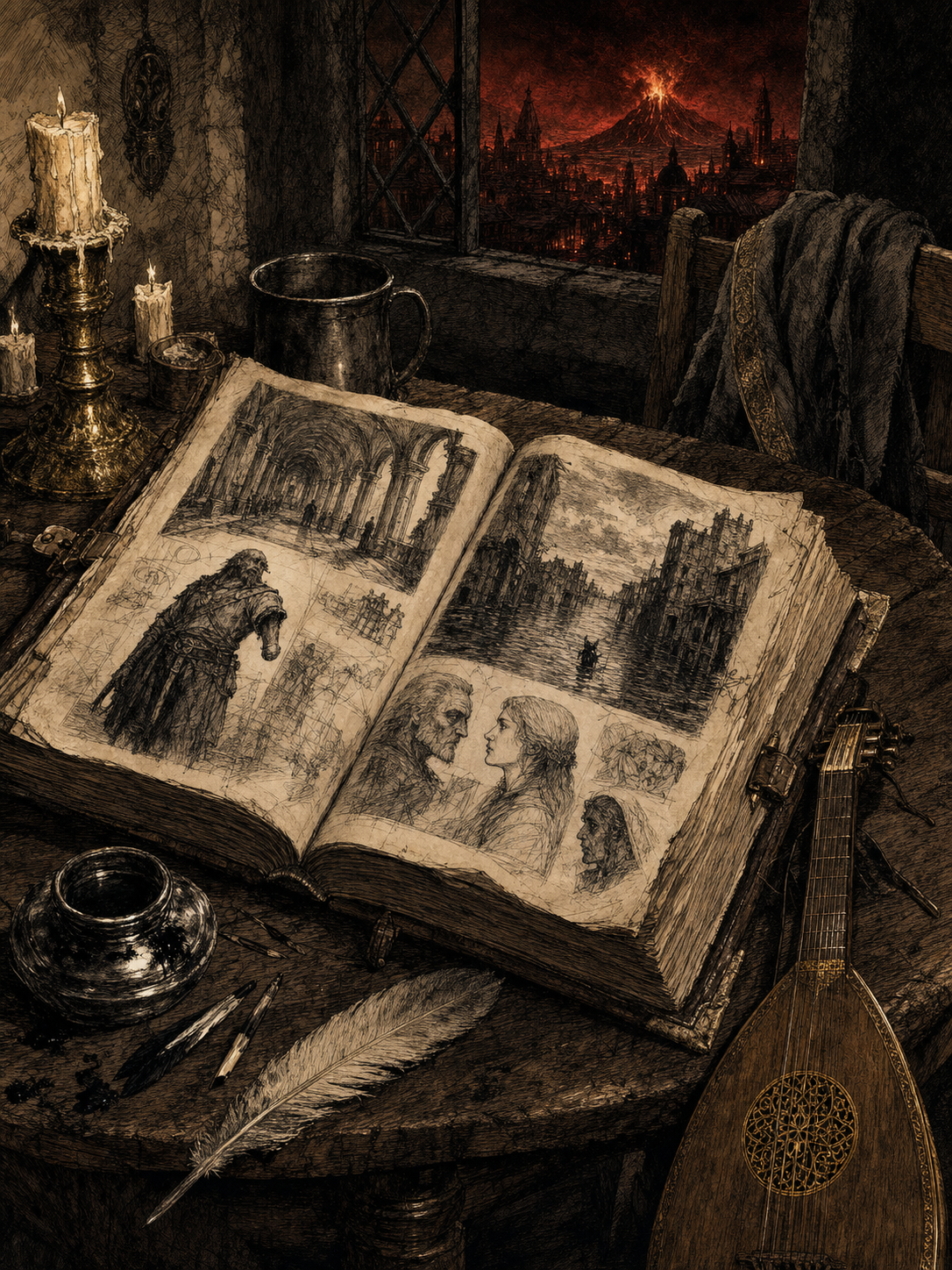
The Caldero Gazette is a compilation by the itinerant bard Mascor Blancarba, completed in December 1824 AE in Caldero. It is the primary written source on the present cycle of the volcanic city and its sister, Star City.
| Type | Work (compilation) |
| Author | Mascor Blancarba |
| Spanish entry | Gacetilla de Caldero |
Origin
The bard left his home in Star City more than a year earlier and “began to create gazettes about the main figures involved in the birth pains of a new society”. His tone is journalistic and humorous without contempt; he signs ironically “by a bard who takes no responsibility”.
Contents
- Chronicle of events — the present cycle of La Jabalina: the Bazaar of Life (descent into the Malachite Fortress, the fight with Kazmojen, the orphans freed); the Path of Drakthar (descent to Yathrebu, where Teo loses his arm); the Flood Season; profiles of the antagonists Lord Valanthru, Tittiframe, the Company of Laughter and the Cageewrights; and Roads Traveled.
- Chronicle of a Curious Visitor — the bard’s own arrival in Caldero from Star City.
- Sensationalist magazines — Forbes Caldero (economy and power), Gossip & Style: Caldero Edition (society and noble rumors), City Star Magazine (techno-magical controversies, the Miracle of Miles, flying brooms) and Indie Magazine (alternative voices, clandestine serpent doctrine).
- Appendices & Assorted Ravings — the Founding Myths of Caldero: the Eagle Asvila, the Moon-Serpent Auna, the Phoenix, the Goddess of the Deck of Many Things, the Myth of the Lovers and the Lunar Serpent, and the Embassy of the Devils with Pablo the Chronomancer.
Voice
The bard records dialogue verbatim (“Belleza!”, “Gostosoo!!!”) and keeps nicknames: Belicio “Gostoso”, Sila “invisible edge”, Tony “Mage of Strange Ideas”. He cites sources and admits limits (“according to one version”).
Copies
The original travels with the bard. Copies, none identical and each with different marginal glosses, are held by:
- chroniclers’ guilds and private libraries of Star City;
- the archives of the Plata, glossed by Arkos;
- the provincial Decadian church (Imperial Church), with minimal doctrinal remarks;
- the private archives of the Blue House of Vala, for the myths.