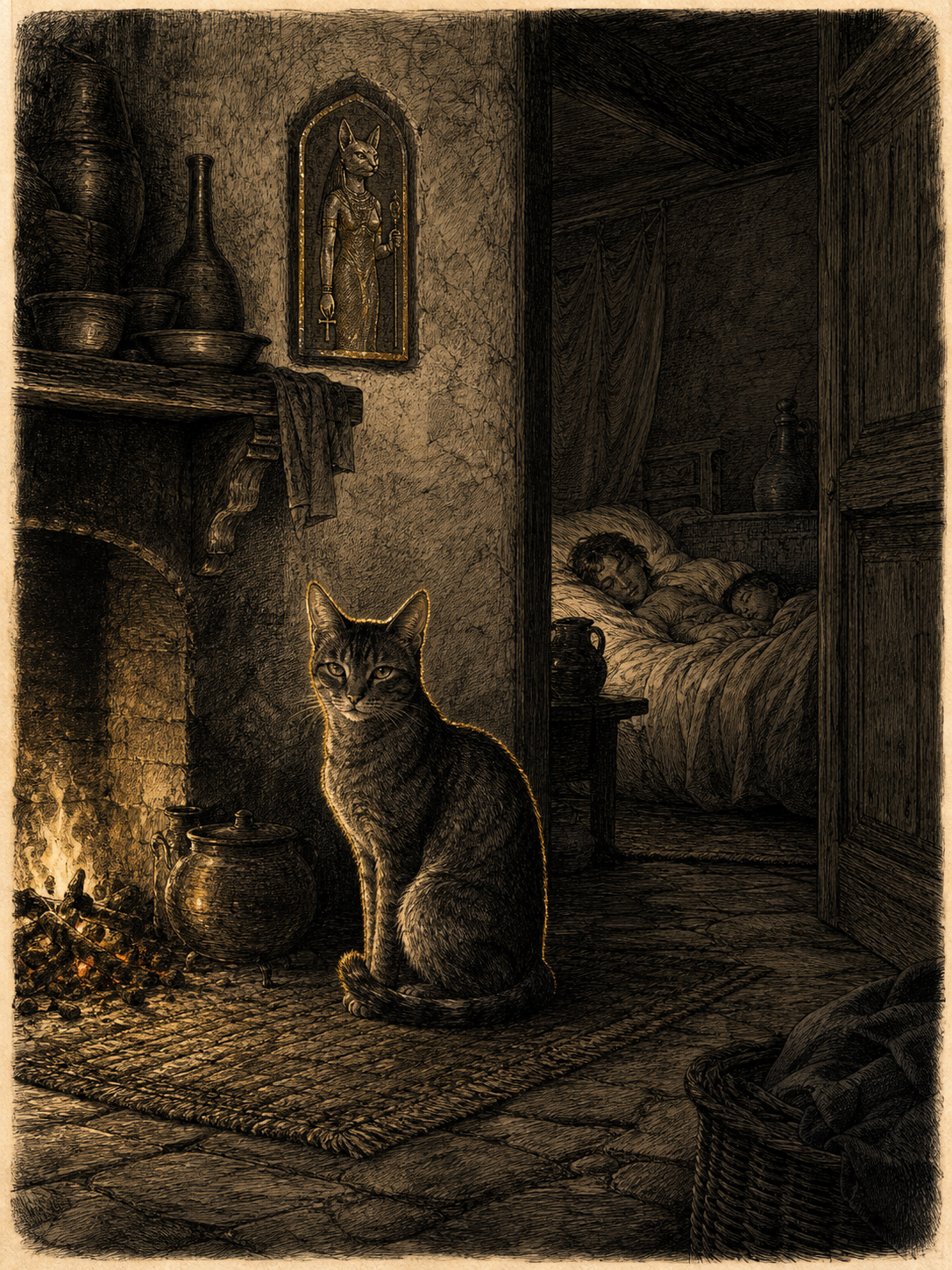
Bastet is a minor deity of the Archontean imperial pantheon, goddess of the home, the household and the cat — “the goddess of the cat” in common speech of the Archontean Empire, “the protector of the home” in popular Decadian doctrine.
| Type | Deity |
| Domain | Home, family, domestic protection, the cat |
| Spanish entry | Bastet |
Doctrine
- The household cat is sacred: whoever drives it out drives out Bastet.
- The hearth fire falls under her doctrine, not the greater fire doctrine of Sekhmet or Set.
- She needs no major altar, only that the household cat have a warm place near the fire.
- She does not answer public oaths (that is Mithra’s jurisdiction), but everyday minor loyalties.
Place in the pantheon
Bastet holds the domestic, protective pole alongside Mithra (sun, oath; public martial pole), Thoth (scribal wisdom; archival pole), Set (cyclical chaos; dark pole of order), Sekhmet (vengeful solar war; destructive military pole), Maat (truth, cosmic balance; pole of equilibrium), Anubis (psychopomp; mortuary crossing) and Ra (full sun; everyday light).
Pantheon doctrine holds that the Empire rests as much on Mithra (oaths) as on Bastet (homes): if either collapses, the Empire falls.
Popular cult
Her cult needs no church mediation. Whoever keeps a cat and respects it is with Bastet; whoever expels it is against her. There is no formal confession, no major liturgy, and no priesthood specific to her in the central Decadian hierarchy. This autonomy has let the cult survive reforms and crises; the orthodox Imperial Church prefers to tolerate it.
History
- Early imperial era — the domestic cult is established.
- Successive Decadian reforms — it survives centralization.
- Present cycle — active in everyday domestic life.