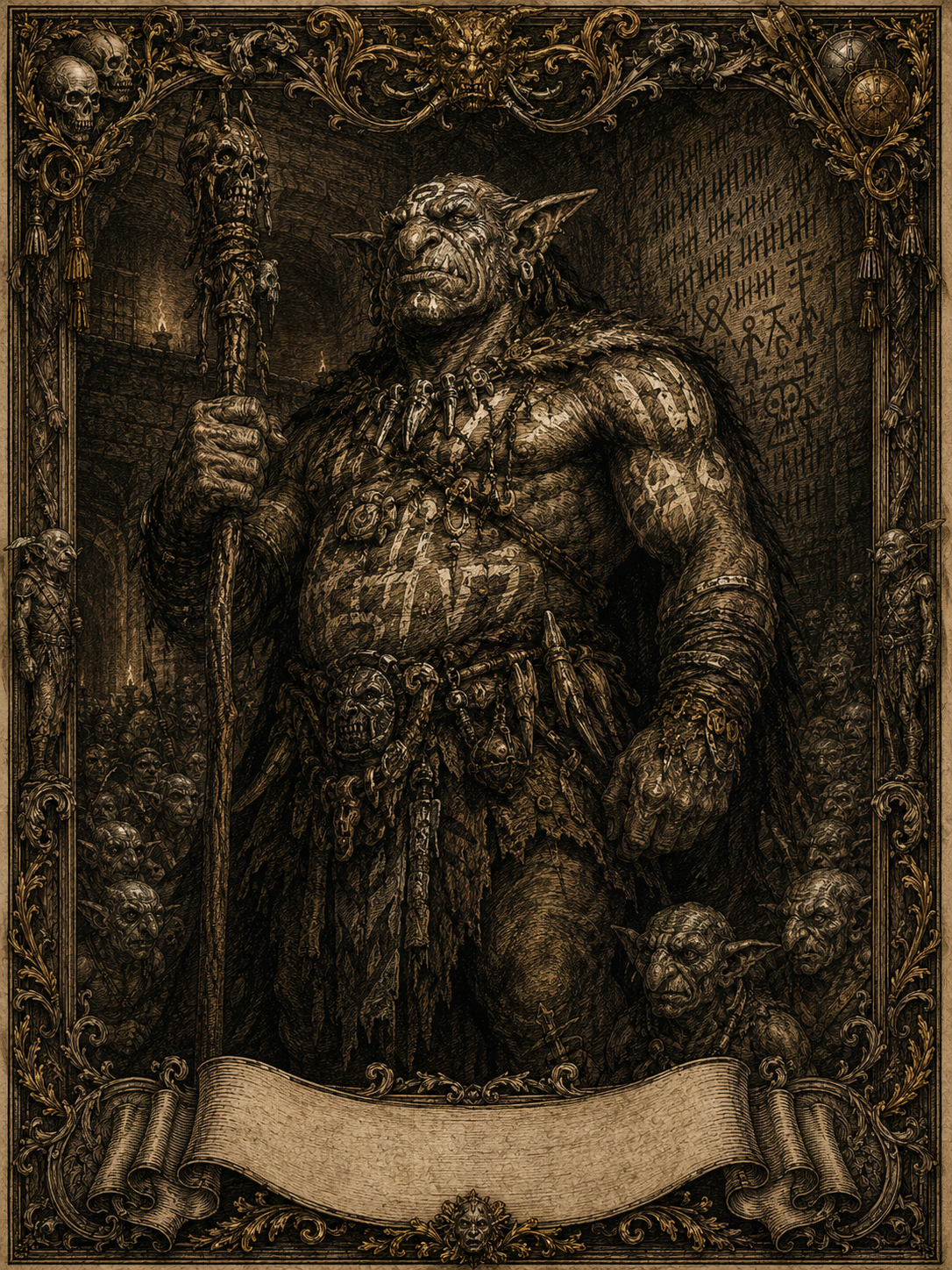
Narbisto the Colossal was the goblin warlord who united the feral tribes of the Ardis Vala Mega-Dungeon around 2810 AEP and became the first Great King of the United Goblins. His line continues in the present cycle with King Weskenim.
| Type | Character (historical figure) |
| Era | Unification c. 2810 AEP |
| Seat | Goblin Warrens, Forum of Set |
| Spanish entry | Narbisto el Colosal |
Name and origins
The etymology of Narbisto in the imperial language is unknown. “The Colossal” (Narbisto Colossalis in imperial Latinization) is literal: the rural broadsheets say he stood more than twice a standard goblin’s height, almost orcish — possibly a late mutation in the imperial slave line.
The valley’s goblins are not native: they descend from imperial slaves, imported from other regions of the Empire or captured in the northern ranges during the Archontean presence, then freed or abandoned when the Empire left the valley after the Schism. For a thousand years they survived in the ruins as rival feral tribes on the lower levels.
The beastman threat
The unification answered the beastmen made by Lady Deino in the Massacre of the Cave of Blood (2759 AEP), during the expedition of Phocion IV. Soldiers of the 3rd Cohort of the Tagmata, under Adrienic, were captured alive by Girbala, 31st Varumani tegnu, and handed to the witch, who transformed them. For decades these beastmen acted as one body under Deino’s residual influence, devouring and spreading through the middle and lower levels.
Unification
Narbisto united the feral tribes by charisma, force, or both:
- Pacts with lesser chiefs, granting warren territory to those who joined.
- Campaigns against chiefs who refused, remembered with respect in goblin tradition.
- A common dynastic mark, the United Great King, over tribes that kept local chiefdoms.
- The Goblin Warrens of the Forum of Set, possibly scattered burrows before him, reorganized as the kingdom’s seat.
It was complete around 2810 AEP, some fifty years after the massacre: the first central authority of an underground people in centuries, opposed to the imperial legacy.
Reign
His reign as “Great King of the United Goblins” (a formula some imperial copyists record skeptically) lasted decades:
- Defense against the beastmen, pushing them to deeper levels where their coordination weakened.
- Coexistence with the Varumani of the Court of the Thegn, then under the 32nd or 33rd tegnu: the goblins respected Varumani sovereignty over the depths; the Varumani tolerated the goblin kingdom on the middle levels.
- Furtive trade with Ritornello, the Archontean surface people consolidated after the Reconquest of Bellatrix and the founding under the exarchates: human go-betweens brought food to the dungeon portal for archaeological objects.
- Balance with clandestine Sortian cults, Theosophist hermits and lesser groups.
The balance the Seekers of Ardis Vala find today is partly his work.
Succession
Narbisto died at an unrecorded date before the present cycle. Succession is not strictly hereditary: by tradition the next Great King is chosen by consensus of the major chiefs, possibly with ritual confirmation in the Great King’s hall. King Weskenim, Great King of the present cycle, continues the line (how many generations removed is unknown), ruling from the Warrens and negotiating with the Seekers.
The goblin kingdom is one of the few political bodies of the dungeon to survive the Hiatus: the Varumani fell, the Theosophist clergy faded, the beastmen scattered.
Memory
- Ritual marks on the Warrens’ walls, attributed to his fist or brush, are kept as political relics; some survive in murals of the Forum of Set, described by the Seekers of the first cycle.
- The Great King’s hall holds a throne said to be his (unconfirmed).
- Every coronation repeats: “Narbisto el Colosal me precedió; yo continúo lo que él comenzó.” (“Narbisto the Colossal preceded me; I continue what he began.“)
- Annual festivals mark the unification with chants, banquets and mock combat against the beastmen.
No portrait is known: goblins prefer rough wood carving, skin marks and ritual wall painting to imperial portraiture.
Conflicting accounts
The imperial record keeps two readings:
- Charitable: a competent leader who organized an abandoned people and stabilized the dungeon against atrocities the Empire itself had caused.
- Suspicious: a goblin warlord whose unification blocked any future reconquest of the dungeon by force.