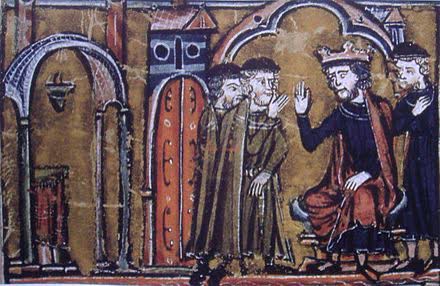
The Templars (Order of the Temple) are a military religious order founded in Jerusalem in 1120 that guards relics, roads and treasure and holds the ability to travel through time. They left Jerusalem that same year and reached Paris around 1889; they exist across the interval from 1055 to 1389.
| Type | Order |
| Founded | 1120, Jerusalem |
| Headquarters | The Temple, an old mosque in Jerusalem |
| Spanish entry | Templarios |
Founding and vows
The order was founded on the fifth of the city donated by the king. The patriarch and bishops charged it, for the remission of sins, to protect the roads from ambush and robbery, above all for pilgrims. It also guards relics (the True Cross, the Lance of Antioch and the disputed Holy Grail, kept in the Temple and the adjoining Palace), must destroy the enemies of the Christian kingdom of Jerusalem, and must shelter any traveler who asks.
Only Christians may approach the order. Members take the vows of regular clerics (chastity, poverty, obedience) under the Rule of Saint Augustine, which they find insufficient; they go to France and the Holy Father to seek “a more specific rule, of warriors for the faith who protect relics”. The founding vows were sworn before King Baldwin II, who allowed the foundation in councils, but the order answers only to the Pope. A knight’s loyalty is “with the order and with the king”, and he is judged by the Temple’s laws. Attacking Templars, breaking the sacred vow, brings a curse.
History
At first the order was new, with two legendary founders and initiations of twenty knights at a time. Late on it is “much reduced”, mostly in France; it holds the castle of Limassol in Cyprus, 40–50 km away, where its head “has been seated for at least 10 years”, and a seat in Famagusta with 150 armed Hospitallers. The Holy Land possessions are lost, the Mamluks hold Jerusalem, and the order was driven from Florence. The Ilkhanate is expected in November; everything must be removed before then.
Dress and signs
The uniform is “the white tabard with the red cross”, a white cape and a great sword on the left side; armor bears the Templar sign, and a recognition pendant hangs at the neck. A veteran keeping “a great black armor” covered and unused is rare. Entry requires a Templar code and a password. Secrets are stratified by rank: low-ranking Templars do not know of the Hidden Castle. The founding seal shows “two men riding” one horse.
The Temple
The headquarters, an old mosque in the southeast of the city remade as a church, has many strata: parade ground, training yard, cloister, dome number five, treasury, artifact chests, library, secret infirmary, semi-underground stable, cemetery. The great yard shelters 300–400 refugees in tents. Hebrew conjuration symbols on the floor once “turned over” and became stars. A 1,000-kilogram bell with Orthodox engravings, wrapped in chains and ropes, charges energy over a year and radiates holiness for 120 feet.
Below run catacombs and passages from Muslim times and earlier, with exits “perhaps only the masters know”. The building is older than the order: demons entered through it when “cracks opened in the air”, and it leads down to the Labyrinth.
Banking
Prosperity made the order “interest-free lenders” to the kings of Europe, “for example the French”. Treasure in transit rests in small fortified hostels; funds deposited at one house are withdrawn at another against a paper. The order lends without interest to ventures that serve its politics and nearly monopolizes healing essential oils and potions. The Temple is barracks, monastery, hospital, bank and archive at once.
Hierarchy and customs
Ranks run Grand Master, maestres (masters), maestros. Each Grand Master is named by his predecessor and recognized by the Pope; a second must always be ready; if none is named, an assembly meets and the Pope chooses. The office brings political power; some Templars are also nobles. Members include Luca de’ Medici, Commander Rolando with his shared hash pipe, and a Hungarian Templar tied to the recently pagan Magyars.
They keep night vigils and bless weapons with Gregorian chant. Their training leaves them fresh “between two and three in the morning” without long sleep and gives them their spells from eight in the morning.
Heresy and the Ivory Templars
The order is suspected of matriarchal, Gnostic, unorthodox Christianity, with the Albigensian crusade as precedent, and of worshipping Baphomet, “for which the Templars were really condemned in history”. In Baphomet’s sanctuary some Templars also belong to the Ivory Templars, an underground branch of the Labyrinth associated with the minotaurs, who have mined the place where their grand master was killed and are the order’s main antagonists: “they are Ivory Templars and may be the minotaurs; the Originals were those of the Temple”. In Paris the opposing faction is the Assassins of the Old Man of the Mountain. Some Templars feign loyalty to Jacques de Molay while serving the cult.
The order keeps books on the Huestes Torcas (the “Torcas Hosts”), and its knights guarded Kronamon, with an ancient expedition at their head.
Time
Pablo bequeathed to the order the ability to travel through time, the basis of the Templars of Time, whose mission is “to fight the devils, to make of the world a labyrinth of time”. The Ivory Templars “were involved in both” ends of the journey from Jerusalem to Paris. The Labyrinth of the Templars runs under Paris.
Conflicting accounts
- Legend has the two founders riding one horse, as on the seal; the rule forbids riding together (as it forbids kissing) and forbids the seal itself. When and why is not recorded.
- Whether the Ivory Templars are a branch, a heresy, a precursor or a usurpation is not established.
Open questions
- Whether Jerusalem, Jerusalorium and Jerogloriorum name the same city, and which form is correct.
- The names of the Grand Master of Cyprus (“somewhat fanatical about taking Jerusalem”), of the original master “who was cut down”, and of the two masters lost in the attack on the Temple.
- Who installed the bell, why it was chained, and its function.
- The paper system’s fees, the number of fortified houses, the door code, which ranks know which secrets, and the location of the Hidden Castle.
- Whether the new rule was ever obtained, and how it would fit with Saint Augustine’s.