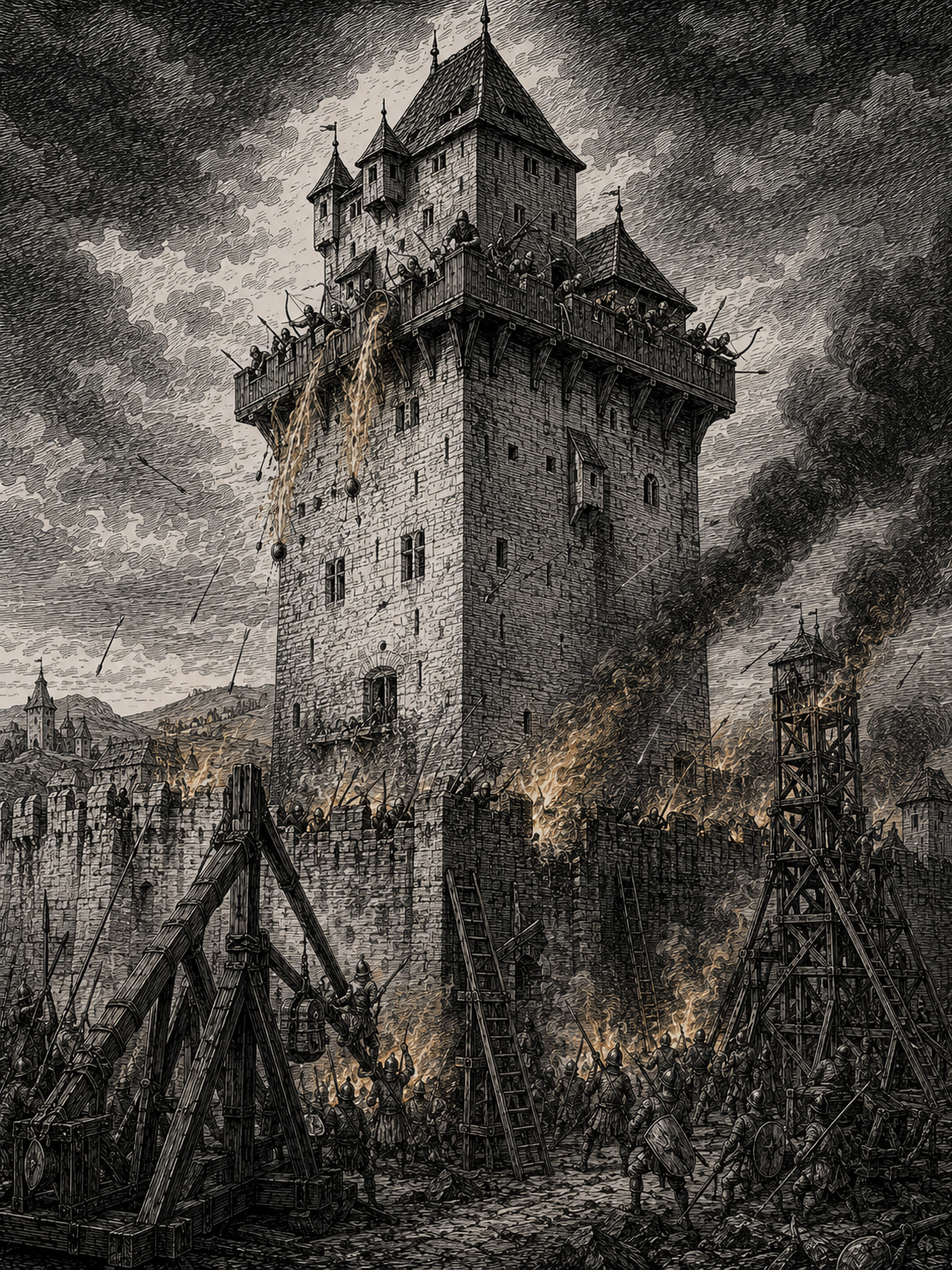
The Tower of Heva is the tallest tower of a guarded castle-prison in the village of Mikulov, thirty kilometers outside Prague, in Antiterra. Queen Eva Huizinga was held captive in it, and it was later besieged and blown open.
| Type | Place (tower-prison) |
| Status | Blown open (“the burst tower”) |
| Spanish entry | Torre de Heva |
Description
The castle at Mikulov is “an important guarded castle, which is also a prison”, with many towers; Heva is the highest, 40 to 60 feet tall, given as “5 tall floors”. Its levels are double-height, 20 to 25 feet (“more than 6 meters”) apart; the accounts do not reconcile how many real levels this makes.
At the top, the vault bears engraved descriptions of the virtues: “if you reach the roof there are 24”.
Siege
The guards “surrounded the place” and “set up cannons” around it. The episode is known as the Siege of the Tower of Heva. Its outcome is “that exit of broken rock that is the burst tower”, with a figure still floating above it “as if erasing” the breach.
Other towers
- A watchtower “beside the river, right where Torco territory proper would begin” is recorded separately; it marks a frontier and holds no one.
- The Iron Tower of Paris is recorded under the same heading: near the Champ de Mars, painted yellow, “lighthouse of the chronal city”, begun 1887 and completed 1889, with “the stone, the gem” at its tip grown threefold. It throws “terrible rays”, causes “strange magnetisms”, and can release an electric impulse able “to move people”. No account says it is the same tower as Heva’s.
Conflicting accounts
- Of the Paris tower, one witness says it was absent from its era and later seen in a painting; others place it standing in Paris at Christmas 1889.
Open questions
- Whether the tower was destroyed entirely or only breached.
- Who built it, and for what, before it was a prison.
- Whether the vault of virtues is original or added, and which the 24 virtues are.
- Whether the river watchtower shares its builder or type.