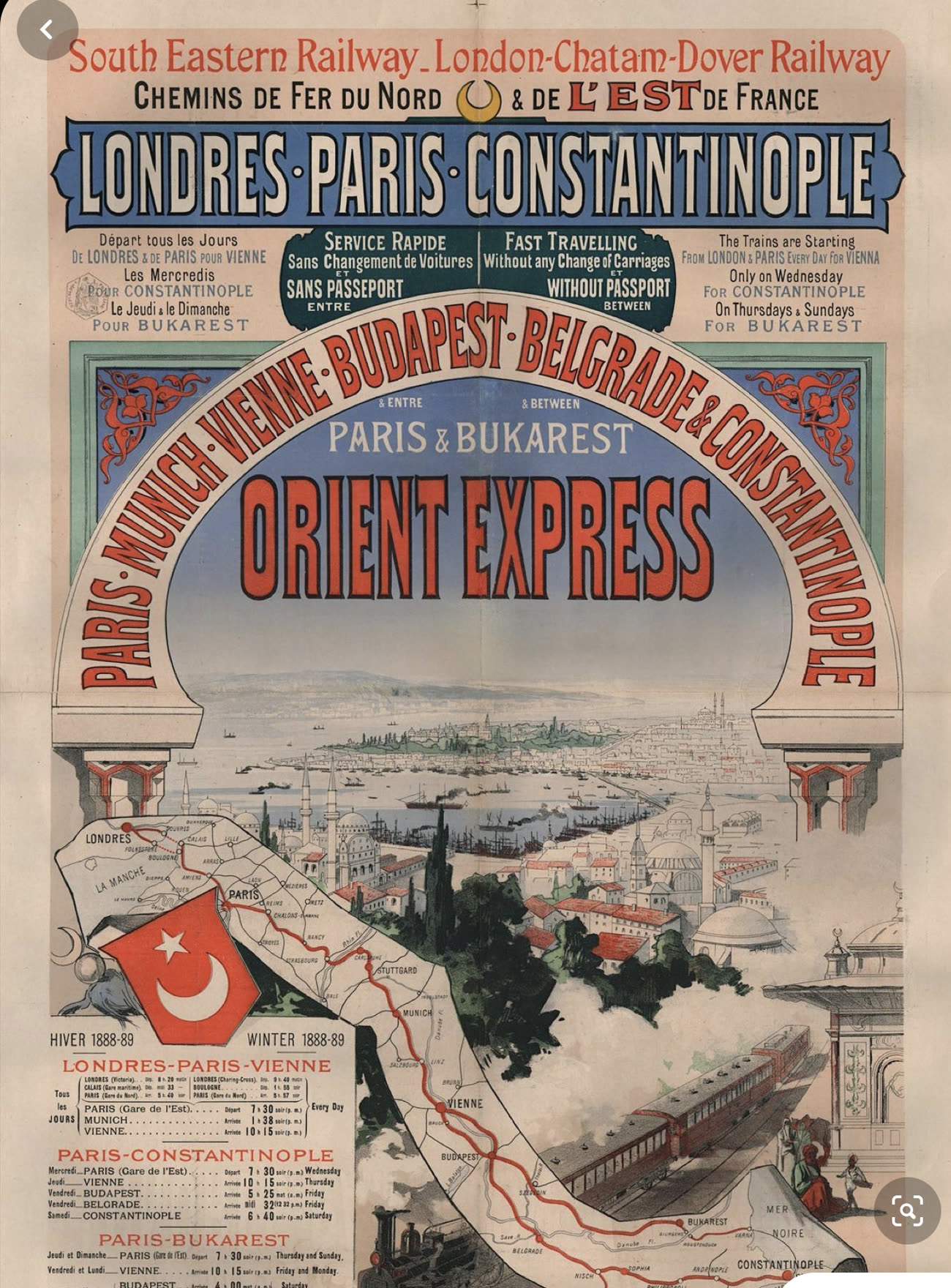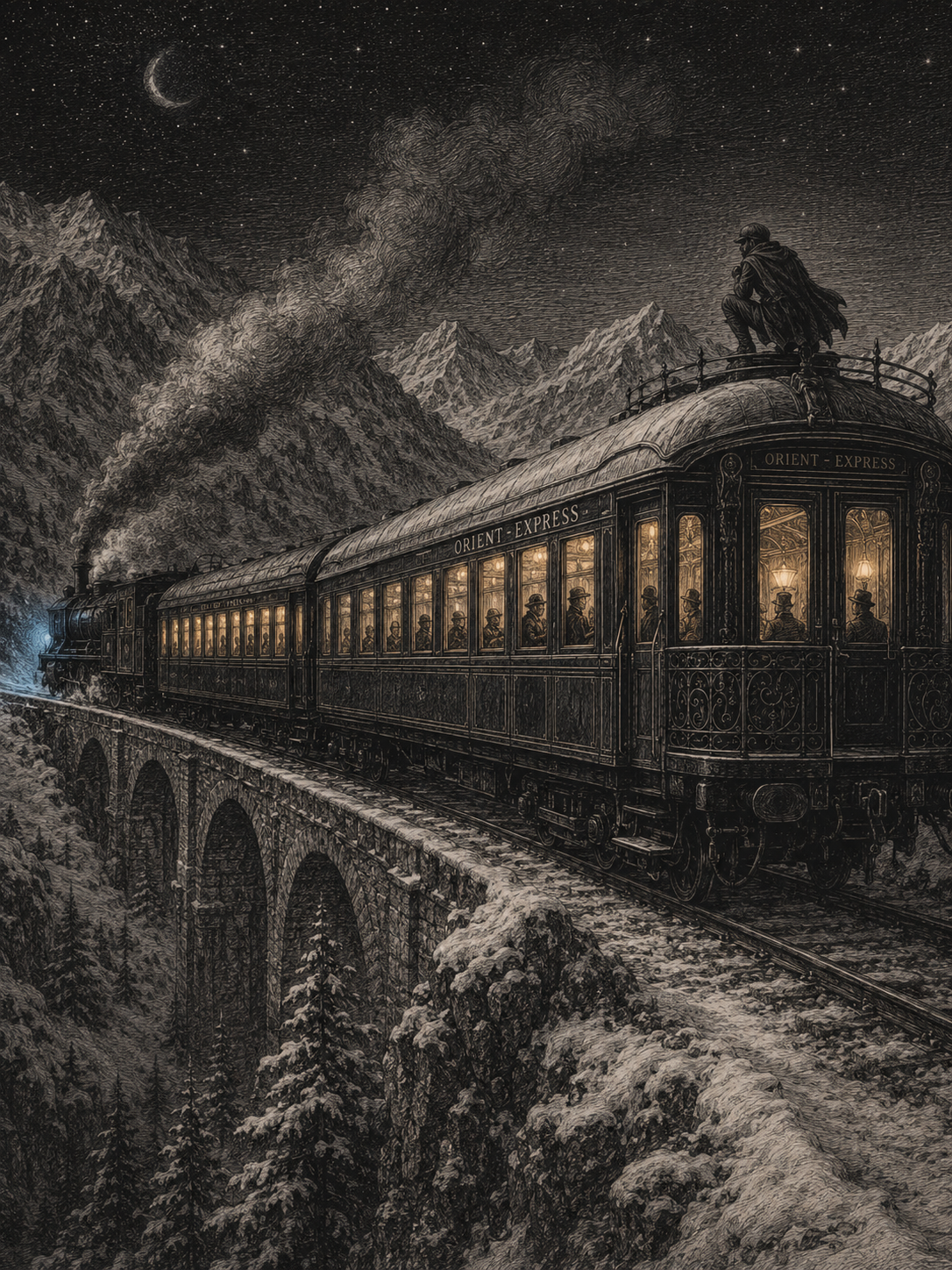
The Orient Express is the train that crosses the continent from Paris, after roughly one night through the Balkans, to Sarajevo or on to the capital of Serbia: “it’s the Orient Express, no kidding”.
| Type | Train |
| Route | Paris – Balkans – Sarajevo – Serbian capital |
| Spanish entry | Orient Express |
Description
The cars form a scale of wealth:
- Two private cars, each with its own kitchen, wardrobe, servant’s place, convertible seats, extending table, drawing room and “a place where one can hold meetings”.
- Four Pullman cars, with private compartments and an open lounge. One sleeper of this type has seven private compartments connected by inner doors, so one can pass between them without using the corridor.
- Five or six third-class cars, a car for ladies and the dining car.
A private compartment holds a luggage area, washbasin, toilet and an illuminated bathtub, beside narrow bunks. Of the bathtub it is said that “the bathtub is where the girl was”, and in it “a kind of illuminated white shawl” was seen. The engine is driven by a woman engineer.
Tickets are checked; first-class passengers travel on a reinforced “Orient Express special”.
Role
The train is a closed stage and a declared intelligence target: “if any force, ours or foreign, had something to get close to their operations on that train”. Of the two private cars, the occupant of one is known; the other is not.
Open questions
- Who travels in the second private car.
- What the illuminated white shawl is.
- Ticket prices, and what distinguishes the “special” service.
- The physical order of the cars, and whose “operations” on the train are meant.
- How the drawing room differs from the meeting place in the private car.
Gallery