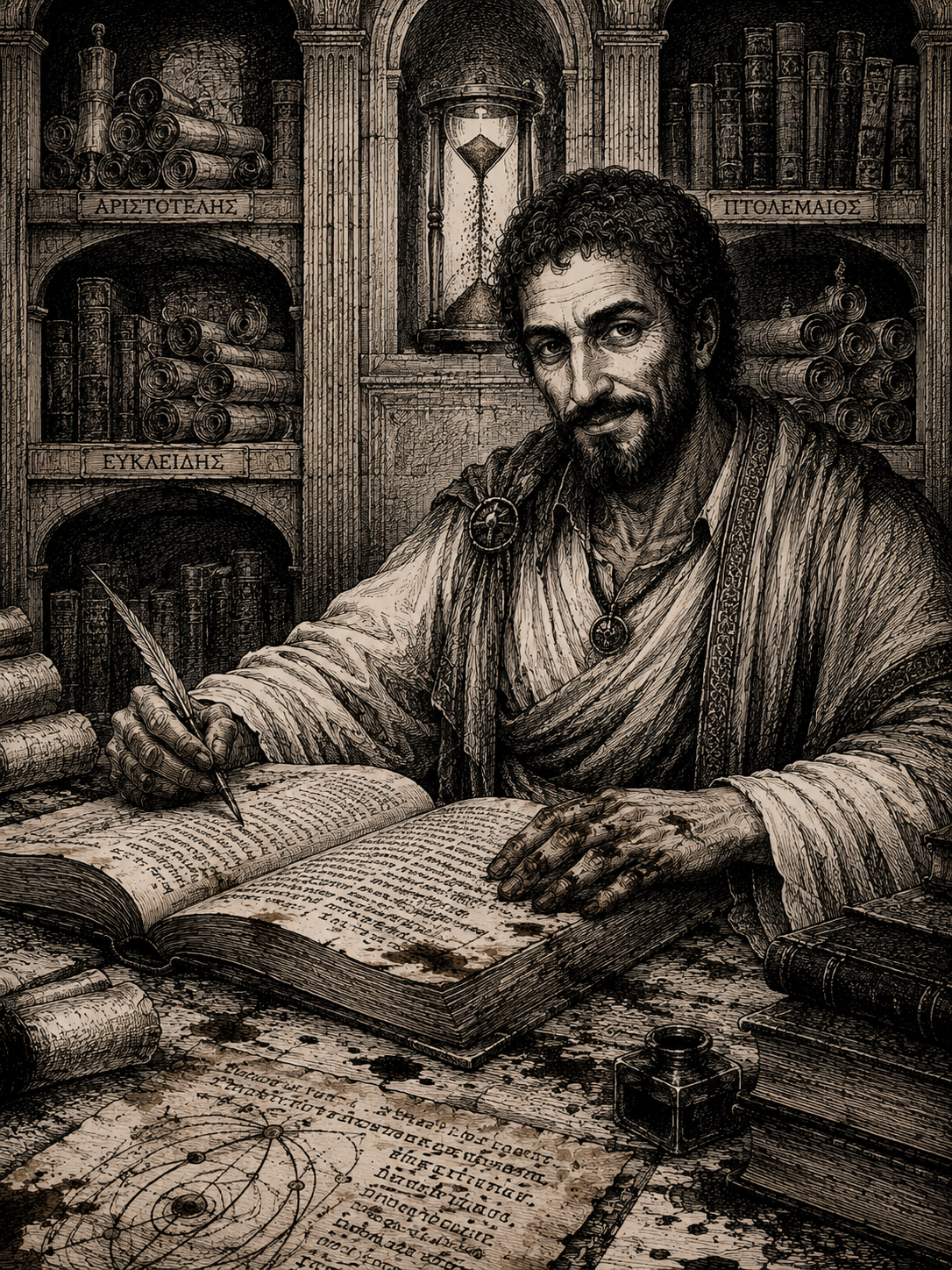
Paulus of Alexandria (Paulus Alexandrinus; Arabic al-Iskandariyy) is a 4th-century Alexandrian astrologer who did not die when his death was announced and has persisted across the following centuries and worlds as a chronicler. He is the hidden author of the encyclopedia, died as Paul Claudel at the end of Antiterra, and is worshipped afterward as the Lord of History.
| Type | Character |
| Born | Alexandria, 4th century |
| Trade | Astrologer, translator, chronicler |
| Other names | Paul Claudel; Pablus; Lord of History; Master Alterer |
| Work | Eisagogiká Apotelesmatiká (Introduction to the Art of Astrology) |
| Spanish entry | Pablo de Alejandría |
Early life
Paulus was born in Alexandria in the 4th century and trained in the last circles of the Library. He wrote an Introduction to the Art of Astrology, the Eisagogiká Apotelesmatiká, which later masters cited for six centuries. His study holds Aristotle, Euclid and Ptolemy in the places of honor, and an hourglass.
The paradox
Tradition records his death in his own era; the archives keep citing him as alive, with new residences, friends and works, for the next twelve centuries. Both are held true.
The other Alexandria
Paulus is also present in the Alexandria that Antiterra founded in 270 A.D.A. The Gesta of Khalim, documented in the Events of Antiterra, shows him that year exhorting Alexander, the Greek paladin; five years later someone seeks his writings in the infernal library. In between, a “Pablo” was found tortured in the Serapeum, the temple-library of Rakotis; he is almost certainly the same entity.
From this period comes the Book, a sealed and encrypted astrological treatise kept in the Infernal Library of the Seventh Circle, which only Paulus can decipher; “the heavens judged that he should receive it”. One conjecture makes Paulus himself, in an earlier incarnation, its original author; the proposed chain of authorship (Paulus, Blavatsky, Claudel) closes on itself, since Claudel is Paulus.
Toledo
Between the 11th and 13th centuries Paulus lived in Toledo. The stay is absent from his signed works but appears in the letters of Father Juan Lobos to his Islamic correspondents and in the margins of Sufi codices. There he read, translated into Greek, Latin and “a Spanish he swore he was inventing for internal use”, and kept company with “the wrong people”. He returned fluent in Spanish and with a moderation toward the acts of the flesh. Arkos holds that in Toledo Paulus fell unrequitedly in love with the daughter of a cabalist of uncertain trade; Paulus neither confirms nor denies it.
Abyssinia
In Abyssinia, over years possibly spanning several centuries, Paulus transcribed the codices of the Apocryphal Gospel of Noc, now kept at the monastery of Debre Damo and consulted only by dispensation. He knew the Ethiopian court of GRDT and the records of the Triple Kingdom of Axum, and witnessed, without intervening, the episode that left Graz’zt diminished. His manuscripts make no explicit reference to that scene.
The cosmological act
Some contemporary mages hold that Paulus was the indirect agent of the separation of Arcoms when Clarisa made her exposition. The separation caused grave consequences for other mages. Paulus was present and did not prevent it, and from then on stayed outside the course of events: he stopped acting in order to record. The encyclopedia, with its records, glosses and marginal notes, is the result.
Death as Paul Claudel
In the final cycle of Antiterra, under the name Paul Claudel, Paulus died: Graz’zt ran him through with an acid-dripping sword in the street before Notre-Dame while he was trying to warn Henri La France about the Blue Book. The sentence was «Hasta acá llegaste» (“This is as far as you go”). He returned later in other forms.
Lord of History
After the liberation of 1901, the new pantheon of Antiterra made Paulus a cult under the title Lord of History. His final acts turned the churches of Paris into libraries; he is remembered as a hero of the city’s post-revolutionary transformation, alongside the Panthéon where statues of the heroes are honored without promise of resurrection, and as a symbol of the passage from Terra to Antiterra.
Pablus
Pablus is the Pablo who crossed, through the Convergences, to the World of Kryle, the cosmos of holiness, and had stories of his own there.
Later accounts
- Thief of the dual fire. What dual magic calls “the fire stolen like Prometheus” was stolen by Paulus. He carried the dual knowledge, of which the Rod of Infinity names him “depositary”; Graz’zt later wrote it down in his cell.
- Shadow in Arborea. In the planar arc, a shadow of Pablo, the form that renounced magic and time, roams Arborea.
- Ghost-father of Kronamon. Paulus and Amikai had, late, a son, Kronamon (“beloved of time”), heir to the book of secrets. After Pablo’s death his spirit remains half-manifested in the son and can possess him.
- Associated with him are the three forces of the Antiterran cycle (GRDT, Asmodeus, Arian) and a book whose reading summons a creature-manifestation.
Other details
He is a first-degree initiate of the School of Illusion and returns to Sigil when he has nowhere else to go. In modern times he has read Nabokov without comment. Arkos glosses his chronicles.
Conflicting accounts
- His survival is explained by Neoplatonists as the persistence of the separate intellect; by Sufis as the greater opening, al-fath al-akbar, which Paulus studied in Toledo and from which he returned changed; by astrologers as an unusual Saturn–Jupiter conjunction on the night of the false announcement.
- The seal at his neck is called astrological by some archives, Sufi by others, both by others.
- The Book’s authorship by Paulus is explained as either anachronism or time loop.
- His moderation after Toledo is attributed to Sufism or to plain weariness.
Open questions
- The exact years of his stay in Abyssinia.
- Pablus’s stories in Kryle are not yet recorded.