This name refers to different figures in 2 worlds; the versions are not merged.
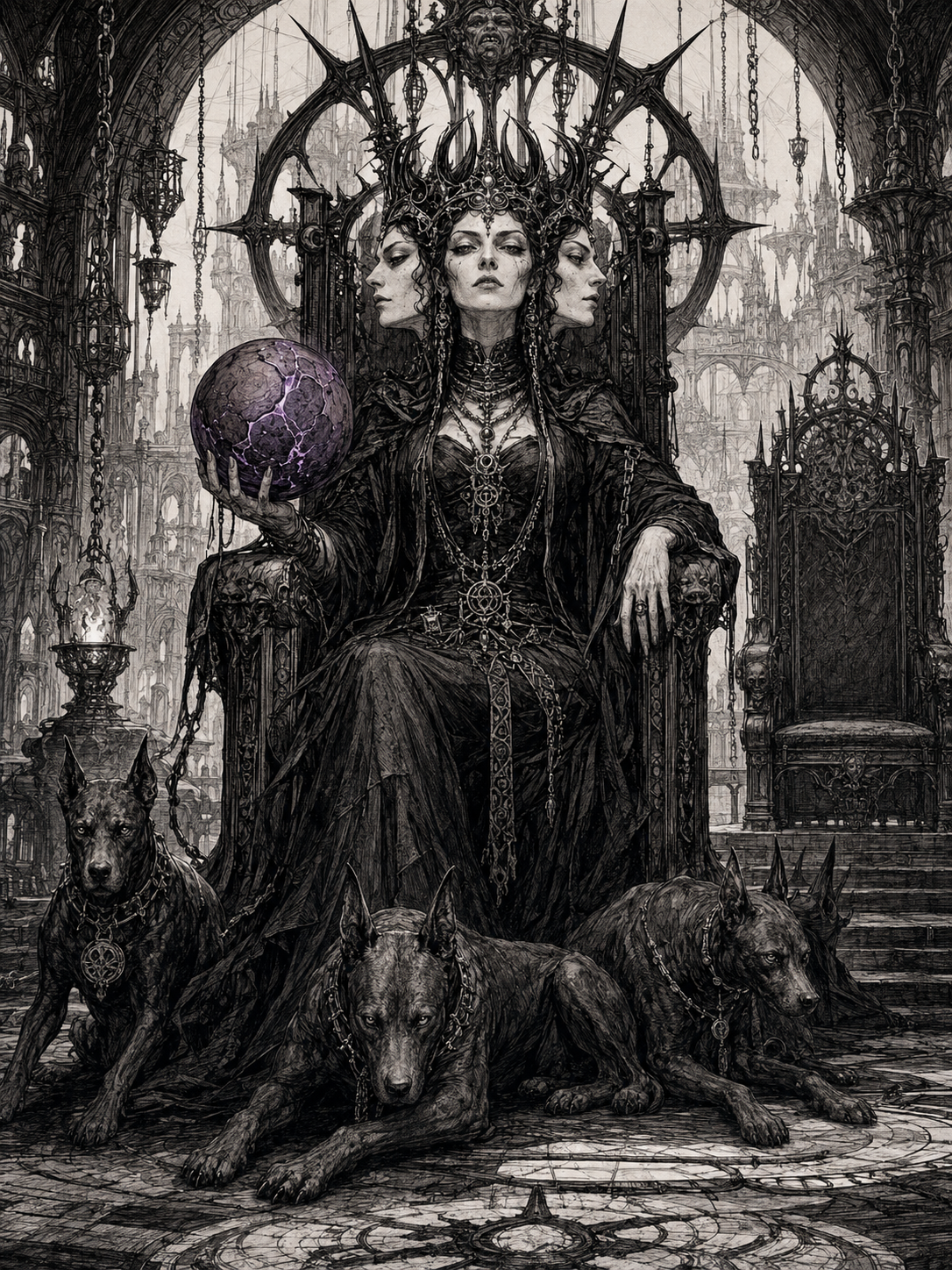
Hecate is, in Antiterra, the oldest power that knows magic, who proclaims herself the coming White Goddess; in Vala, the queen of sorcery imported into the Dantean Hell, ruler of its gates and portals.
| Type | Entity |
| Spellings | Hécate, Écate, Heikate |
| Spanish entry | Hécate |
Antiterra
Presence and avatar
She acts through avatars and in person. One avatar is recorded: a girl (la pibita) who proved to be her vessel, linked to Anubis. On the Astral Plane she appeared in person, “floating in the void with her dark hair in a nimbus”: «Este no es el avatar de Cate. Es Cate. La sentís» (“This is not Cate’s avatar. It is Cate. You feel her”). The avatar is seen; the goddess is felt.
History
She is “the one who did not let her head be cut off while being [buggered] by a strange being”: she survived mutilation and subjugation by an alien creature, and that survival is part of her title. Helm was present at the scene of the beheading and the accusation, in an unstated role. She declares: “I am the oldest one who knows magic.”
With the fall of the former dualist system of God and Devil she became “totally free of the patriarchal world”, and proclaimed: “the only thing that rules above all the damned patriarchals is the White Goddess. And that is going to be me.” Her rise is a reckoning: “those who have taken control are now going to pay”; it is “the day of justice, the hour of justice”. Her new world reserves a place for “those of the old [thirst]” and for “feminine magic”.
Cult
She is “the divinity it is wise to worship”. Her cult spreads by chain: whoever becomes her “faithful and sincere worshiper” may “carry to others the new word of the goddess”. She is a goddess of sorcerers; Arian worships her because he is one. To him she said she could destroy him, but would rather «dejarte pasar y entrar vos solo en el infierno» (“let you pass and walk into hell on your own”): her weapon is not combat but letting the opponent through. Her followers “have set fires, among other things”. She belongs to a syncretic pantheon with Anubis and Sobek, and is called “the wife of Anubis”.
Conflicting accounts
- She carried off the Stone of the Apocalypse; one account hesitates: “Heikate or a goddess took it, I don’t know who.”
- Whether the White Goddess already reigns or is only announced: her words look forward (“that is going to be me”), while other voices say she is already free of the patriarchal world.
Open questions
- Who the “strange being” was, and when and where the mutilation happened.
- The girl avatar’s name and status, and how many avatars exist.
- What “the old [thirst]” means.
- No temples, rites or prices of her cult are recorded.
- Whether her followers burned or set the fires.
Vala
The records call her “the Goddess”; her true name is not to be spoken (“I do dare to say her name,” one said). The company used the password Cacahuate to speak of her without summoning her.
Nature
She is “the queen of sorcery of classical antiquity”, imported into the Dantean Hell, the most dangerous infernal power met so far. She rules the gates and portals of Hell from two seats: one in the Nine Hells, the city of Dis, where she is queen and guardian of the gates; and one in Hades, “where the Daemons are”. All portals of Hell “render account” (rinden punto) to her.
Her only recorded physical manifestation is her rise over the river Styx: “a figure you see rising over the ocean”, gripping the heads of all who fell there, hair raised, wrapped in a serpent. Otherwise she is felt from afar. “As she walks, she blabs. She can’t help it”: the voices call her buchona (“snitch”) and “cursed”.
Role
Any expedition through Hell depends on her permission or on evading her. The companions requested an audience to gain her help in reaching the tomb of Maristo’s master. The guardian of the fourth or fifth circle “negotiated something with the usurper”. On mortals she inflicts a psychic curse, “a painful sensation in the head”, through which she communicates her will to union.
Conflicting accounts
- She is “the queen” (“you are in her city”) and also “the usurper”.
- The key passage names only “the Goddess”; her identification with Hecate awaits ratification.
- Whether she stole something or was robbed, and of what, is unclear.
Open questions
- Whom she usurped at Dis, and what came before her.
- What the circle guardian negotiated, and the price of an audience.
- What the “union” is.
- Whether she rules both seats equally.
- Whether “rendering account” means tribute, report or obedience.