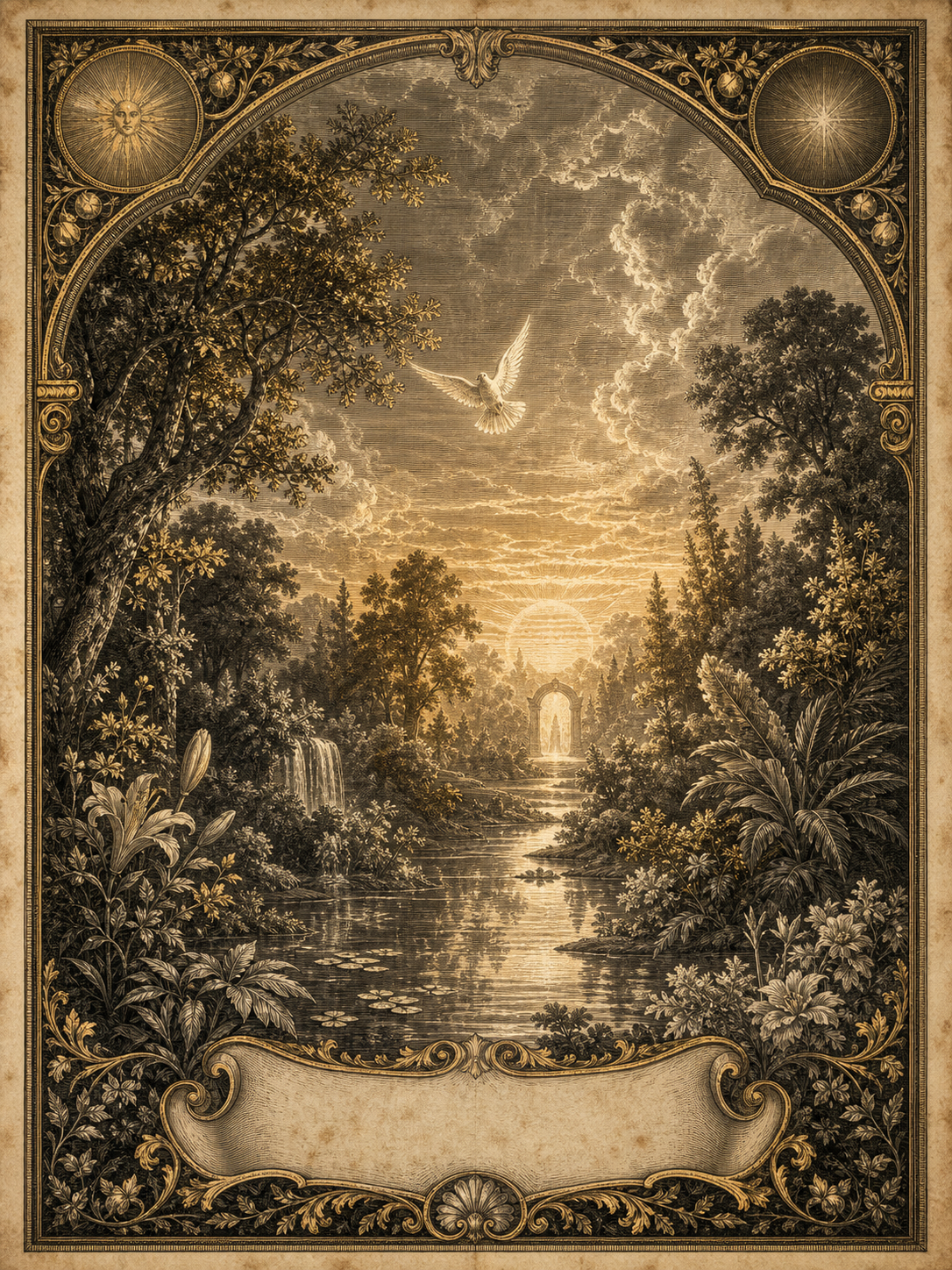
Arborea is the primordial garden of the cosmology of the Pit, a geography older than the portal of the Temple and Place of the Just. Souls descending into the Pit come from it without remembering it. “Arborea” is its name in the common tongue of the Pit; other liturgical languages call it Eden, Paradise or the Garden.
| Type | Place (primordial geography) |
| Inhabitants | Adam / Arian, Sariel, Eve / Swedenborg |
| Status | Exists; sealed and inaccessible |
| Main source | The Chorus of the Descent |
| Houses of the Cycle | ☯ House of the Twin Cosmos · ☷ House of the Descent · ✒ House of the Chronicler |
| Spanish entry | Arbórea — el Edén del Foso |
Description
Arborea is a lush garden:
- a forest with no visible edge, under continuous golden light and a red sunset that never turns to night;
- a central mirror-like pool, in which one sees what is not yet, or what was before;
- animals in pairs, gazelles the most visible;
- no death and no pain: both belong to later geography.
Inhabitants
- Adam / Arian — the figure of the first breath, naked and without powers. The soul that is Adam in Arborea is Arian in later geographies.
- Sariel — serpent/angel, an ambiguous figure whose alignment the Chorus does not judge.
- Eve / Swedenborg — created from a rib, taken from Adam by separation; that separation inscribes the primordial dualism. The soul that is Eve in Arborea is Swedenborg in the Pit and in other geographies.
Swedenborg and Swedish mysticism
The Chorus’s canticle keeps the central verse: “Si escuchaste hablar de Swedenborg, / que se suponía que venía de un reino dodín” (“If you heard of Swedenborg, / who was supposed to come from a dodín kingdom”). Reino dodín is possibly a sung form of reino divino (“divine kingdom”). The verse ties Swedenborg to Swedish Christian mysticism: Emanuel Swedenborg, a mystic of the parallel terrestrial geography, taught the angelic spiritual realms. Swedenborg-Eve joins the Decadian primordial garden to the Swedish mystical one.
History
Arborea lasted the whole first cycle, sung in eighty-three antiphons of the Chorus, plus the first scenes of the second cycle, the phase of the Expulsion. Adam and Eve were then expelled into the mud, which the doctrine identifies with Antiterra: a passage from a garden without death to a land where death operates, the inscription of dualism rather than a simple punishment. After those scenes the garden was closed to direct access.
Present status
- It still exists; the Chorus does not record it as destroyed.
- It is inaccessible: no route to it survives in the geographies of the extended universe.
- Residual life continues: the paired animals keep their calendrical rotation and the pool still reflects, though no one looks into it.
The doctrine holds that descending into the Pit is a second descent: “Quien baja al Foso baja por segunda vez. La primera fue de Arbórea” (“Whoever goes down into the Pit goes down for the second time. The first was from Arborea”). The first descent ran from Arborea to Antiterra; the descent into the Pit runs from Antiterra to the circles. Those descending receive unrecognized echoes of the garden: gazelles at the edge of some passages, the red sunset some circles keep in their sky.
Only the Chorus of the Descent keeps a detailed memory of Arborea.
Conflicting accounts
- On Sariel’s nature, some chroniclers see an early fallen angel, others a serpent with an ambiguous protective role, others an entity double from the start. The archive keeps all three.
- In one version Sariel stayed in Arborea, which then keeps its own guardian, now watching an empty garden; in another Sariel descended with Adam and Eve, leaving the garden unguarded.