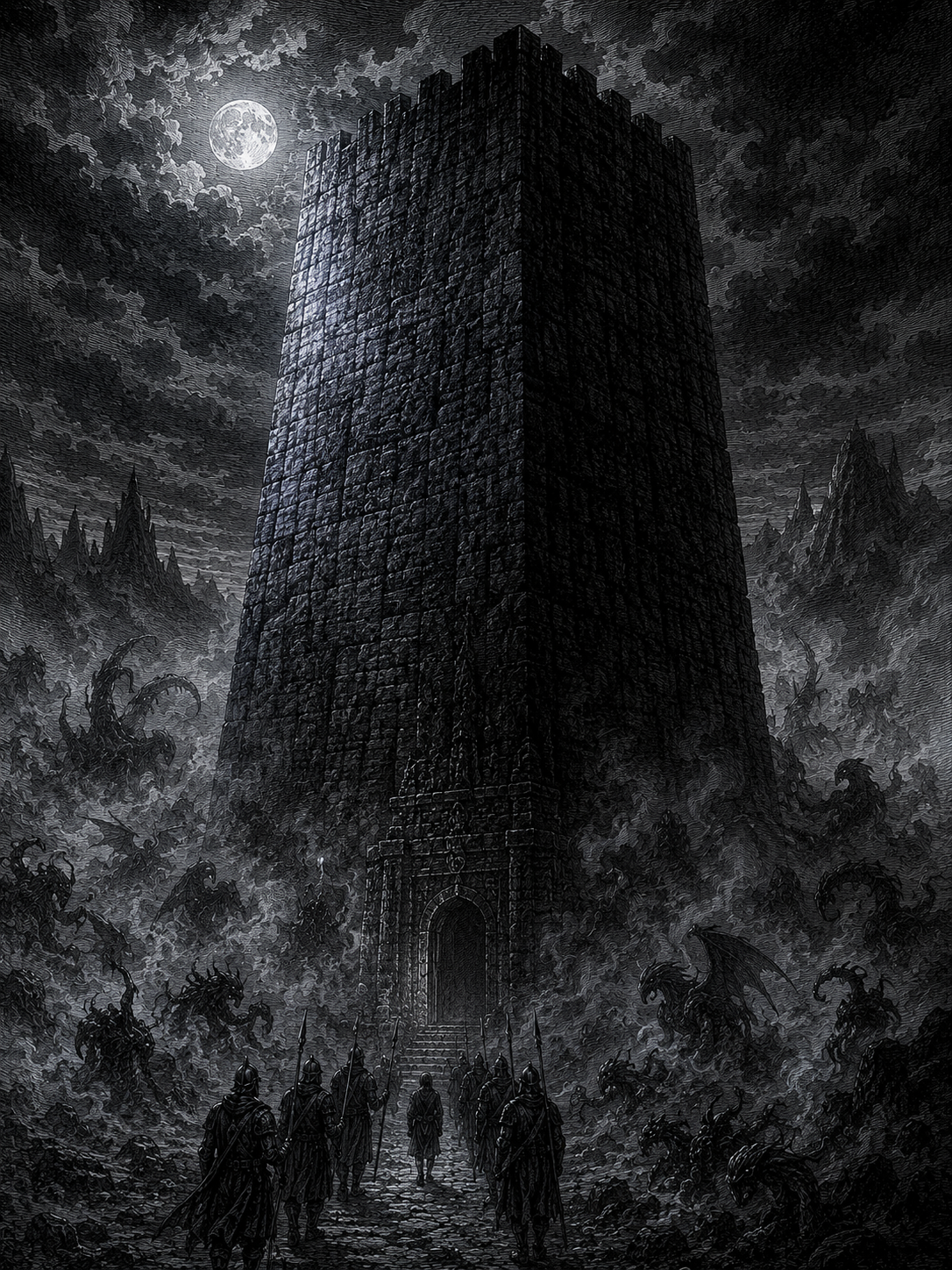
Tovag Baragu is a place of passage between worlds: on Antiterra a guarded ring of menhirs and portal-obelisks, on Vala a dimensional labyrinth and temple of Vecna.
This name refers to different places in 2 worlds; the versions are not merged.
| Type | Place |
| Worlds | Antiterra; Vala |
| Spanish entry | Tovag Baragu |
Antiterra
Approach
Tovag Baragu is reached through portals, not roads. A figure called Pico, who claims to have been there, counts “three, to be exact”. Entry requires the sacrifice of a horse.
One account places it in the Russian steppes, toward the territory of Gran Cana: three or four miles from Kanak, two miles from a river, on a salt plain of heavily eroded ground. Arrival comes at about five in the afternoon, in heat and suspended dust. A mile from the circle the wind stops entirely, and travelers feel “as if incorporated into some strange network”.
Rings and obelisks
It is a great center of menhirs in six concentric rings, some broken: trilithons with lintels beside single slabs, stones “Celtic, druidic, of many kinds”; the whole is called “exocosmic”. In the central circle, on white planks, stand thirty-six smooth white stone obelisks over ten or twelve meters high, hard to make out at first, of unclear, “half-flattened” shape, with arches. The obelisks are portals, and “not all portals lead to good places”. Eight of the arches hold dormant transmutation magic; three of those also hold healing.
At the center is an astrological clock, and beside it relics: the place was called “the heart of darkness”, holding “the greatest treasures of all”.
Guard
A tower with a guarded main gate is opened by an enormous ugly green troll with a halberd. The horse rite is a fixed toll. The site combines a planar gate, a relic store and a guarded threshold in a single point; whoever controls it controls the transit.
Effects
The place affects gravity; there was a void; presences would have drained the intruder’s life energy but for a condition the account does not explain. In some regions one passes “from dead to living”. Beyond the portals, or within the complex itself, lies primeval tropical jungle with huge insects, abundant sap, brontosaur-like beings and enough water to raise the level and reshape the ground. On leaving, “a mist envelops them”. Lucas was among those with the company.
Conflicting accounts
- One itinerary places it in the Russian steppes; another beside the coast.
- One record describes a coastal druidic circle for weddings; another a portal network with a clock. They are the same entity.
Open questions
- What it means that Tovag Baragu was once “the bottom of the center of the crest”, and when it ceased to be so.
- How the dormant arches are awakened, and how a destination is chosen among the thirty-six obelisks.
- Which relics lie beside the clock, who placed them, and what the clock marks and governs.
- Who performs the horse sacrifice, and what happens to those who enter without it.
- Who raised the six rings, and why some stones are broken.
Vala
A dimensional labyrinth that works by the principles of the Kabbalah and other esoteric formulas: a plane of concentric circles called meniles. It is placed where the stars align, among ruins, beside a source of the river of time; that river appears again in another record, skirting a temple where a terrible ritual is held. The only firm fact is that Tovag Baragu is a temple of Vecna.
- Whether the labyrinth, ruins, circles and temple are one thing or four sharing a name is unresolved.