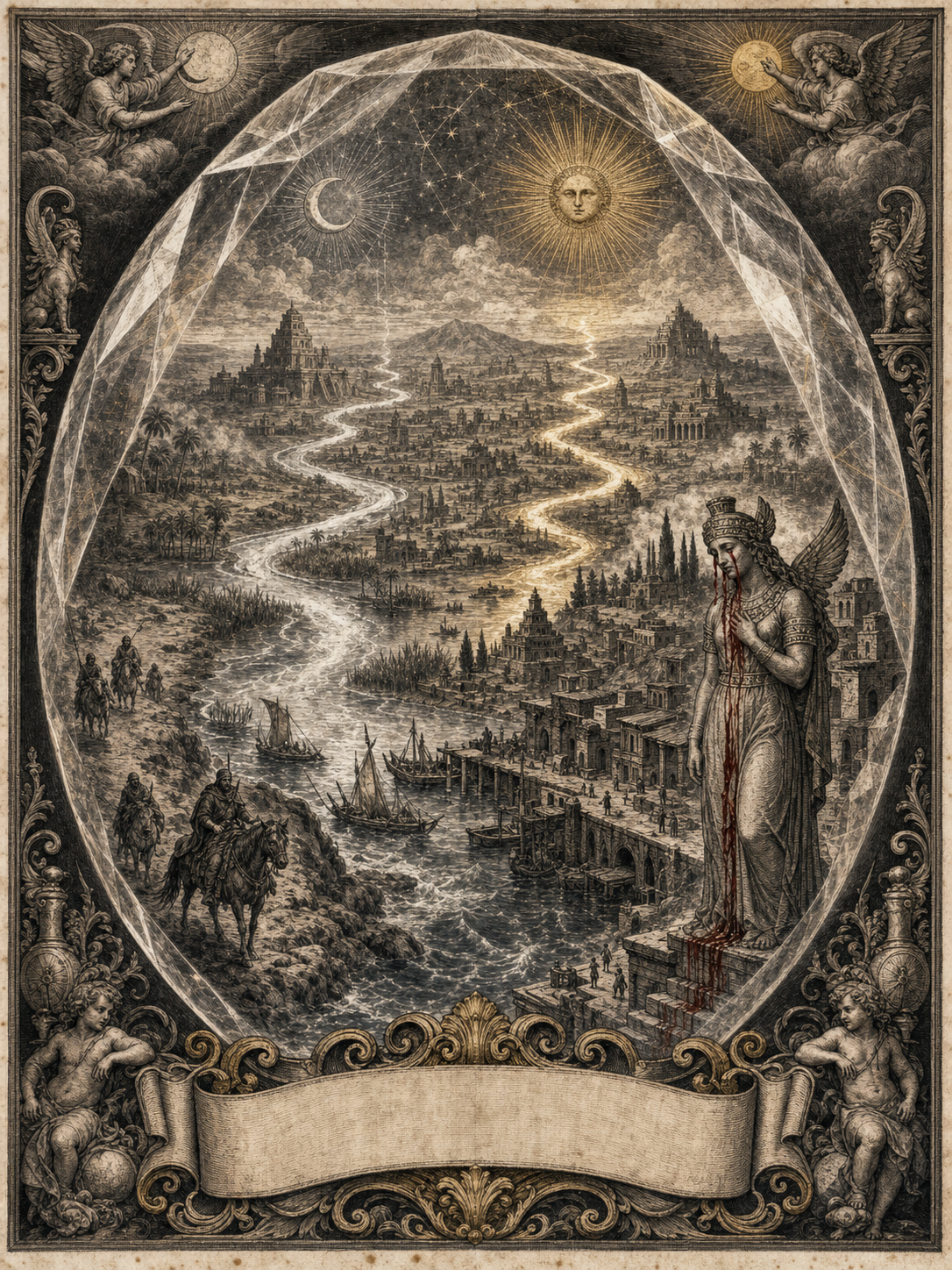
Ancient Vala is the first recorded form of the world Vala: a two-river mesopotamia existing, unknown to its people, inside the crystal Vala Cristalis. It is the narrative base of Medieval Vala and Ardis Vala, and the world whose survivors were deified in the new cosmos.
| Type | Place (world) |
| Spanish entry | Vala Antigua |
Nature
When the End of Antiterra closed with Asmodeus, Lucifer and a crystal holding something, the archive’s figures came to walk, unknowing, inside what was saved. The crystal is named Vala after William Blake’s unfinished poem Vala, or The Four Zoas. Inside lie coasts, reeds, temples and two rivers: the River of the Moon and the River of the Sun.
The world has a color code: the Blue House rules from Urupla Azul, the White Towers withdrew south, and the Beautiful Mount of Fire burns at the center. It is Mesopotamian: at New Year the king receives his court, and a Substitute King ritual is performed only when omens are terrible. Its magical infrastructure (nine rods of lesser sorcery, a beacon’s central eye, ten cranks) proves to be built. At the end the chronicler tells Sven the Cook this is not the world of the other cycles but a “malgnostic” one.
History
Nesut
In Nesut of the Reeds, a misty town of salt tides, a statue of Ishtar weeps blood; seven objects tied to the myth of the descent to the underworld have been stolen or profaned; the bandits Luigi Bamba and Mario Navarro kidnap innocents and rob travelers; skeletons rise in courtyards at dawn; and a paladin, sister of the local captain, does not return, her soul answering no invocation.
Adventurers converge there:
- Midori, who will find, inside a metal sphere, a network of beacons linking regions.
- Sheridan, who deceives the governor of Bity la Abeja.
- Garkan, a barbarian who casts oracle spells while roaring and, in rage, speaks only Aclo, the tongue from beyond the veil.
- Tailoor, a provincial tailor, living anagram of Lotario and Oratiol.
- Nibiru, a monk who remembers the Dragonkin and links the White guardian House to the moon and its dark side.
- Shakes, Antinoo, and Yuvé Bribaldo, a reptilian.
They call themselves the Word Breakers.
The road
They meet elven menhirs outside Bity la Abeja, an orc chief demanding tribute or flesh, life-draining shadows, the statue of the Bull of Heaven in the Valley of the Tempest, an impostor witch, and a funerary sanctuary whose names matter only to Ishtar and Ereshkigal.
The Tower Ob Caligni (three days) is the turning point: amid coins totaling 13,001 and shadows that compile to alter reality, they fight chaos seeping through the seams of the cosmos.
The Dura Verdad arc forces a moral choice that divides them. The boatman of day, counterpart of the boatman of night, stands at the stern of a white object, a direct reference to Dante’s Purgatorio, Canto II. Yuvé climbs Mount Purgatory alone, among night songs and crowns of kisses, in this gesta.
The Black Egg shows the whole geography: the mesopotamia between the rivers, the Smoking Crown, the Lost Oases of Ankaranay and the Sea of Guilt.
The Vala phase
In Kardan Xairas chaos coins have corrupted even young paladins; a boy with a strange arm, locked up by the Yoti, escaped in fury. The Labyrinth of Qabalah opens pre-real mental landscapes tied to the astral plane by a golden cord, the old lifelines. Belial appears through phantasmal figures in the mist and whispered norms on who may judge the king; the emissary Naya Lautep sees the world from outside. Ur-Draxa, city of the dragons, waits at the end with canals of ice and fire, defended outer rings and a privet labyrinth.
Tailoor faces his own parents amid Etruscan hepatoscopy, acromancy, crystals and a bronze angel.
The end
Back in Nesut, the Devourer lurks in Death City and Doom Prophet and his hired killers perform necromantic rites around a cauldron. Sheridan departs riding the beacon. The final act is the Lance of Marduk: a blow struck on a plain before a coliseum.
Nibiru then proposes a fractal cosmos of infinite possibilities, one where they hold power and one where they do not; the closing debate asks whether duality can be transcended: “Life is many. We are all one. The learning is being able to realize that.”
Thalia Cristalia, the vanished paladin, ends married to Tailoor. The Legend written afterward, attributed to L.O.T. (Lotario, Oratiol, Tailoor), is a verse epic told from the bard’s perspective, illustrated by Gustav Cröia.
The survivors
The heroes who crossed Ancient Vala were deified in the pantheon after the Supreme Ones (the Triumvirate), born at Nexus:
- Tailoor: god of love, play and pacts.
- Antinoo: god of magic, stars and sky.
- Shadydron: silver dragon god of the moon and knowledge.
- Jax: a survivor of the pantheon.
- Garkhan: dragon god of the black moon and death.
Like Thor, they are very powerful heroes whom mortals took for gods.
Later phases
- Medieval Vala: the world in a medieval key (probably crossing with the Ardis Vala gesta).
- Ardis Vala: the run of the present cycle, based on the pages of Ardisvala.
Vala is the continuum linking the phases.