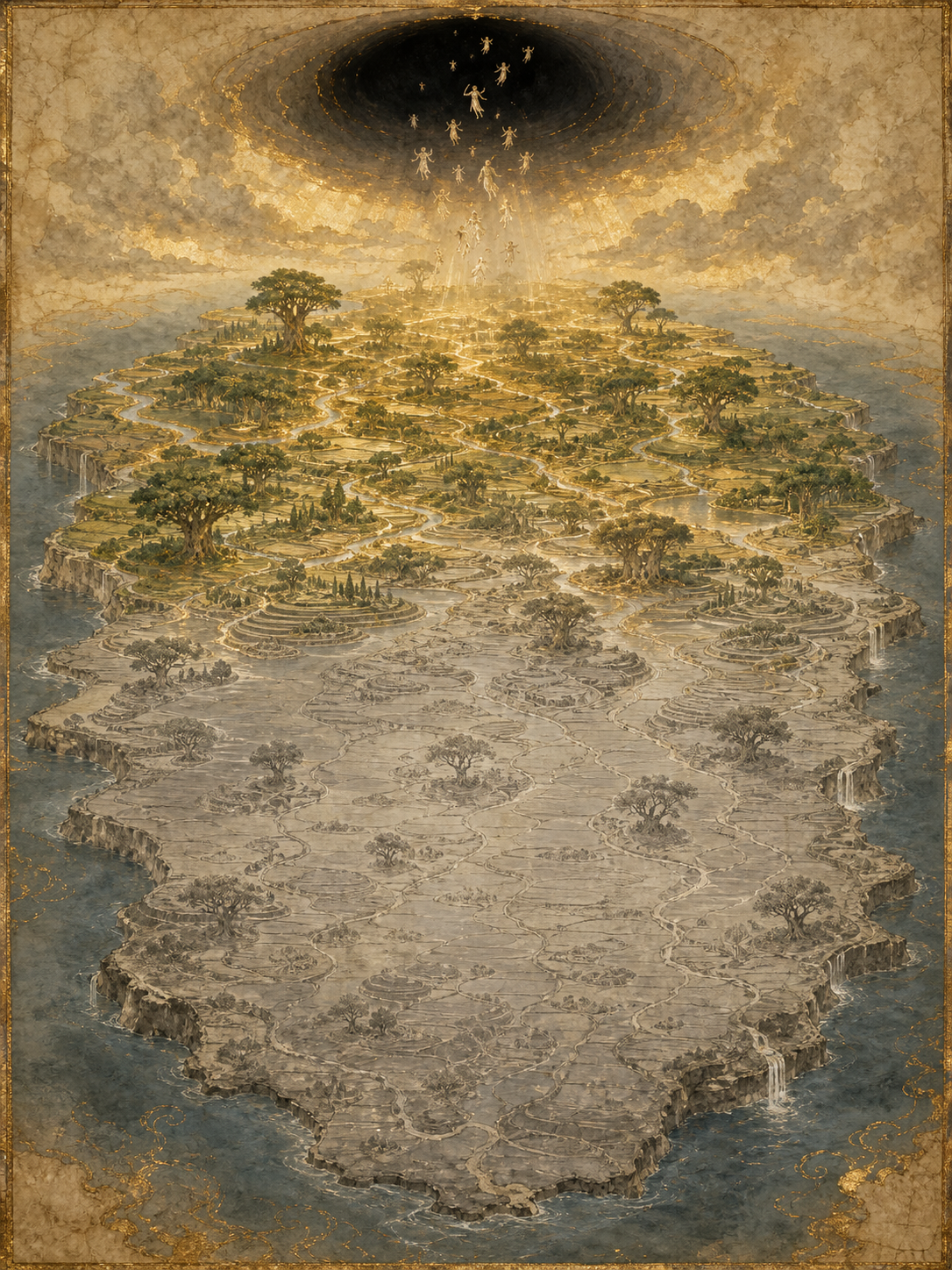
Angara or Andgara is the first continent of the shared cosmos, whose pantheon was trapped in the Abyss by Lotan and which then drained into the desert later called Athas. The two names are spellings of the same continent; the form with d is that of Paulus (see Andgara).
| Type | Place (continent) |
| Pantheon | Angarian Pantheon |
| Spanish entry | Andgara |
Description
Angara was a matrix where magic, ecology and races coexisted in agreement. Its own pantheon, the Angarian Pantheon, with Yelmalio and Sati among its greater deities, kept the continent’s balance without rigid hierarchies. It was a solar-vegetal continent: its gods depended on light circulating through the land, its races lived by pacts over water and land, and its great houses had no armies because they needed no fixed defenses.
History
The trap
Lotan — in other records Tiamat, in some the Dark Queen herself — came and ended all the gods of the Pantheon. She did not kill them: she trapped them and shut them in the Abyss. Accounts of how differ; they agree on what.
Kronamon, the primordial lord of Time, asked: “What does it mean that Tiamat came and finished all the gods of Andgara? What does it mean that she trapped them?” Paulus answered that the capture was absorption: the gods became part of their captor’s body. One reading, noted as possible but not certain, makes Lotan a seven-headed serpent, one head per captured god.
The draining
Without the Pantheon, the continent drained. It did not sink or flood; it emptied. Rivers were sucked underground, forests dried, and the races lost their agreement and their land. Destroyed Andgara is equivalent to Athas a thousand years later: the same ground, emptied of its divine support, became the desert where magic consumes without return.
Identifications
- Paulus to Kronamon: “Armenia and the Arsacids came to an end. That is what my father calls Andgara.”
- A phonetic echo with Ankara: Ancyra means “anchor” in ancient Greek, the “first place of the Fall” according to the Skronamon document.
- Kronamon’s hypothesis: Lotan is the Ugaritic name of Tiamat, placing the enemy’s origin on the Syrian-Ugaritic coast, not in Mesopotamia.