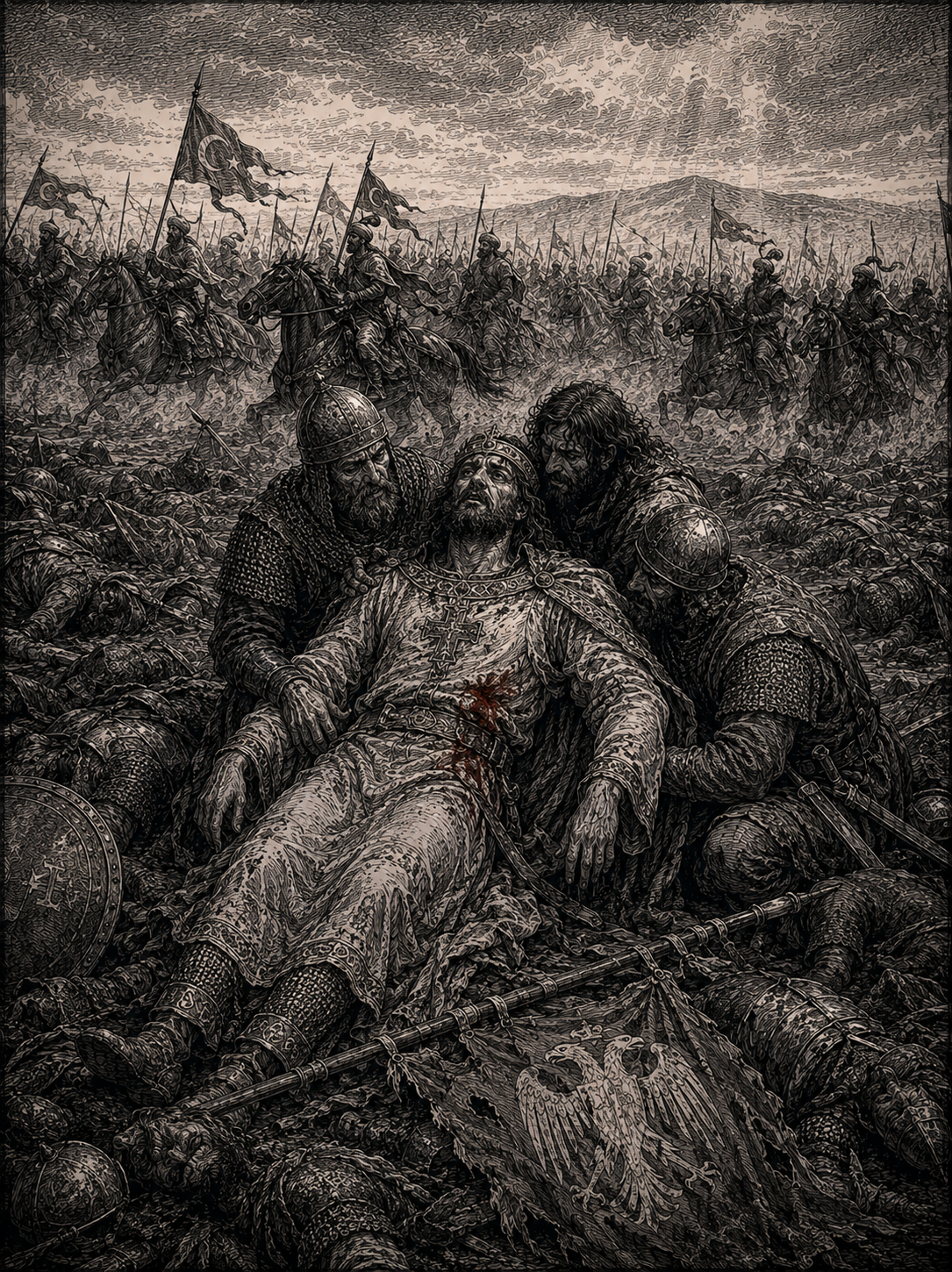
The Battle of Kosovo was fought on 28 June 1389 (Vidovdan, Saint Vitus’s Day) at Kosovo Polje, where the Ottoman army of Sultan Murad I destroyed the Serbian army of Prince Lazar. Lazar’s martyrdom is the chronomantic root of the 28 June cipher later exploited by the Black Hand.
| Type | Event (battle) |
| Date | 28 June 1389 |
| Place | Kosovo Polje |
| Belligerents | Serbs under Lazar; Ottomans under Murad I |
| Result | Total Serbian defeat; martyrdom of Lazar |
| Houses of the Cycle | ⌖ House of History · ⏳ House of Carnal Time |
| Spanish entry | Batalla de Kosovo — 28 de junio de 1389 |
The battle
Vidovdan is the day of Saint Vitus, saint of vision and dance. The defeat is total. Lazar dies a martyr: captured, beheaded, his body exposed. His death founds the Serbian memory of loss: five hundred years of mourning renewed every Vidovdan, transmitted through a genealogical line unique of its kind.
Kosovo Polje is marked as chronomantic, not military, geography: whoever treads it on 28 June of any later year hears the echoes.
The curse of Saint Vitus
Moni Vivescu, through a crystal ball in the Uchronic Paris arc, identified the battle as the chronomantic root of 28 June as an operative date. Lazar’s martyrdom opened a cipher in the calendar that the Black Hand later learns to exploit: each great century collects an attack on its 28 June.
The chronomantic chain:
- Kosovo 1389 — Lazar’s martyrdom, first anchoring of Vidovdan.
- Serbian cultural memory — five hundred years of mourning; 28 June as symbolic cipher.
- Use by the Black Hand — 28 June chosen for its charge, not tactical convenience.
- Sarajevo, 28 June 1914 — the Latin Bridge attack, fulfillment of the cipher.
- The Time Bandits projected as Uchronic Guards — the group pays the price of the Inevitable.
If Kosovo did not happen, the chain would break at its origin. The Marquis de Sade — Hugo suggested this from the tower of the Valley of Death, and the group discussed it after eliminating the four war generals, the last being Eurodico, executed by Claude.
The diplomatic plan
With the four generals gone, the group considered avoiding the battle diplomatically: the Torcos and the Serbs could meet at a Byzantine Anatolian table before 28 June. Without the battle, Lazar would not die a martyr and the Vidovdan curse would not be established. The Marquis de Sade — Hugo mentioned “a child, a talvito” in connection with Kosovo.
The operation was planned in Constantinople 1055, with 334 years of tactical future ahead. Plan B: a direct time jump to Kosovo 1389 with magical components gathered during the Byzantine lustrum.
Open questions
- The outcome of the jump is not recorded; the question remains open.
- The meaning of “un niño, un talvito” is unclear. One reading, by the Chronicler of the Plata, takes it as Saint Vitus himself as a childlike chronomantic entity who could be addressed before the rite.