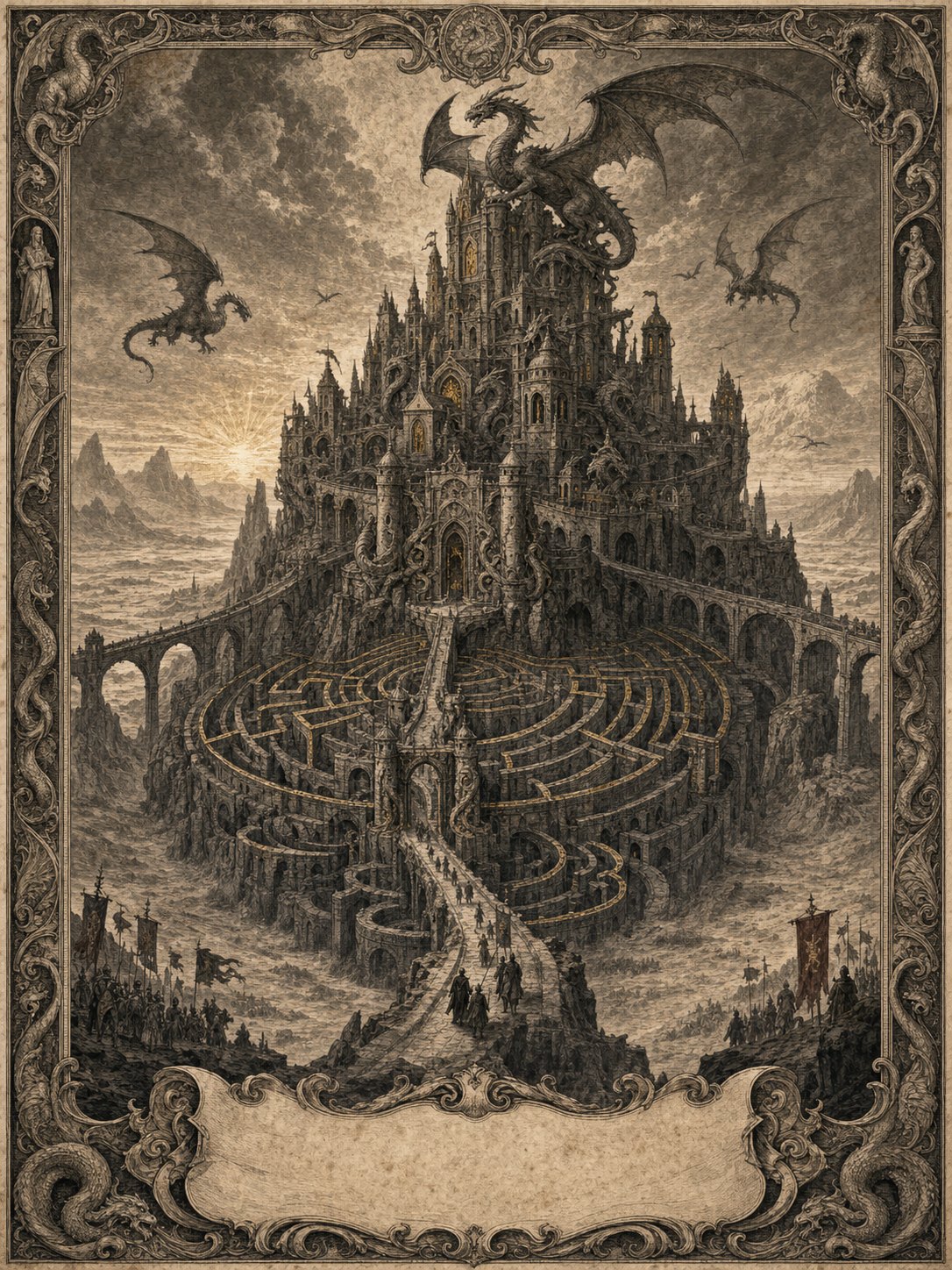
Ur-Draxa is the city of the dragons and former seat of the dragon throne: a once-flying, wheel-shaped city of concentric rings around a walled garden, which landed in a hidden world beyond the Sea of Guilt.
| Type | Place (city) |
| Spanish entry | Ur-Draxa |
Description
From the edge inward lie “a series of what were called the cardans, and boulevards, and concentric circles”, and only then “the walled paradise, the walled garden”. The outer rings are held by combat creatures. Further in, the cardans and boulevards display “the different chromatic colors, but also the metallic forms”: seven colors and seven metals of cosmological significance. One metallic form is “in crucial essence of destruction”.
The center is a walled garden whose “paths and labyrinths” fork and confuse.
History
The city once flew, and landed beyond the Sea of Guilt, in the hidden world where it now stands. It can be reached and left: companions “were returning from Ur-Draxa”.
Tiamat was in Ur-Draxa. At the center of the labyrinth was held the Cakravartin, the substitute king, also called the gardener, who was rescued from there.
The return from the city brought the dispute over what to do with the black sphere, and a clash of opinions with Nibiru.
The gardener plans to convert it: “this will be the city of orchards. We are going to plant the trees.”
Open questions
- How many rings there are, and in what order cardans, boulevards and circles follow, rests on testimony the archive itself calls unclear.
- The seven colors and metals are not listed, nor which metal holds the essence of destruction.
- Materials, scale, population and the city’s state after the rescue are not recorded.
- Who held the Cakravartin, and how this relates to Tiamat’s presence, is unknown.
- How the city flew and landed, whether it could rise again, and whether the orchard plan was carried out are unknown.
- Where the Sea of Guilt lies and how it is crossed is not recorded.