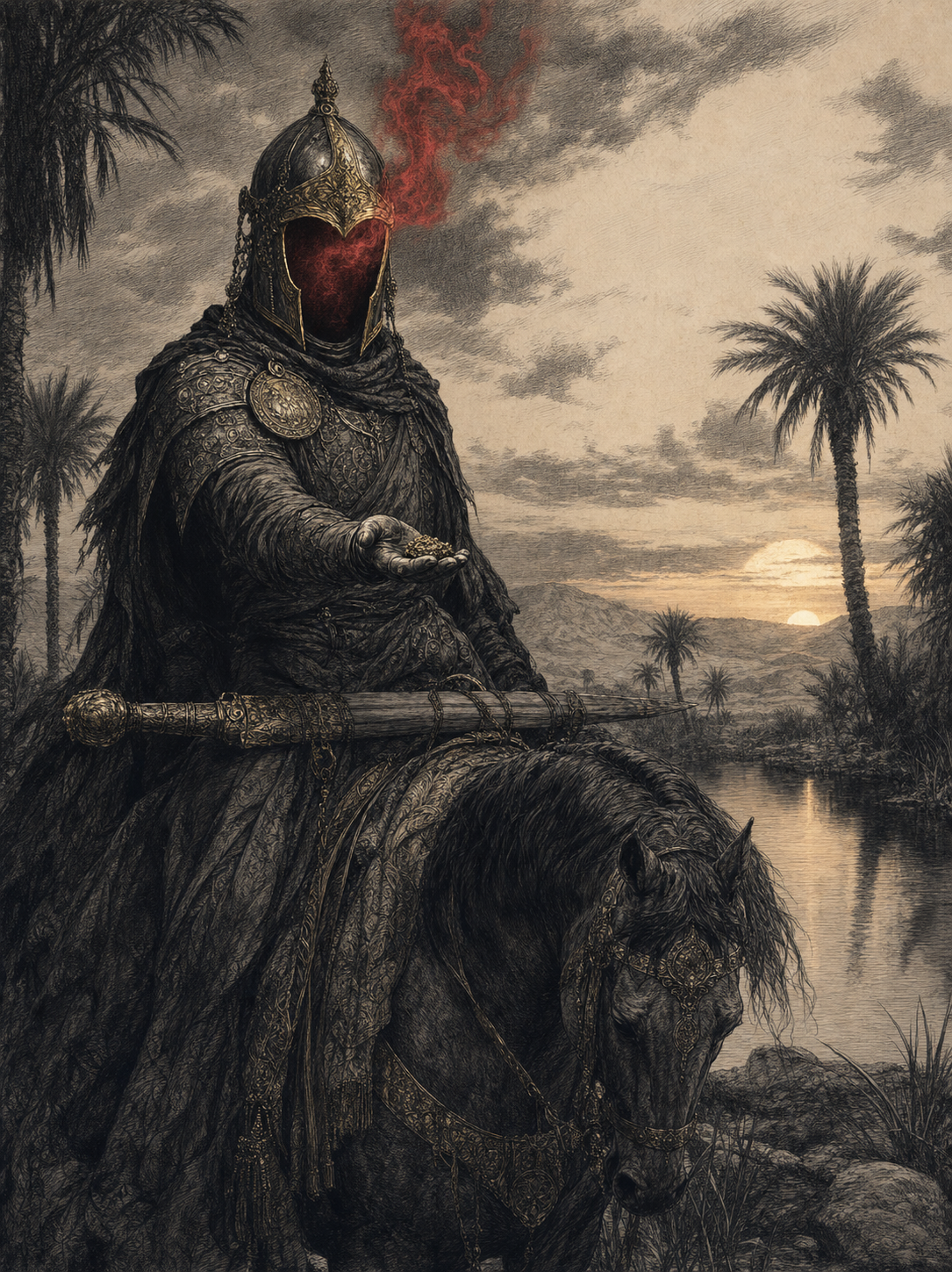
The Horseman of War is one of the Four Horsemen of the Apocalypse, a power that feeds on violence. He “strangely” renounced his office, and the vacant seat is contested in a public competition called by Charon.
| Type | Entity |
| Status | Renounced; seat vacant |
| Spanish entry | Jinete de la Guerra |
Description
His weapon is “a tremendous sword like a blade of silver”, its hilt set with a white gem. He talks, laughs and applauds; he loves a brawl. He applauded the archer whose arrow had just struck him: «Mueran todos en esta batalla» (“Let everyone die in this battle”). He shattered a warrior who deflected his attacks with a lance, and as a general he deliberately spends his troops as cannon fodder.
History
A mortal paladin expelled for his sins, he became a general who conquered and ruled empires. The records identify him with Richard the Lionheart: a prisoner, he “sold his country to his brother, who was John Lackland”, and demanded a tribute so heavy that many peasants died raising it; he then began the Hundred Years’ War and conquered France. Whether this is history of this world or a borrowed legend is left open.
He passed through Tovag Baragu, is associated with Alexandria after leaving Egypt, and after renouncing came to Mount Analogue to redeem himself.
The office
Candidates submit papers and forms to Charon; a tribunal of the three remaining Horsemen decides. A minimum is required — “for example, having a planar ship” — and candidates are judged on firepower, mobility and ability to obtain refuge. The prize is the Castle Prima, “the jewel of the crown”. The powers are temporary at night and permanent in the morning. One of the Horsemen is to kill the other three.
The vacancy offers certain companions — chronal guardians of a war in the first third of the twentieth century — the chance to become one of the four powers of the Apocalypse.
War as a force
Redirecting a war force to another city has a fixed price: 1,200,000 gold coins. War “burst cities, flies that grow, swamps”; the front has reached Italy.
No account puts the Horseman in command of the world’s named wars:
- The war of the shadows, with sides of light and dark and recruitment by coercion. The Great Khan won a pyrrhic victory through alliances; the war was pushed north.
- The War of Blood, demons of the abyss against devils, is now unbalanced, a fact linked, uncertainly, to the absence of Coyote, who stayed in the abyss. One figure believes the Dark One seeks to enclose his enemies in a closed world.
Conflicting accounts
- Winged: “black wings, onyx eyes”, smiling down at those who fight, pleasant-featured, dressed in silks, with a smile “of a shark”.
- A human-looking knight in his late thirties, short dark hair, full armor, mounted.
Open questions
- Whether the two forms are alternate shapes, different moments, or two informants’ views.
- Whether the tribunal is the three remaining Horsemen; whether “Castle Prima” and “Castle of the Prism” are one place.
- The name Suriel circulates for him, unconfirmed.
- His relation to the war of the shadows, the War of Blood and the War of Alpha Centauri; what the “holy war” requested as a magical action is.
- Why he renounced.