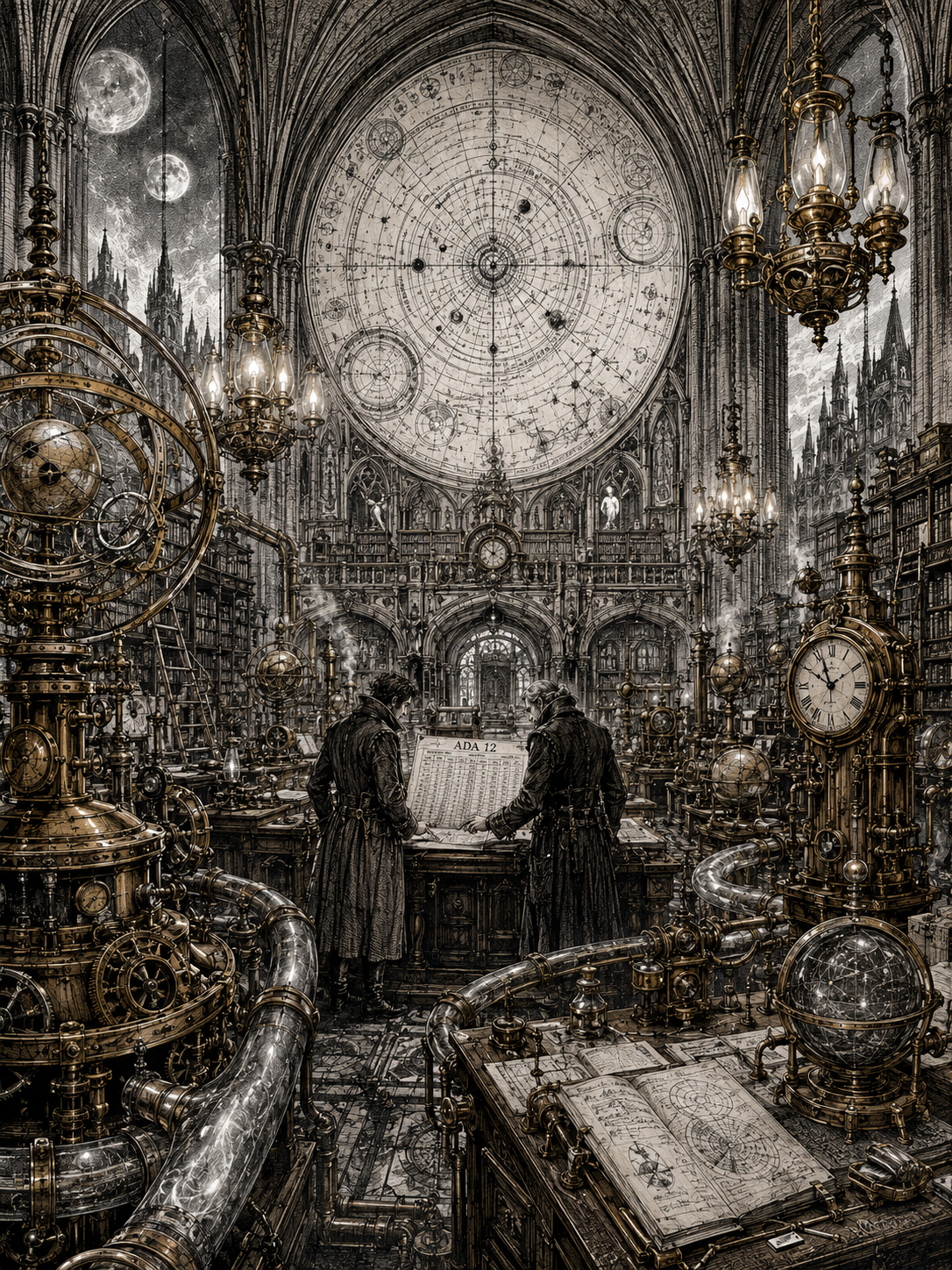
Antiterra, called Demonia in its oldest records, is the twin world: the other hemisphere of the cosmological pair of which Terra is the familiar half. It shares Terra’s continents and city names but has a different air and a stack of extra-dimensional layers; it burned out around 1901 A.D.A. and was synthesized into Sinterra.
| Type | Place (world) |
| Other names | Demonia; the Twin World; Mundus alter et idem |
| Calendar | A.D.A. (Anno Domini Antiterra) |
| Documented span | 270 A.D.A. – c. 1946 A.D.A. |
| Spanish entry | Antiterra |
Description
Antiterra is neither a colony nor a parallel dimension in the weak sense. Its continents are Terra’s, and its historic cities bear the same names (Alexandria, Florence, Paris, Prague, Shoa). Some travelers have crossed over without noticing for days. Its astrolabe spheres are active machines that turn when consulted, calculate transits and point out portals absent from official charts.
A Terran novelist, Nabokov, wrote of a twin world named Antiterra, formerly Demonia, where electricity was forbidden and the sister planet was Terra. Followers of the Decadian debate whether this was revelation or leak.
Demonic layers
The renaming did not cancel the older condition:
- Certain Roman cellars, Ethiopian catacombs and Lombard wells lead, with the right steps, to the depths of Azzagrat in the Abyss.
- The Place de la Bastille in Paris opens, under certain conditions, a portal to Sigil.
- Graz’zt walks its history under a dozen names: GRDT in Axum, Ludovico Sforza in Milan, Jack Azul by Notre-Dame, and in one unexplained variation Arcoms Cosmar, lich mage of the Seventh Circle.
- Its hells have first lords; the First of the First is Barbatos. In its heaven gods are literally nailed onto iron towers.
Four or five planes are stacked beneath the surface:
- Under the ocean: inhabited Atlantis, reached by tunnels missing from merchant charts.
- The zodiac: an activatable platform in each of the twelve zodiacal sectors, the Game of Shadows, installed in 1784 A.D.A. by agents who no longer operate openly.
- The Red Sea coast: Broken Reach, portal-fortress to the triple kingdom of Axum.
- The great catacombs, Paris’s the best known: entrances to the infernal Abysses.
Society and church
After the 19th-century wars, France fell under a uchronic viceroy, an office of English making held in Paris by Lord Gaul, whose coats were red as devils are red. The aesthetic is mystic steampunk: electricity is forbidden (for political and theological reasons, upheld by the Decadian’s theologians and the English governments), steam trains and paddle-wheel boats are common, and the telephone is a rare wonder. The liberating revolution of 1901 A.D.A. ended English rule, leaving twelve avenues named for heroes, pantheons with statues and no resurrection, and triumphal arches where crowns once stood.
The dominant church is a syncretic Gnostic Christianity with Manichaean, Neoplatonic and Coptic strands, divided into auditori (laity) and electi (ascetics). Roman Catholicism survives only as a minor sect in some Swiss cantons, a strip of Ireland and two parishes of Rome. Its head is the Patriarch of Glastumville, whose city is on no official map yet is reached by the pilgrims who need it. The theology of the Temple of Pelor fits its scheme; the great devils have hidden solar faces; contradictions are left unresolved.
History
The archive entered Antiterra through bands: the Boreals from Diamond Lake; the Australian journey to Sydney (alchemists’ quarter, dragons under partial imperial autonomy), prelude to the Deep Ones, Atlantean anarchists of 1888 who mapped the layers; and the Regulators, who carried the final cycle.
Key dates: 270 A.D.A., founding of Alexandria in Antiterra (gesta of Khalim); 1880, start of the cycle’s programmatic mythology; 1888, the Regulators activate the zodiac platforms; 1900, GRDT’s domain founded in Shoa; c. 1946, a speculative future of the Regulators as agents of time.
Around 1901 A.D.A. Antiterra neared the Band of the Dissolution, the line where a world can no longer hold against its twin. Paulus, the Regulators and the Cakravartin foresaw it. The final arc brought the Eiffel Tower Tournament, the attack on Notre-Dame, the fall of Barbatos and the nailing of Seth onto the Tower by Faragod, God of Lightning. Antiterra burned entirely. Paulus witnessed it in literary guise and died in the archive as Paul Claudel. What followed was Sinterra; Uchronic Paris, its churches turned into libraries by Paulus, became the membrane where Terra and Antiterra were sewn together for the last time.
Graz’zt’s survival
Graz’zt outlived Antiterra, though diminished by Maleika in Ethiopian Antiterra, beheaded by Faragod’s sword, expelled from the council and defeated at Notre-Dame. During the last battle he hid himself in the world of Vala, in the valley of Ardi (“where the arrow falls, where it is decided”), in the proto form Ardipithecus, the abyssal ancestor from before the split of man and demon, and waited as a chrysalis. The paladin Valerius Utrecht unknowingly brought him back in a later cycle.
Time
A.D.A. runs parallel to the terrestrial count but cannot be converted mechanically. Paris is a crossing point of times where time travel is routine for those who operate the zodiac platforms or come from Sigil. Twelve-year cycles mark periods of liberation and reorganization. The Great Khan, lord of Tartary, is a resident demon.