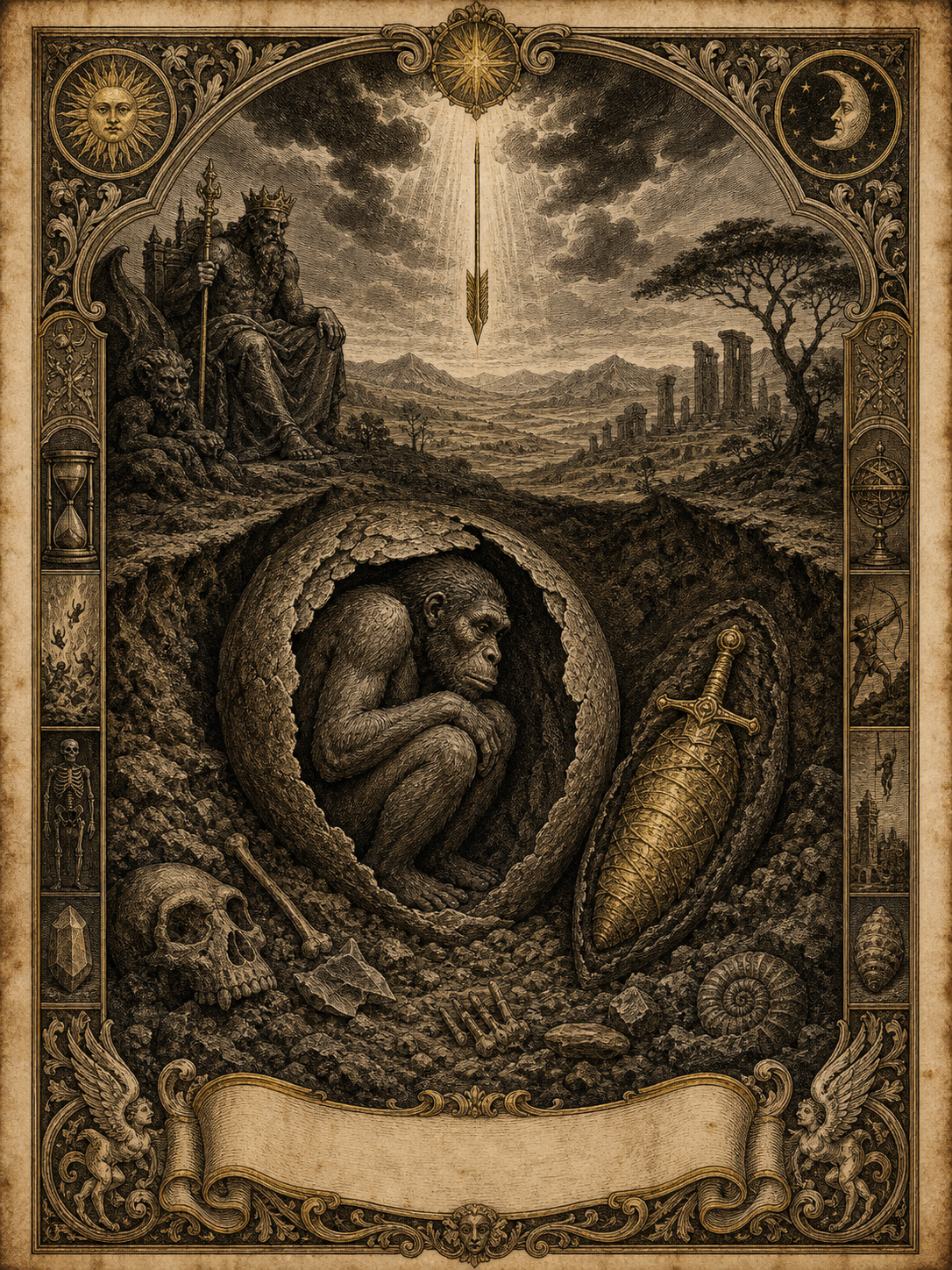
Ardipithecus is the most ancient and hidden form of Graz’zt, a primordial ancestor from before men and demons were distinct. He hid inside the companion sword of the paladin Valerius and emerged as a giant ape from a black chrysalis in the Palace of the Prism after the Hiatus.
| Type | Entity (proto-form of a demon prince) |
| Identity | Graz’zt in proto form |
| Container | Valerius’s sword |
| Emergence | Circle of the Palace of the Prism, after the Hiatus |
| Spanish entry | Ardipithecus |
Name
The archive reads the name as “the ape of Ardi”, where Ardi means the place of the arrow, where the arrow falls, where things are decided — the same element as in Ardisvala, the valley of Vala. The fossil hominid of that name is dated to 4.4 million years; Ardipithecus ramidus was unearthed in Afar, Ethiopia. That is the soil where Graz’zt reigned as Geredet between AD 200 and 230, founded a domain in Shoa around 1900 A.D.A., and was diminished by Maleika.
Nature
He has three faces:
- A proto-human ancestral form, before the separation of man, ape and demon.
- Graz’zt in his oldest, most hidden aspect, which the prince does not admit in council.
- A self-chosen proto-guardian: he was not banished but chose to hide. In Decadian cosmology the banished return for revenge; the hidden return by plan.
His emblem is the phoenix, not the dragon. When Graz’zt was diminished in Ethiopian Antiterra, he kept his knowledge and lost his strength. Meanwhile he hid his proto form in the companion sword of a paladin not yet born, waiting for the wish that would bring him back.
History
The sword
Valerius, paladin of the Scar of the Sun, asked for a sharp sword that would bleed acid, the attribute of Graz’zt’s own sword. The wish was mediated by the demonic creature Labresu. The sword was delivered and Valerius carried it for years. It held two occupants: a clone of Arian, the work of Rudishva intelligences on the oldest history (possibly RAJ-750 or Akala), and Ardipithecus himself.
The emergence
In the circle of the Palace of the Prism the Seekers of Ardis Vala faced a demonic emissary — Labresu or an agent close to him — offering to return the sword and the key to the Midnight Circuit. The sword spoke: «Hacete de mí, deshacete de mí» (“Take me, get rid of me”). The group threw it out of the circle; it crossed the prismatic barriers and petrified halfway, suspended in the air. A black chrysalis of pulsing matter began to grow.
A brain-rat emerged first, a lesser manifestation, and asked them to let him out: «Él es el ancestro primigenio. Es el ancestro de los hombres, de cuando no había diferencia entre hombres y demonios» (“He is the primordial ancestor, the ancestor of men from when there was no difference between men and demons”).
A gigantic ape-like figure with a five-pointed star above it came out. There was no battle and no pact. He turned to the man who had carried the sword, said “thank you”, and left: he broke the door, ran over the arriving guards, left a trail of blood and two dead acolytes, took some rags and a staff, and threw himself down the shaft to the Midnight Circuit, where those who took all the lower levels nest. The pontiff concluded that the released demon is the key to the deepest level, since he fled there.
Afterward
He remains at large. The Custodes Oculis Solis mention in passing a primordial who escaped from a sword down a shaft. The Seekers never saw him again; when they fell in the mausoleum, he was still below.
Conflicting accounts
- Decadian theologians and some Sortian heretics read the five-pointed pentacle at the center of the Abyssinian flag as the seal of the Proto-Guardian, its points being the five eras Graz’zt crossed in that land: the ape era, the Axumite era (GRDT), the diminishment, the hiding in the sword, and one not yet named. Modern republican theologians would reject this.
- The equivalence of Ardi (place of the arrow) and Ardipithecus is rejected by some doctrinaires on etymological grounds; Arkos upholds it.
Open questions
- What he is doing below is unknown.