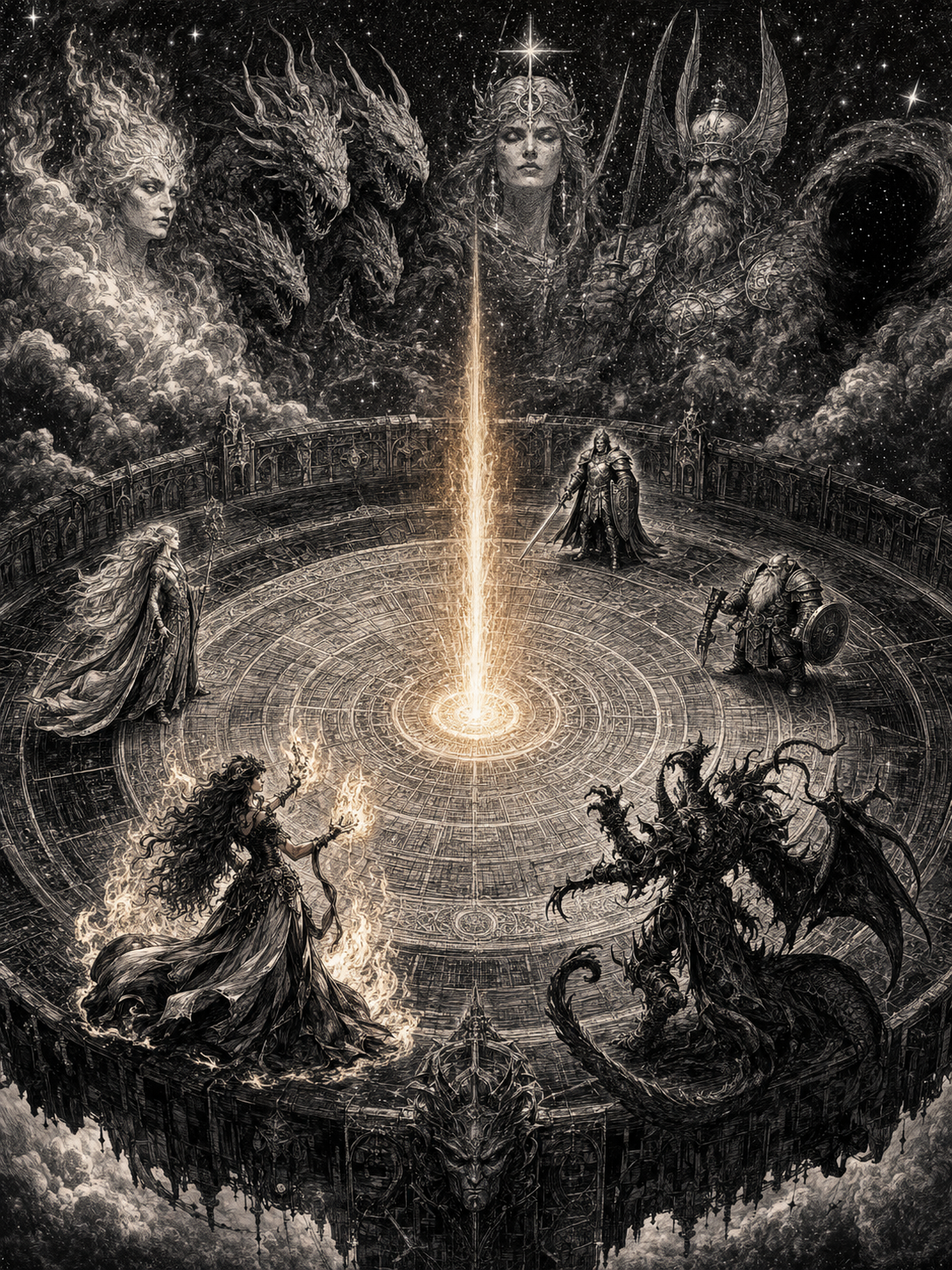
The Contest (la Contienda) is the supra-divine council in which four powers, through five representatives and before three judges, disputed control of the entire Multiuniverse. The betrayal of the judge Graz’zt derailed it; the representatives were thrown a thousand years into the past and returned in 1353 D.R., sixteen years before their departure, leaving the council forever unclosed.
| Type | Event (council) |
| Powers | Kosuth, the Dark Queen, Mystra, Helm |
| Representatives | Arian, Maristo, Minborgen, Cloeh, Tii |
| Judges | Ao, Sumo, Graz’zt |
| Return | 1353 D.R. |
| Houses of the Cycle | ⏳ House of Carnal Time · ✒ House of the Chronicler |
| Spanish entry | La Contienda |
The council
At stake was control of the whole Multiuniverse. The assembly met outside mortal geography, at an unnamed place. By old rule, each major power sent a representative who spoke with its voice; what the representative won or lost, the power won or lost.
The four powers
- Kosuth — elemental, primordial tyrant, a force prior to forms; represents the cosmos without a subject.
- The Dark Queen — mother of the five faces, partially beheaded, tyrant of the thousand years to come; represents the totalitarian order that emerges from the first Chaos.
- Mystra — goddess of the Art, sovereign of magic, mediator between the possible and the real; represents creation that allows doubt.
- Helm — God of the one true religion, soldier of manifest order; represents faith that does not negotiate.
The asymmetry is deliberate: two extremes (Kosuth, the Queen) and two middle terms (Mystra, Helm), designed so the middle terms would arbitrate.
The five representatives
- Arian, for Mystra — the 25th sun, of the first noon; a bodhisattva by trade who had already danced with the Queen and cut off one of her heads. His mandate was to defend what he himself had violated by making a pact.
- Maristo, for the cause of God — “the one who must be killed”, in the formula the assembly assigned him. He was named on the implicit condition that his victory would undo him.
- Minborgen, for Helm — soldier-priest of the faith that does not negotiate; the least elegant voice, which won through stubbornness.
- Cloeh, for Kosuth — voice of the cosmos without a subject, representing what cannot be represented.
- Tii, for the Dark Queen — human avatar of totalitarian order, a widow in black who knew the assembly from inside because her cosmic mother had been partially beheaded in an earlier round.
The three supra-divine judges
- Ao — judge of the greater laws, voice of the cosmological order preceding the powers.
- Sumo — judge of measures, voice of equivalences: if one power wins, another loses the equivalent.
- Graz’zt — the third judge, prince of the Abyss.
The betrayal
Graz’zt lodged an impugnation, which was a betrayal. The exact procedure is not recorded, only its result: the proceedings derailed and the cosmos lost its rhythm. The five representatives were forced to live adventures a thousand years in the past — a thousand counted years — falling through the chronomantic rift. The Multiuniverse entered a pause that later Decadian doctrine rendered, not quite accurately, as the greater interregnum. The betrayal is a prelude to Graz’zt’s later diminishment in Ethiopian Antiterra.
The first Paulus
A thousand years back, the five met a young chronicler: Paulus in his first form, before he had written the Eisagogiká, before his first death, before becoming chronicler of the whole archive. He was being pursued by his demonic double, later called Marcos the Mage, who would steal the Blue Book from him and become a lich in that same Alexandria. The representatives rescued — or accompanied — him. Paulus himself has not fully absorbed the temporal asymmetry of the meeting.
Tii’s abandonment
During the journey Tii abandoned the cult of the Dark Queen. Her later career — seizing power in Egypt in 1401 D.R. with Ai as consort, murdering the Patriarch, operating as a widow in Waterdeep — belongs to her own entry.
The misaligned return
When their millennial adventures ended, the heroes came back 16 years before their departure, through a misalignment in the lines of life: the year of return was 1353 D.R. The council never ended and the heroes never returned to it. The assembly remained open, the dispute without official resolution, the representatives scattered in a present not their own. The Decadian, book eight, records the misalignment.
Aftermath
- A thousand years of the Dark Queen’s tyranny unfolded in that open period, during which she wielded dual magic, until Sol-Luna and Minaya ended it in 1375 D.R., in the late closure of the Last Judgment.
- Graz’zt acted freely for centuries; his diminishment in Ethiopian Antiterra came later, and his hiding in Valerius’s sword much later.
- Young Paulus survived the pursuit; his rivalry with Marcos the Mage was fixed from that encounter.
- Tii made a career apart from her cosmic mother.
- Maristo was indeed killed, but by a procedure other than the one the Contest foresaw.
- The other representatives returned to their geographies marked by the unclosed council.
The open council, the traitor judge and the misaligned return form the central narrative axis of the first decade of the shared cosmos. The five representatives belong to the Pantheon.
Conflicting accounts
- The design of the council: one doctrine holds the asymmetric design was balance; another suspects it was a trap.
- How Graz’zt became judge: some hold he infiltrated; others that one of the powers invited him as a counterweight; others that the office was his by cosmogonic seniority the four powers dared not dispute. One doctrine calls his presence an anomaly, another a cosmological trap from the outset.
- Tii’s abandonment: one doctrine reads it as conversion, prompted by seeing young Paulus pursued by his double; another as reciprocated betrayal — Graz’zt betrayed the council, Tii her mother. Both are recorded together.