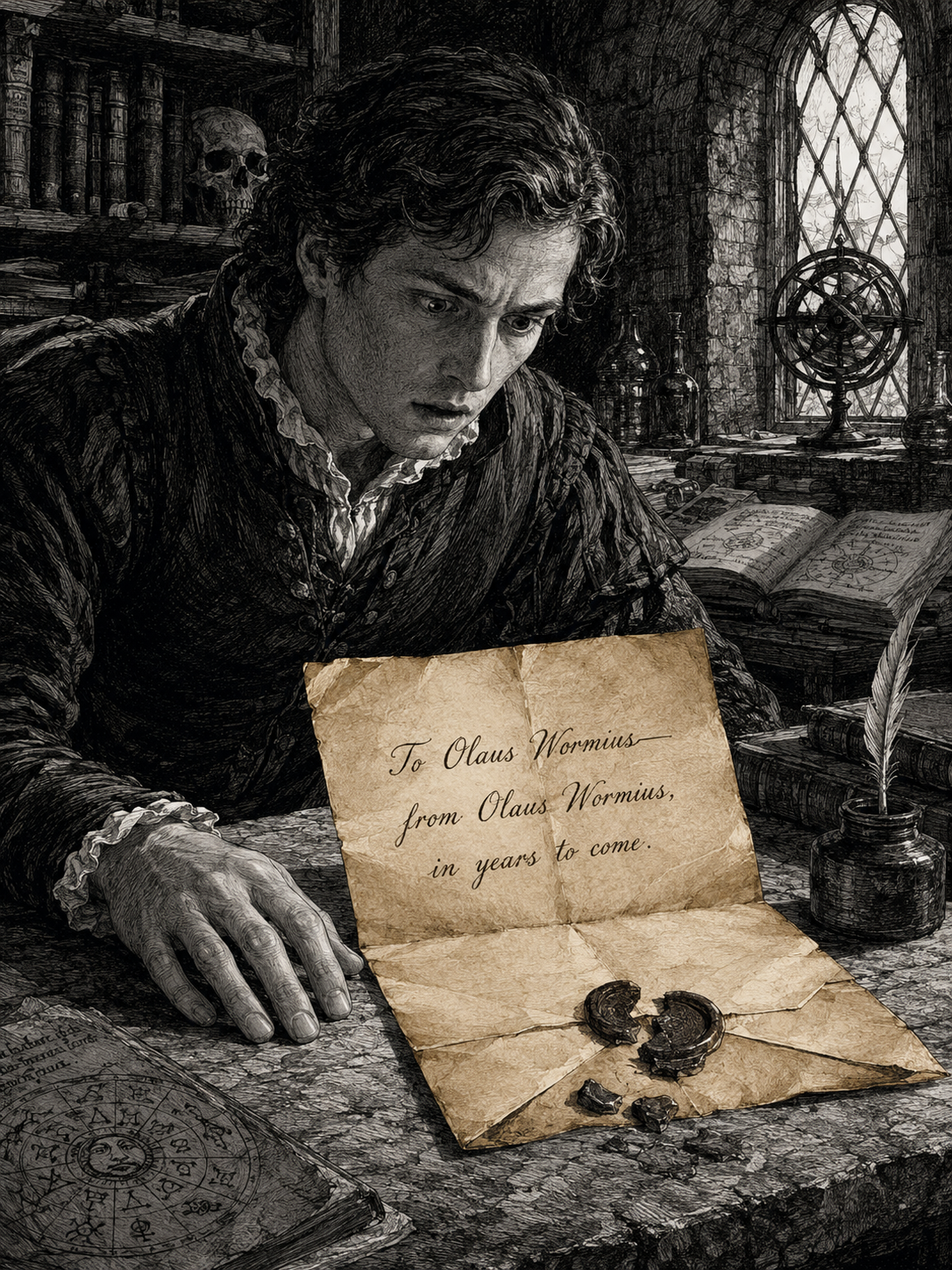
The Letter from One’s Own Self is a chronomantic letter written at one moment and received at another by the same person on different lifelines; the documented case is that of Olaus Wormius.
| Type | Artifact (chronomantic letter) |
| Known case | Olaus Wormius, probably in Constantinople (1055) |
| Spanish entry | La carta del propio yo |
Description
A stone table; an opened sealed envelope with a broken seal; a folded sheet whose heading, in sepia ink, reads: “To Olaus Wormius — from Olaus Wormius, in years to come.” The young Olaus’s hand rests beside it, just withdrawn from reading; his face shows a man recognizing his own handwriting for the first time. Behind him: a skull on a shelf, open books, a stained-glass window with a family crest, an astrolabe.
Procedure
Letters to oneself require the mediation of the arts of time; the procedure is not recorded, under the Decadian rule of not teaching the forbidden publicly. What the letter says matters less than the recognition: the recipient knows his own hand before reading the content. That recognition is the chronomantic trap — once it happens, the two lifelines are sewn together, irreversibly. The procedure applies to any cycle in which a character’s lifeline is sewn to itself.
See also
- The Sucronic Golden Thread
- Ripple Effect — side effect of miscalculated time travel
- Paulus of Alexandria — who could write himself such a letter, but has not