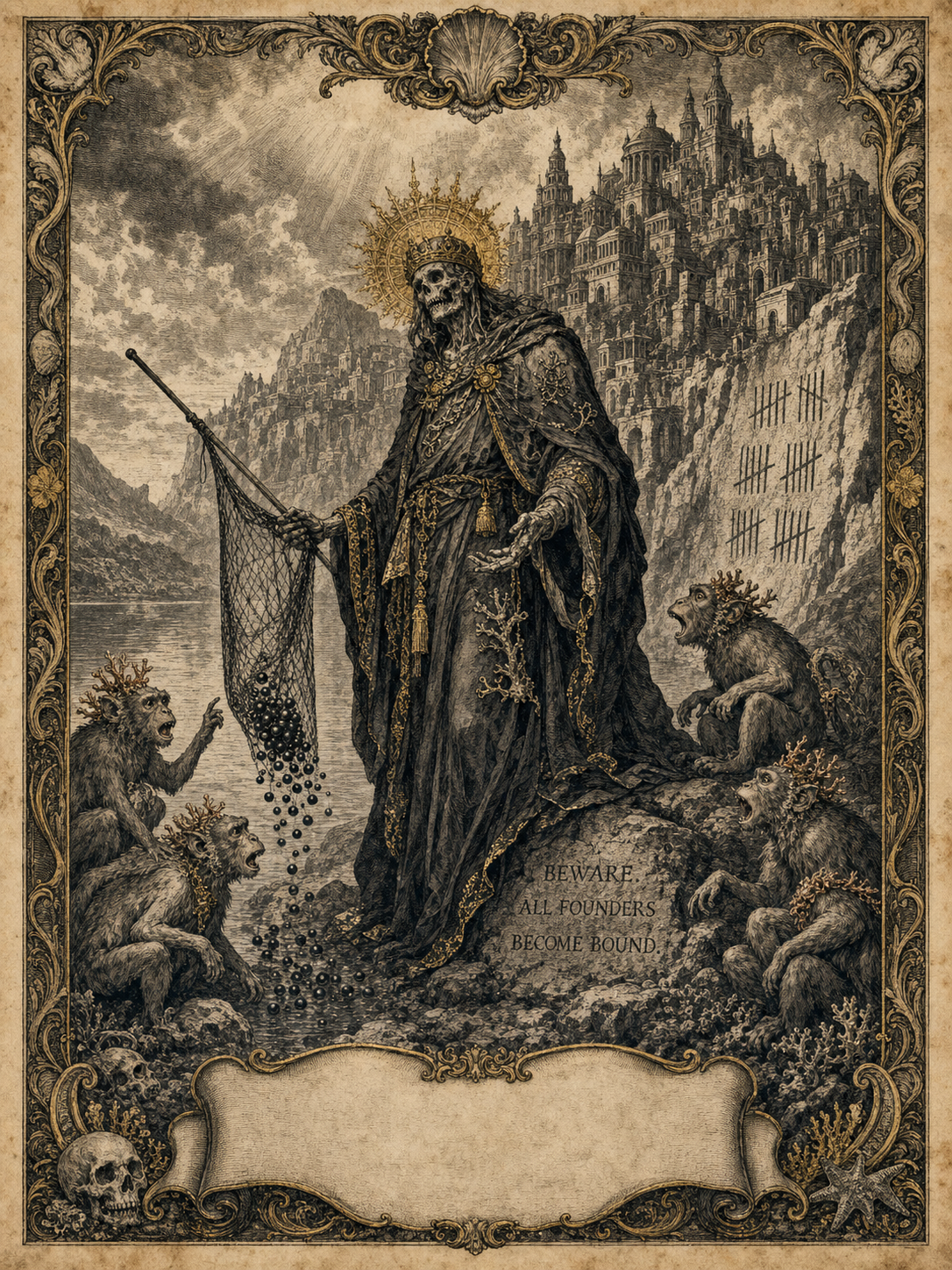
Kirios is the undead founder of a city, dead some twelve hundred years without fully dying, who is honored there by a civic cult while he marches, with an undead court, to reclaim it.
Name
In Greek kirios “means lord”, the form of address used for Greeks. Sacrifices “for the good of the lord of the place, for the good of Kirios” make no distinction between courtesy, civic deity and the founder himself. The city’s name is not given.
Cult
The cult is “mystery-like, esoteric, not serious”, practiced “with a kind of civic devotion” on a large scale. The richest citizens donate things to Kirios; ceremonies are held in the city’s stadiums (there is mention of “one of the stadiums”). The temple has its own priesthood, controlled by a blue-skinned priestess who carries out the offerings; the officiants call their rite “a pagan sacrifice”. When one stadium was destroyed (“they just blew it up”), where and how the lord is honored changed at once.
Body
There is no class of kirios: there is one, the founder. He is “an undead surrounded by undead”, accompanied by a court of his own condition. On his chest he carries a beetle-shaped magical trap, so whoever approaches his torso meets the device first. He is allied with a faction that will help him recover the city, and has already fought alongside them against others.
Barbatos “has been seen as Kirios’s teacher”.
Open questions
- Whether the priesthood knows that the recipient of its sacrifices walks.
- What is sacrificed, how often, and what is done with the donations.
- Which faction marches with him, whom they fought, and who now holds the city.
- The priestess’s name (some murmur Marta, unconfirmed) and whether her blue skin marks a people, an office or a condition.
- How the beetle trap is triggered, what it does, and whether it can be disarmed.
- What Barbatos taught him, and when; his face, size, dress and state of preservation.