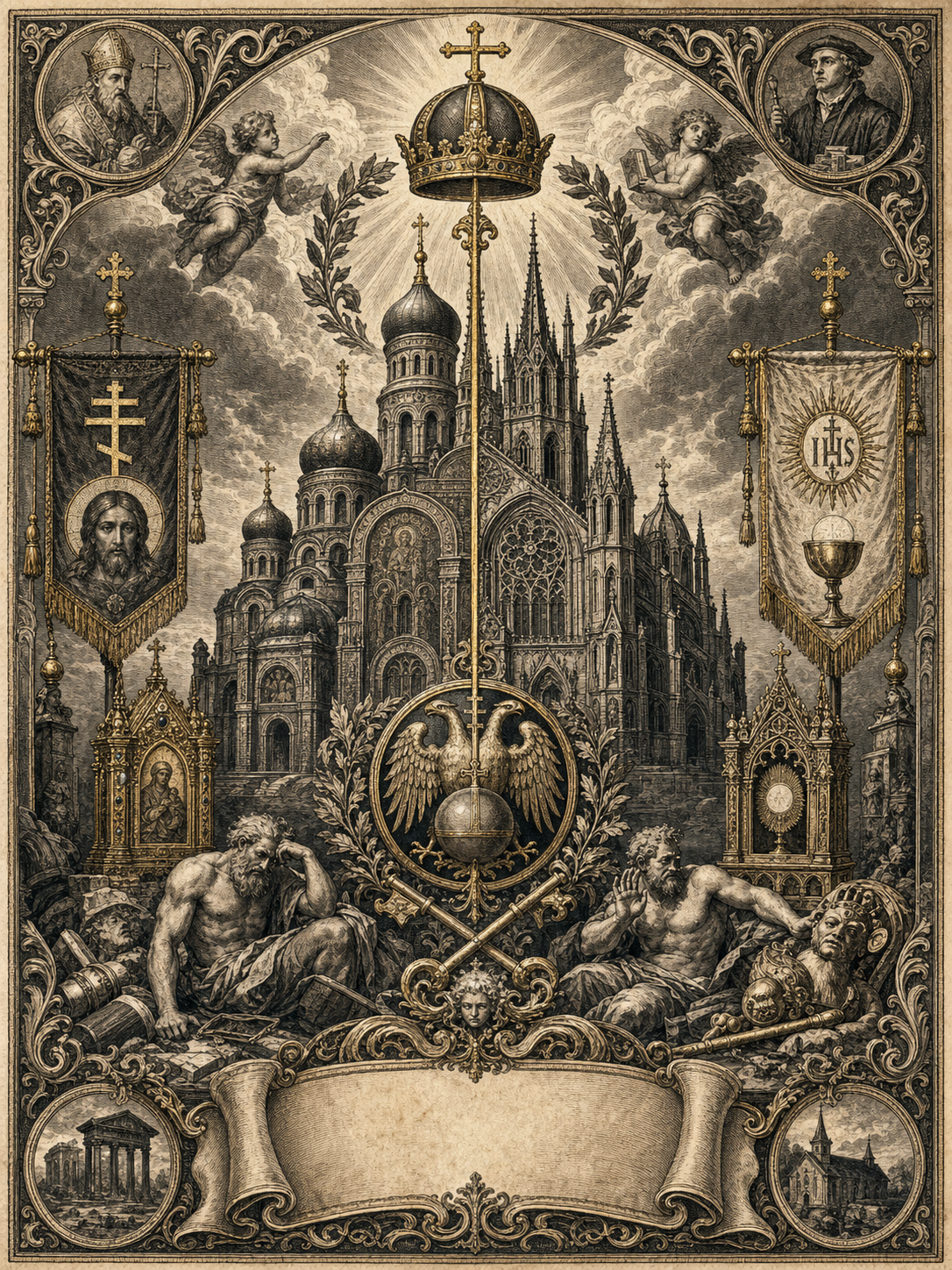
The Imperial Church is the official religion of the Archontean Empire in the World of Archontos. It venerates the Ten New Gods of the Decadian Orthodoxy, which replaced the old Twelve; its unity is one of apparatus, not of doctrine.
| Type | Organization (state church) |
| Other names | Imperial Orthodox Church; Decadian Church |
| Seat | Great Basilica of Archontos |
| Head | The Primarch, appointed by the reigning Basileus |
| Spanish entry | Iglesia Imperial |
History
- c. 1900 AEP — Magical Schism in the clergy of Thoth at Ardisvala.
- 1775 AEP — the War of the Sortians and Theosophists, magical in origin, becomes a general religious split and ends militarily.
- c. 1700 AEP — the Decadian reform (decadianus, “of the Ten”): the Twelve gods of the first Empire are replaced, reinterpreted or absorbed by the Ten.
- c. 2400 AEP — after the civil war, Drusus V imposes theological peace: he opens the Order of Thoth to anyone with magical talent and ends active persecution of the Theosophists, provided they do not organize institutionally. The peace holds, with tensions, into the reign of Basileus Drusus IX.
- 2639 AEP — the imperial reoccupation of Irthuin reopens the valley to Decadian worship.
The Ten
| God | Function | Relation to the Twelve |
|---|---|---|
| Asterion | Daytime sun, imperial justice | Possibly a synthetic aspect of Mithra |
| Nemea | Wisdom, archive, law | Female aspect of Thoth (Theosophists); a reformulation (Orthodoxy) |
| Zahon | Redeeming death, passage | Replaced the old Horus of the Wiskin people |
| Sutekh | Secrets, measured shadow | Possibly Set in disguise (clandestine Theosophists) |
| Mithra | Riding sun, oaths | The only one of the Twelve explicitly incorporated |
The other five are known only to the higher clergy; the full list is kept by the Primarch.
The doctrine is universalist and moderately reformist: “The Ten see every subject of the Empire without distinction of birth.” In the Schism the Orthodoxy sided with the Sortians, and some senior bishops still privately honor the Sortian martyr Priscus Pulcher.
The Twelve: the Old Faith
The Old Imperial Faith (Theosophist cults) venerates the original Twelve. Known members and their status: Thoth (knowledge, writing, magic; partly tolerated, his Order surviving under a new name); Set (night, secrets, borders; banned); Horus (daytime sky, warrior nobility; banned as tied to the pre-Schism empire); Bastet (felines, fertility, home; tolerated in rural areas); Anubis (tombs, funerary passage; tolerated); Mithra (incorporated). Of the other six, some are banned, some privately tolerated.
The Old Faith has no seat; it survives in minor, often clandestine cults (monasteries, noble shrines, Thorcin huts, rural chapels) and is the Theosophists’ lineage. Its institutional power broke twelve hundred years ago, but many pray privately to Horus at dawn, to Set at nightfall, to Bastet over cradles and to Anubis at burials while attending Orthodox mass. The Church tolerates this until collective liturgy appears.
Present tensions
- The heresy of the Eleventh. Some Sortian circles, the Priscians among them, posit an Eleventh God who will unify all pantheons. The Primarch has condemned it twice without naming the Priscians.
- Cults of Set. Cults with black masses and human sacrifice operate in Narsileon and other provincial cities; the imperial Inquisition crushes them, but they keep reappearing.
- Theosophist-papal convergence. In the valley — Ardis Vala and the domain now called Valakhan — Pope Alejandro Sixto, on his ruby throne, works under the Decadian umbrella with a centralized authority that converges with the Theosophist doctrine of the closed spark. The Orthodoxy may distance itself from this papacy or absorb it.
The Church in the valley
- Ritornello (before its fall): the Temple of the Divine Decade, run by the fervent Father Belias; Baron Argus was a public devotee.
- Ardis Vala: ancient temples of Thoth and Set, including the Halls of Thoth and the Forum of Set, whose octagonal chamber holds the rubies of Priscus Pulcher. They are tolerated as ruins; reactivating them is condemned. Their arcane protections (hexagrams, closing spells in Mithraic) date from the Twelve and answer to the old names.
- Glastumville: an improvised chapel to Mithra and a clandestine shrine to Thoth kept by mages of Sir Glastum, with the warden’s silent tolerance.
- Valdemora and Estellara: local worship answers to the Pope at the Palace of the Prism, not to the metropolis; the split between central and papal Church begins there.
Conflicting accounts
- The Orthodoxy holds that the Ten and the Twelve are distinct. Clandestine Theosophists whisper: “Los Diez son los Doce disfrazados, aún con nosotros” (“The Ten are the Twelve in disguise, still with us”).
- The Theosophists are called victors militarily but defeated doctrinally; Set is also tied to “the defeated Theosophist side”.
Open questions
- Whether the Church is one institution or already two sharing a name: the Primarch and the Pope recognize each other in liturgy, but neither submits.
- The identity of five of the Ten and six of the Twelve.