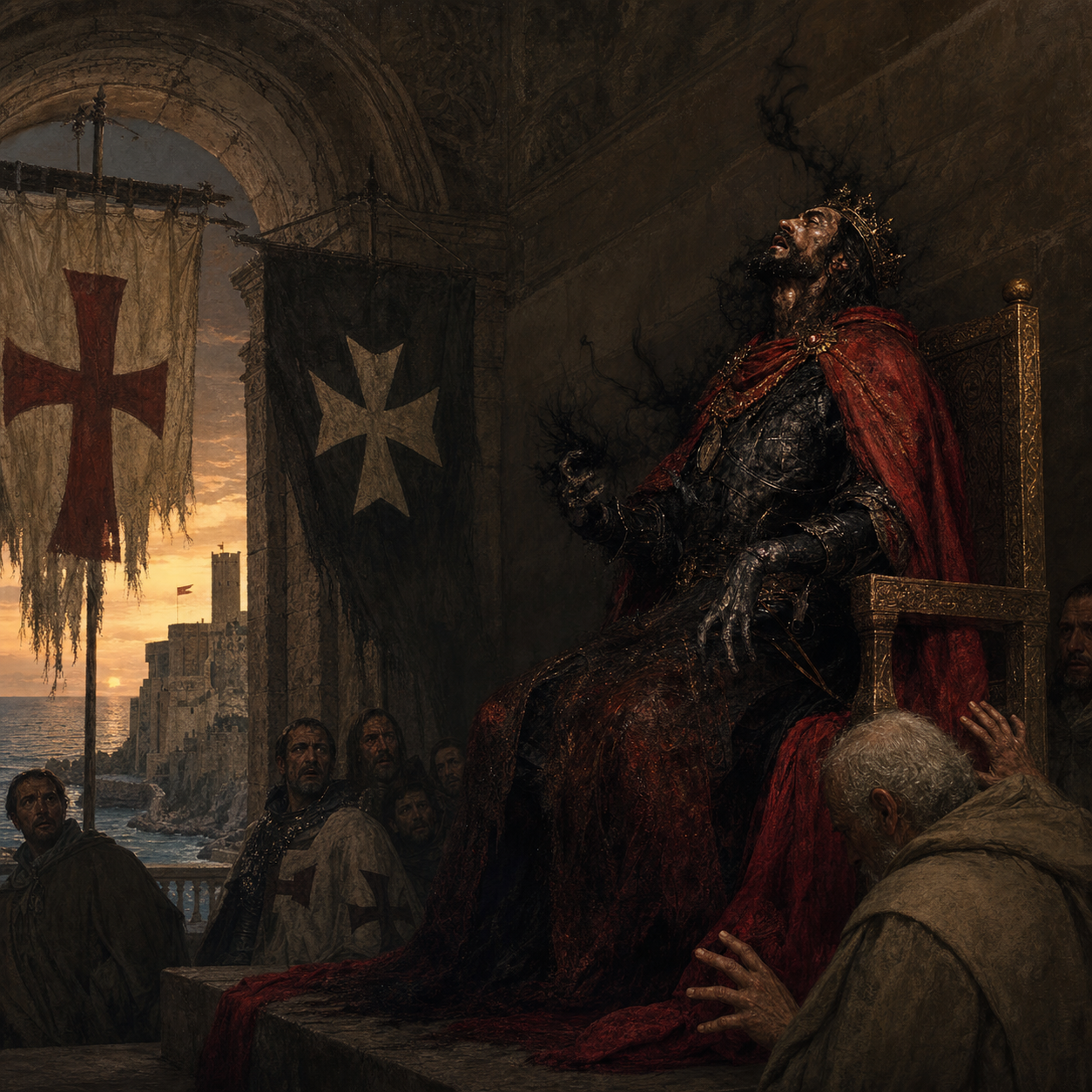
Cyprus, the Island of Copper, is the last Christian bastion of the eastern Mediterranean around 1300: a center of trade, ruled by the Lusignan family, where the last Templars and Hospitallers have retired. Everything beyond it, including Jerusalem, has been taken.
| Chronicle | florenzen |
| Rulers | Lusignan family |
| Spanish entry | Chipre |
Description
From the West one sails via Genoa and Sicily, then ten days by ship. The coast is “strange, beaten by winds and a storm”; even in autumn a hot wind blows from the shore. The interior is mostly forest (“70 %”). At sunset the shadows stretch east, long and with “something red”. The ancients called it “the place of Aphrodite”.
Port and city
The quay holds sixteen ships, but only eight are there. The island is “one of the safest places at this moment”. The city has a four-story tavern and Genoese and Venetian bankers seeking a trade route to the Holy Land. Trade is large enough that some Muslims come; they may not practice their faith freely, but are not forced to convert.
Arwa lies about 200 km away by sea, across currents where “you will probably get killed”.
The population includes Ethiopians, Greeks, Orthodox, Latins, Franks, Germans, and the descendants of Logodo.
Castle and king
The castle runs from the barbican, with murder holes for oil, inward past alcove and throne to near a hall of wonders. The Lusignans, descended from the Poitiers, hold a double crown: kings of Cyprus and of Jerusalem, “only Jerusalem is taken”. The king is “somewhat irascible at the least, and perhaps even ill”, and has dealings with the Pope. Only those he deems worthy may bear arms; any expedition must be negotiated with him.
Conflicting accounts
- In one account the irascible king and the king of Jerusalem are a single person.
- Another speaks of a separate “former king” living on the island.
Open questions
- The names of the city and main port, and the contents of the hall of wonders, are not recorded.
- The name “Logodo” may have been misheard.
- The destination and owners of the eight missing ships, and which faith (Orthodox, Muslim or both) may not be practiced freely, are not stated.
- The 70 % forest figure is uncertain.