This name refers to different places in 3 worlds; the versions are not merged.
Paris is a city in three worlds of the Archive: in Antiterra, the first chronal city and nexus of the universe; on Terra, the capital of France in 1648; in Vala, a city found in several states depending on the era.
Antiterra
Paris lies on the curves of the Seine. It is “the center and nexus of the universe-world”, “the head of the universe”, “the first chronal city”: it exists in several epochs at once and “must not be invaded”.
The upper city
The city is gigantic, ringed by walls (gates closed at night), ditches and windmills. The surroundings “have something volcanic”. The mills feed the city; on its edge, farmers who shun its corruption traffic in cold iron. Notre-Dame stands on the island that was first a fort of “those who were the Paris”.
Inside: a shoe district, a place of paintings, the Les Halles markets (12th century, later demolished), eastern quarters at “one of the ends of the Silk Road”, literally low quarters, a white semi-central square with five or six streets, five central bridges (one under reconstruction), a dump beside the theater, gargoyles everywhere. On the periphery a giant tower, the Tower of the perimeter, is lit at night, and a pyramid stands “at present”. Parisians carry umbrellas and fine long-fingered gloves. Winters bring morning mists; May is a cold thaw.
Layers of time
There is one Paris but many at once: the 11th-century city, reduced to places defensible against Viking raids; the 1717 city of alleys, without gas lighting or boulevards; the city after the Second Empire and Haussmann (“a cursed man”), of wide stone avenues and ministries guarded by riflemen; the Paris of the treaty; of the Commune of 1870 and the Opera; of 1889, with its Exposition and quarantine; of 1901; and Uchronic Paris, also París Su Crónica (“Sucronic Paris”), as opposed to “Paris Sigil”. Access to París Su Crónica “is only for the rich”. In one branch “Paris does not exist”.
Its sites mark eras: Caesar, the Vikings, Henry IV, and “the fourth time’s the charm”. Chronal authorities include the Chronal Guardians posted at the Tower, “the most watched place”, pounds that capture from other epochs, and passages that are “portals closed for now”. As “a crossing of times… and also of planes and spaces”, its Pantheon excavations, portal-passages, Tower and sewers are all accesses.
The lower city
The sewers are large because they lie beneath the old city: the Roman conduit under the coliseum of Lutetia carries sewers, aqueducts and water reserves. “Paris is a labyrinth of passages”: catacombs, marshes, thousands of galleries, clandestine coliseums, water reserves where injected ozone hovers royal blue over the water, and a geometric grotto “like an underground cathedral”. The galleries serve as route, meeting point and defense. Beneath it all a dragon guards souls and claims to defend “Paris from 1901 onward”. Three hundred years ago came “the last defense against a dragon that wanted to attack Paris”.
Order and society
The city is cosmopolitan and fond of theater, with “some state control” (soldiers, halberdiers, riflemen), yet people go armed and duel in the street. Executions are staged “like a show” behind a cordon of guards; newsboys “celebrate” killings in papers sold for a small coin.
Money: gold francs, copper centimes, silver coins, and the louis, a platinum coin. Magic items are sold at double price. The Boulevard of Crime, with a single barn-like access, shows Matías le invalide and París sin el sol; the official theater stages a “more Egyptianizing” play. There are the Malamar theater, a casino hotel, and the Grand Hotel de Paris with a telephone. Excavations use daylight only; electric light is installed last for fear of accidents. The pompiers (firefighters) are a new institution.
A body of twelve governs: “the twelve houses”, “the twelve clubs”, “the twelve gods that govern Paris”. Republicans and royalists clash; there are clubs, a popular senate, strikes put down by police, Irishmen in the bars of the Turbigo, and Peaky Blinders mentioned in a tavern. The university’s libraries “were emptied”. An embassy of devils is “older than the city, at least in this edition”. Verdict on its corruption: “maximum rot”.
Sacred sites and seals
Notre-Dame began as a fort; it holds “a treasure that goes downward”, and its rose window “has 24 signs” and twelve opposites; it saw a past act of violence and stands empty in 1889. Lirio was there with the company. The Pantheon, the oldest monument, is a Roman-era dig; the uchronic foundation starts from its ruins. The founder is said to be the Etruscan, “approved by Napoleon”, speculatively linked with Alexander and with Paris of Troy, who arrived “after leaving Troy” with the Phrygian cap.
Seals must be set at “seven neuralgic points”; if all are set, the city will be stirred as never before. The Sucubina ordered six or seven things planted across Paris. Paris hosts the Great Tournament (the United States, Notre-Dame, the Devils, “the shadows of amphibians”, Seth, the Tarrasque, the Great Khan, the Invisibles). Treaties are signed there; the English were forced to sign, and the weapon’s area of effect reaches “all France”.
Two years after the event it is “a chronal capital”, larger and richer. Around 1889 it holds 1,825,000 people; during the siege, “two million” endured hunger and disease for “a couple of months”. The Regulators liberated it in 1889, and companions were among “the first liberated of Paris”.
Routes
Walking around the city: three and a half hours. Versailles: 20–30 km. A train leaves at 18:06, near Cartouche’s tavern. German border: three to four hours; Metz lies halfway to Nancy. Bucharest: “72 hours” by train via Stuttgart, Prague, Vienna, Switzerland, the Tyrol and Romania; five days via Budapest; one or two weeks overland. Chained teleports reach Poland and Prague. Lafayette set out for Paris with the ships.
Conflicting accounts
- The founding hero came from Troy with the Phrygian cap; elsewhere he “was defeated” and is “a eunuch” depressed in the library. One man or two is not stated.
- December 1889: in one version Paris is already empty, razed and windswept, inhabited only by “shadows” with umbrellas; in another it is under a fading quarantine, and people dare to open up.
- Some hold that the city “exists outside time, in 1901”; others hold the dragon’s vigil from 1901 onward.
Open questions
- What distinguishes Paris Sigil from Uchronic Paris, and what the branch without Paris means.
- Whether the twelve houses, clubs and gods are one body or three.
- Which are the seven neuralgic points; what the “Pact of Paris” contains; the parties, clauses and date of the treaty.
- Where the Dark Alley is; who “the one-eyed man” was; who Gras, Tel and Henry in the Cathedral are.
- No map: no districts, no relation between wall, aqueduct and ring road, no gallery exits.
Terra
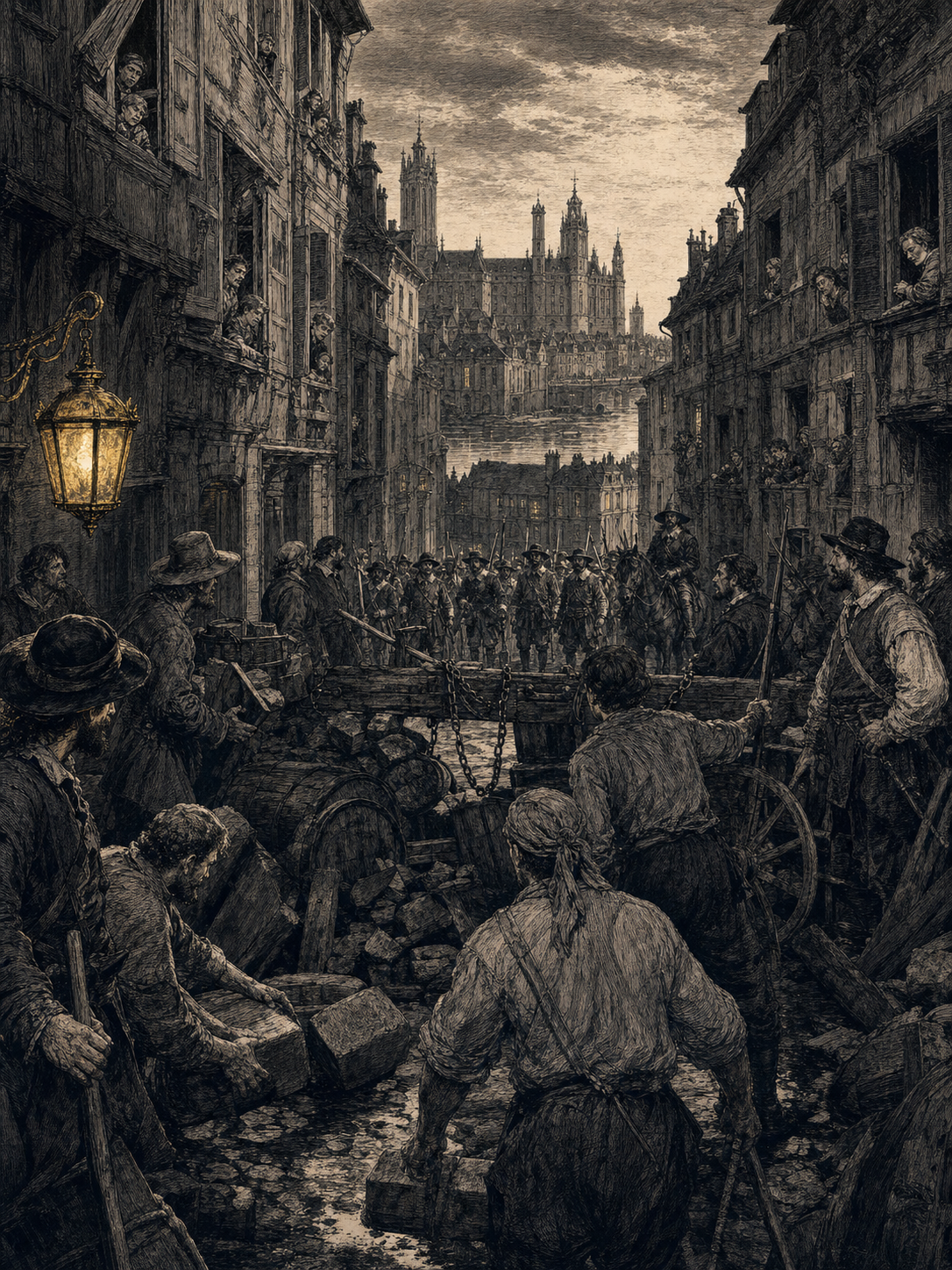
On Terra, Paris is the capital of France, “the city of lights”, for centuries the most populous city in Europe. All the Archive records of 1648, January to June, happens there; hunger, revolt and fire drive events.
Walls and city
A fortified wall ringed by windmills has huáscares (taken to be bastions or towers) at the gates; some gates are customs posts. The Saint-Denis Gate lies north, near Montmartre. One enters by the gates by day, by the river with the Seine gondoliers, or by smuggling at night.
Inside: old alleys or sewers, crowded reeking low quarters, fishwives, a bridge of Henry IV with a statue on the “Plaza de Orquín” (spelling uncertain), and the Latin Quarter of copyists, scribes and students. Glass is uncommon. At night there are at most a couple of torches. January is cold and rainy; winter brings sticky mud. Food is short.
“This is a hierarchical world”: birth sets one’s prospects, and dress declares it; good shoes mark nobles. Men wear cape and hat. In speaking, a sixteen-year-old girl need not speak and soldiers, held licentious, speak last. People drink wine, not beer.
The superintendent oversees all districts. Intendancies are sold: twenty-five instead of twenty-four, at half price, because an intendant “turned up dead”. There is an Archbishop of Paris. Queen Anne of Austria reigns; before her, Marie de Medici. Corneille, Molière and Richelieu are among the city’s learned.
Militias and the Fronde
Each district raises a bourgeois militia; some quarters resist “like the Italian quarters or the mafia”; twelve courts are closed to the police. During the Fronde some upper strata allied with “the populace”. The Prince of Condé’s regiments were called from Catalonia. The Parliament kept resisting during June’s fragile peace. On the afternoon of June 11 (or 10; the records disagree) the streets are still restless, and “all Paris is partly burning”.
Outskirts
Outside the wall the Seine bank is muddy; “the river counts the dead”, and refuse is dumped there. An inn and a tavern lie within a day’s round trip. Vincennes is “farther”, but not far. There are no mountains nearby, unlike the Languedoc. Javier is 560 km from the capital; some point was said to be “ten kilometers, not impossible”.
Open questions
- Between which points the ten kilometers run; the distance to Vincennes and the time to the tavern.
- Which and where the twelve courts are, and who controls them.
- Which plaza “de Orquín” and which bridge of Henry IV are meant.
- What “morinos arrejos” and “cuadrantes de líneas” mean; whether “jacarandú” names alleys or sewers.
- The number of districts and militiamen; the population figure; gates other than Saint-Denis; the customs tariff.
- Whether revolt, fire or hunger triggers the others.
Vala
In Vala, the route confirmed by more than one source is: enter by the Champ de Mars, follow the river rather than the street, and arrive at Notre Dame. These three points survive every state of the city, which is recorded as:
- partly petrified;
- in a vision, “much more devastated. Half apocalyptic”;
- the Templar-era city of the 14th–15th centuries, with “temples and medieval structures”;
- París-Sucronia, dated 1900;
- Uchronic Paris, “the world where possibly time does not exist”.
In the infernal variant the waterway is “River in infernal Paris”. In pre-collapse Antiterra there was a moment “when Paris had been elevated to be sigil, or could be”: Sigil by elevation, not by nature. The Regulators of Paris have custody of the city; their only recorded act freed it “from Lord Gauss and others, precisely the diabolical presence”.
Under the same name, unconnected to the city, is the son of Priam, king of Troy, cast out as a shepherd and called at sixteen to judge the goddesses’ contest, with Hermes warning “you cannot excuse yourself from this”.
Conflicting accounts
- Whether the states are one city at different moments, coexisting versions, or different accesses is disputed.
- Whether the elevation to sigil was achieved or only possible is left open.
Open questions
- Which part is petrified, why and since when.
- Whether the devastated Paris of the vision belongs to the world or to another plane.
- How one passes between the Paris of 1900, the Templar, the uchronic and the Antiterran city.
- Who Lord Gauss and “the others” are.
- Whether the city and the shepherd share the name for a reason.
- Beyond the Champ de Mars–river–Notre Dame axis, the city is undescribed.