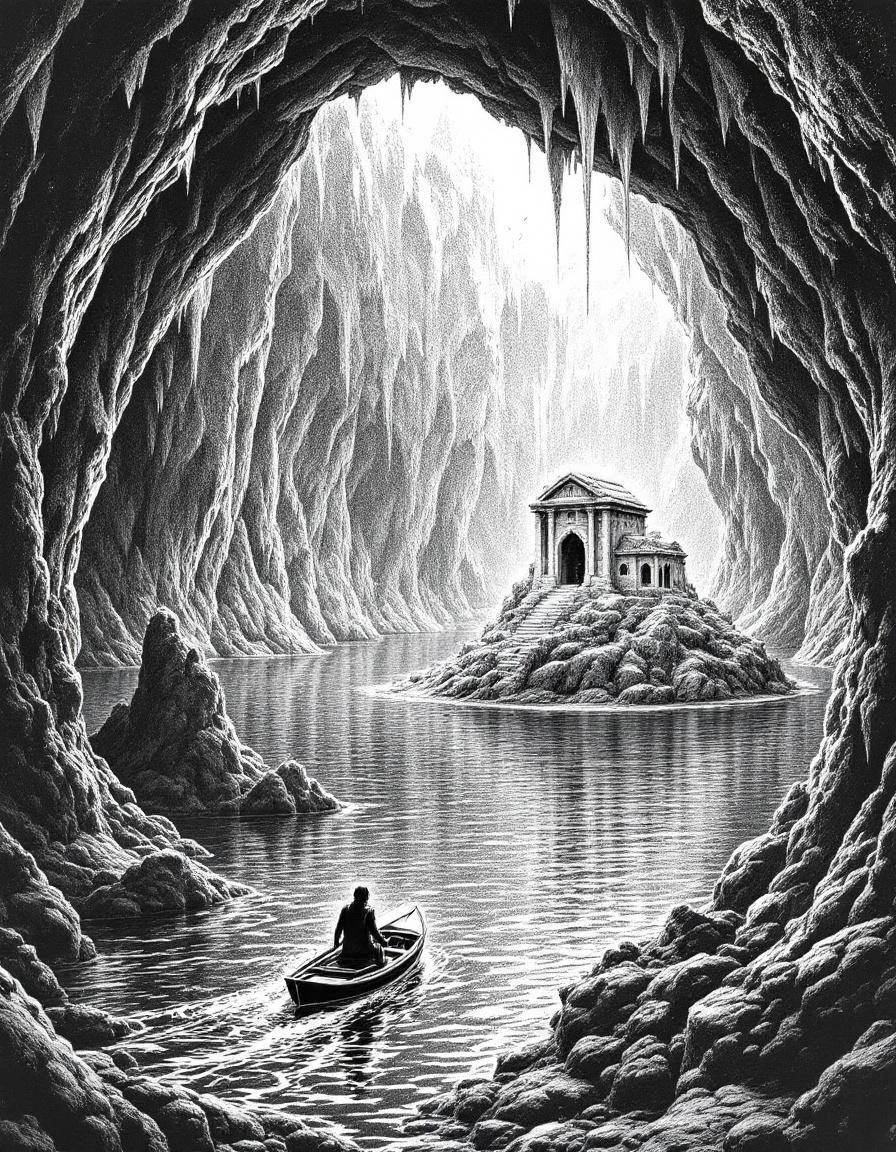
The Palace of the Prism is a flying fortress of gem-colored towers that serves at once as a place of trials and as the prison of an ancient elven lord, older than the vampires. In the present cycle it is the seat of Pope Alexander VI, anchored over Ardisvala.
| Type | Place (flying fortress, prison) |
| Ruler | Pope Alexander VI |
| Guardians | Maruts; Custodes Oculis Solis |
| Spanish entry | Palacio del Prisma |
Description
The castle is “a flying fortress, probably magical, full of towers of different gem colors”. It appears over different geographies as cosmological need requires; some records place it over the Uchronic Mediterranean in shifting positions, and it was never fixed on a map. It has three functions:
- Fortress: mobile, with gem towers.
- Seat of trials: legal tests, psychological daemons and encounters shaped to whoever enters. Those who seek to take the Order of the Scar of the Sun “without more violence” come here.
- Cosmic prison: it holds an ancient elven being, a former lord of vampires, guarded by the Maruts, entities of maximal lawfulness. The trials are the containment mechanism: whoever passes one sustains the prison another day.
The circle and the three colors
At its heart lies a pentagram inside a circle, with three prismatic barriers:
- Green (the horizon): light damage.
- Yellow (the sun): serious damage.
- Red (blood): deadly damage.
Whatever crosses all three is petrified; bodies thrown out of the circle come out as stone. Arcane manuals say specific spells can pass each layer.
Green, yellow and red are also the colors of the flag of Abyssinia, whose seal, the Abyssinian pentacle, is the center they turn around. The identification is a thesis of the chronicler; the Custodes confirm it by silence.
Inhabitants
- The librarian: a friendly, seasoned human wizard with dark stains on his writing hand, who records names in an open book and serves the Pope.
- The Custodes Oculis Solis: humanoids of solidified golden light, featureless gold faces, breastplates bearing an imperial eagle holding a sun-eye. They appear beside visitors who misbehave and destroy anyone who forces the circle.
- Arkos: the clone of the Plata, the Pope’s wizard and scribe, with something like ink on his left hand.
- Argus: a fallen paradigm and ranger, whose body Ardipithecus uses on emerging from the companion sword. The prism cannot absorb him.
The ruby throne is occupied by Pope Alexander VI, who never rises from it to receive. Its style evokes the misty dominions and the ecclesial front of the earlier lord, Strahd, whom some records take as peer and others as mirror.
A minor branch of the Library of Thoth is kept in one of the great halls, run by librarians awakened to guard it. Its shelving bears the trace of Al-Mital.
History
- The same prismatic flying fortress appears in other cycles: in the first chronicles of the shared cosmos, in the Caldero, in the Schism of the Underworld and in the Templar run.
- In the first cycle of the valley it held the trials to take the Order of the Scar of the Sun; Numa Pompilius was corrupted.
- During the Fifteen-Year Hiatus it harvested its three colors in silence. Sir Sixto, lost below, emerged as Pope Alexander VI.
- On their return after the Hiatus, the Seekers of Ardis Vala fell into the pentagram through a trap triggered in the Sunless Citadel. The barriers closed and left them between circle and throne. They met the librarian, Arkos, the Custodes and Argus, and were brought before the ruby throne; their judgment is ongoing.
In the Descent
In the Descent into Hell the palace appears as the Castle of the Apocalypse, or “Castle of the Clouds”, floating among the storms of the Second Circle with iceberg ice at its base, seen only from afar. It held captives, eight girls and eight boys, and was tied to a “night of games” and to the Duke of Blanquist, whose six-fingered seal may confirm the Helter line. The group split over climbing to the castle or descending to the Third Circle, and never entered it.
Conflicting accounts
On the prisoner’s identity:
- He is a future version of Alúmine Manwe Finwe, the group’s Rockseer elf, in a line not yet fulfilled.
- The rudishva intelligences (RAJ-750, Akala) tried to insert into him the most ancient history of Arian, manipulating it.
- Both are the same: the prisoner is a field of cosmic rewriting where the Arian–Alúmine line is kept in manipulable form.
The oldest doctrine of the Decadian states: “The prison sustains the prisoner; the prisoner sustains the prison.”