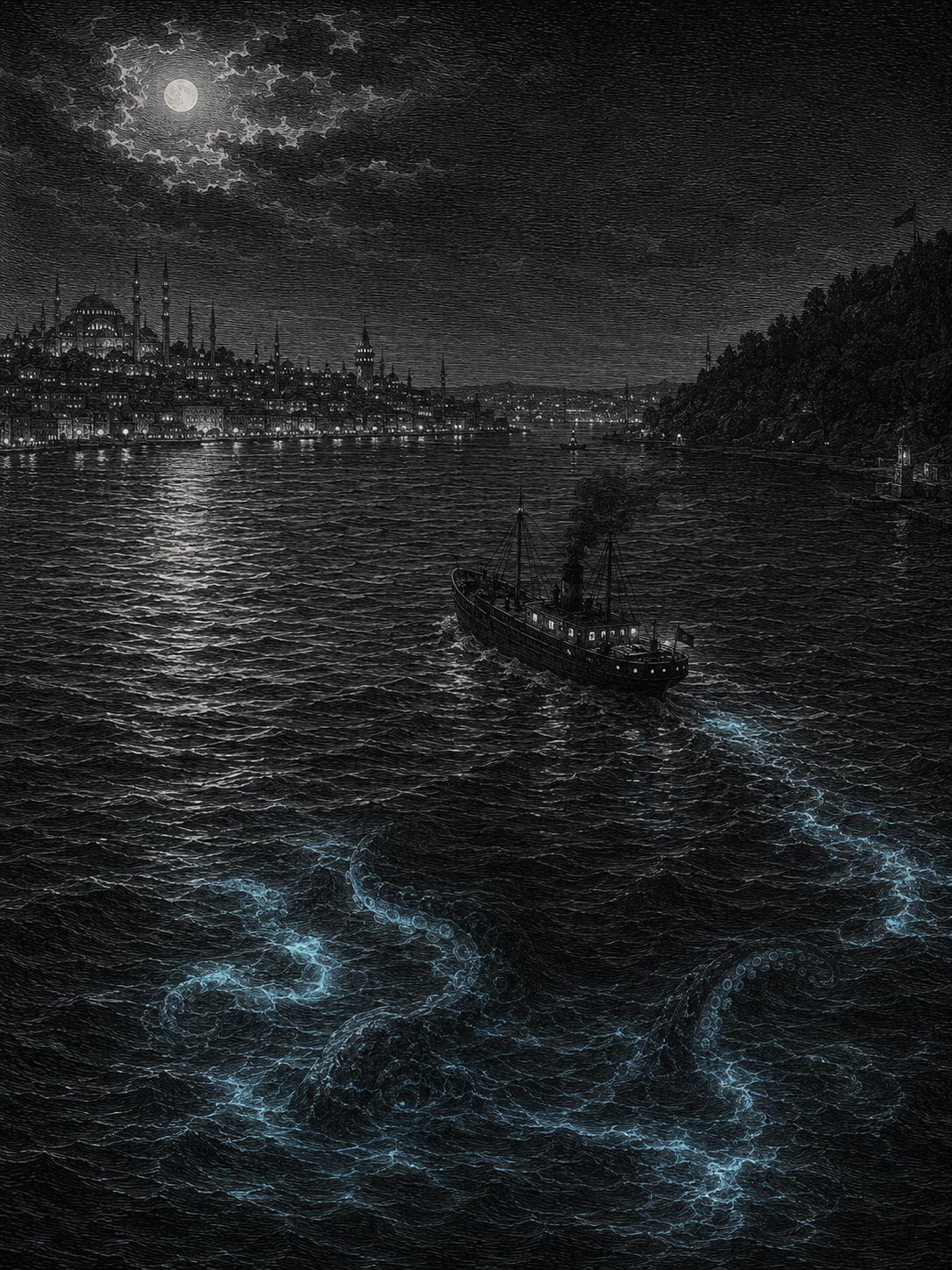
The Uchronic Bosphorus is the historical strait between Europe and Asia in its Antiterra version, a fixed chronomantic nexus: it is the same geographic point in every era, so what passes through it in 1901 can reappear there in 1055.
| Type | Place (strait) |
| Location | Between the Black Sea and the Sea of Marmara |
| Era | Active in 1901 and 1055 |
| Spanish entry | Bósforo Ucrónico |
Description
The strait is the obligatory passage between the Black Sea and the Sea of Marmara. It faces Constantinople, both in its Byzantine version of 1055 and in its modern version circa 1901, and lies a short distance from the ancient beaches of Troy.
Its main cosmological property, rare in the shared cosmos, is spatial coherence across time. Geography here admits no displacement, only temporal sliding. In both eras it is a corridor for goods, travelers and armies.
The Black Octopus
The Black Octopus, whose usual jurisdiction is the strait, operates at the same point in both eras. Two attacks are recorded: one in 1901 against the steamer of the Time Bandits, and one in 1055 against Byzantine ships whose records crossed the group’s during the uchronic regency. The Octopus does not age, move or take other routes; it defends the strait with geological patience.
The time jump
After the shipwreck of their steamer off the Bosphorus in 1901, the Time Bandits reappeared in the same strait around 1055 of the Byzantine count. The jump, one of the few clean cases on record, worked through the Sucronic Flare, which displaces in time while keeping the geographic position fixed: whoever fires it must stand where they want to reappear.