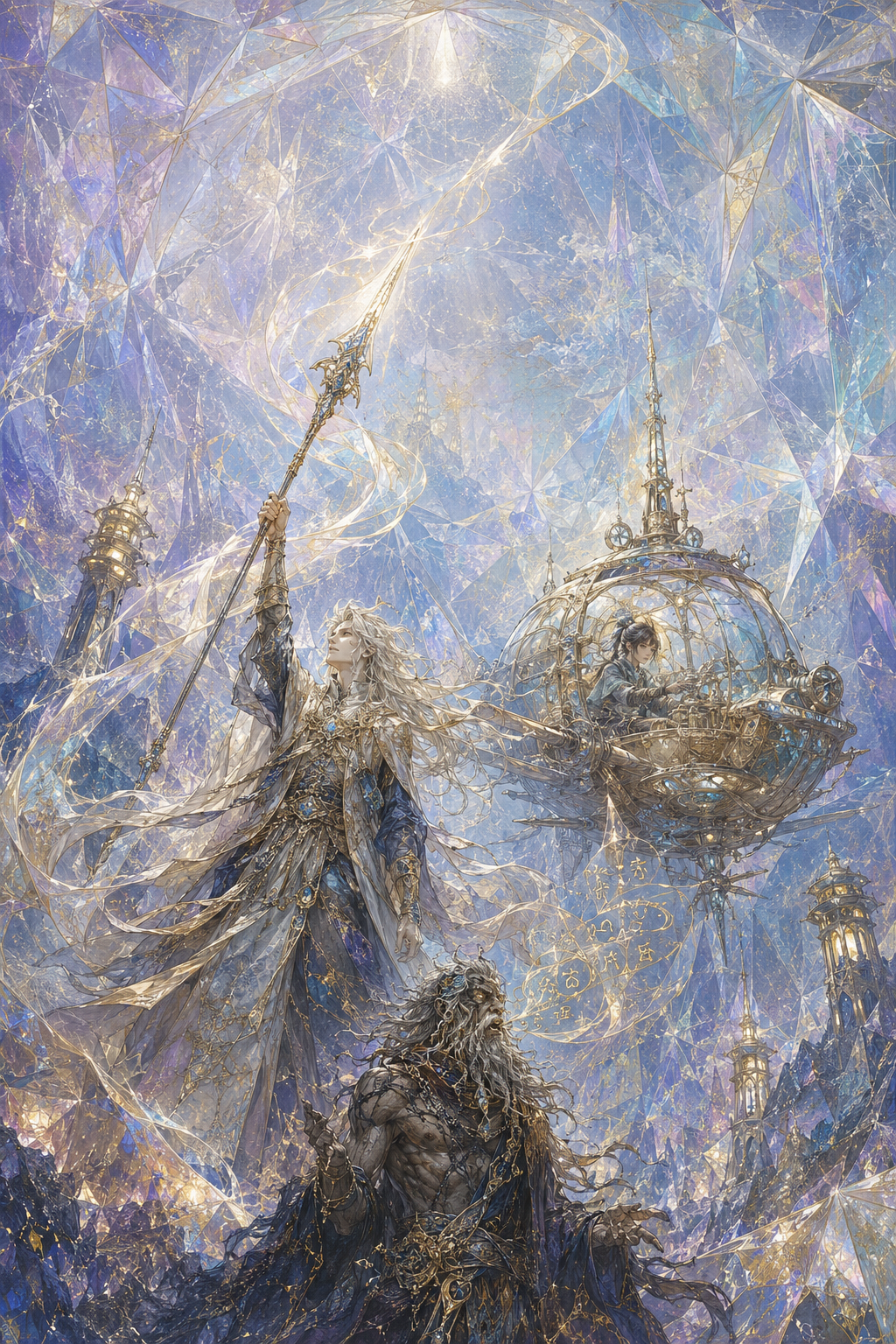
Dual Magic (magia dual) is the highest form of magic in the archive: a power framed in opposed pairs, worked by direct imagination in Antiterra, and in Vala a forgotten, concealed system able to destroy “all possible worlds”.
This name refers to different figures in 2 worlds; the versions are not merged.
| Type | Concept (cosmological power) |
| Worlds | Antiterra; Vala |
| Other names | Fire of the Gods; in Antiterra, anciently “dual power” (form uncertain) |
| Spanish entry | Magia dual |
In Antiterra
The ancient name is recorded as “dual power”, but the word reached the copyist corrupted.
Magic in Antiterra
Antiterra has “a lot of magic”; the claim that it had none, only “the astral”, is false. Magic is visible, felt and radiates; trained eyes recognize it at a distance.
The art has four interdependent layers:
- Material support. Much magic is “made through gems”. Land holds magic or not depending on what was done on it: “in a space where people are killed, magic disappears.”
- Technique. Schools (invocation, summoning and protection are named), techniques called gambits or artimañas (“tricks”), and levels that grow with practice. Detecting magic reveals its school. Formula alone is not enough: “actions are what actually make a spell” work. The records also mention “threads of magic” and a magic “related to chains” that one group used.
- Persistence. A manifested spell detaches from its caster’s life energy and outlasts the caster’s death, so a spell surviving a dead caster shows “someone else cast the spell”. The unexplained exception: “but the generals don’t”.
- Dual magic, at the top.
Nature
Dual magic uses no school or school formula. It modifies “constant reality” by imagination — “you simply imagine things and things happen” — and is posed in opposed pairs: a two-option question (“who rules, me or him?”) or a written formula, “dual magic: to defeat A, B is needed”, where A is Asmodeus. B is not recorded.
It is the layer of domination: Graz’zt was destroyed with it. Elías’s power of domination over it is “approximately five or six times” that of his companions. When the earlier dualist system was destroyed, “magic was released” and the world was reordered.
Geography
- St. Mark’s Square: magic is “dead for everything else”, except at the center and possibly a somewhat larger area.
- Lighthouse of Alexandria: “fundamentally transmutation”.
- Uchronic Paris: “this powerful magic”.
- The prison: “magic worked inside the place”.
- Magic “emanates” from the hole where the tree was uprooted.
Between the two worlds “normal magic generally works”, but certain beings cannot cross, since the companions closed the game of the platforms and changed the passages.
Uses, prices and cycles
- Reconnection of souls costs one hundred souls per person.
- The highest powers wane cyclically as days pass; the rate is not recorded.
- Using magic is now an obligation: “we must use magic, and before, no, you didn’t”.
Rejection of women’s magic
Several voices state that “in most worlds there is a grudge against us, against women’s magic, above all a magic that is not only the place where you put us”. The rejection is general across whole worlds.
In Vala
In Vala dual magic is recognized by its emblem, the pair. The Master of Ceremonies identifies it by “white and black pieces, white and black squares. Marble and ebony. Ebony and ivory.” It is a system founded on duality, forgotten and deliberately hidden at its origin. Its declared power can destroy “all possible worlds”, and its greatest use opens “a possibility of conjoining God and Lucifer”.
Its practitioners divide it: “There are two kinds of magic. The more charismatic and the more intellectual.”
Forgetting and concealment
“Dual magic is totally forgotten the first time one learned it.” The first person to discover it “was forced to bathe in the rivers Tigias”. He in turn “wrote it inside a bobia”, a hidden place whose true name is uncertain. The knowledge thus exists as a hidden text and as memory buried in a mind: “I know that somewhere in my head is the knowledge of dual magic.”
Chain of custody
- The Oathbinder and his like are “the first guarantors of dual magic”; the Oathbinder passes on the legacy before “dissipating into mist”.
- Maristo is bound to it; another figure declares a bond with it.
- A condemned figure comes “to fulfill a pact that would free me to seek dual magic”. Swedenborg explains how that pact works and where it comes from.
It can be studied, and lost knowledge of it recovered through magical techniques, hallucinogenic drugs or revelation rituals.
The 120-day ritual
“We have 120 days to try to prepare this ritual.” The ritual opens the possibility of conjoining God and Lucifer and involves 600 stories of passions of the first communities. The events of the castle run “on the axis of dual magic”.
Ordinary magic
Vala’s ordinary magic is public, gestural and immediate (“I move my hand and make a portal and a pixie appears”), with risks (“there are spells that have accidents here”). It drove advances akin to an industrial revolution — steam engines, chains — making Vala technomagical. A “thing called Veil”, an illusion veil, is mentioned with no recorded link to dual magic.
Conflicting accounts
- Antiterra: dual magic is called a power “of antiquity”, yet the “earlier dualist system” was destroyed. Some hold it a major school among schools; others, a former state of the world. Whether it survived that fall, is its residue, or only shares the name is unresolved.
- Vala: one record is purely destructive — “Dual magic alone destroyed / all possible worlds” — the other is the ritual of conjunction. Whether these are two uses or two versions of one event is unresolved.
Open questions
- What the gems, chain magic and “threads of magic” are, and why only generals tie spells to their lives.
- The cycle of the waning, the number of schools, and whether St. Mark’s dead magic follows the law of killing.
- Who the “us” of women’s magic are and what distinguishes their art.
- What dual magic concretely is, and how it can be “totally forgotten” yet studied and bonded with.
- What the hidden text and its bobia look like, and where the rivers Tigias run.
- The practical difference between charismatic and intellectual magic, and its relation to Vala’s technomagic.