Uchronic Paris is the western capital of Antiterra, a steampunk metropolis of the uchronic Belle Époque whose cardinal year is 1901 and where time is bought and sold. It is ranked the Fourth Pillar of the cycle and is where the Time Bandits were formed.
| Type | Place (city) |
| World | Antiterra |
| Era | Uchronic Belle Époque (around 1901) |
| Rank | Fourth Pillar of the cycle |
| Administration | Lord Gaul (viceroy); Prefects of Time |
| Spanish entry | París Ucrónica |
Description
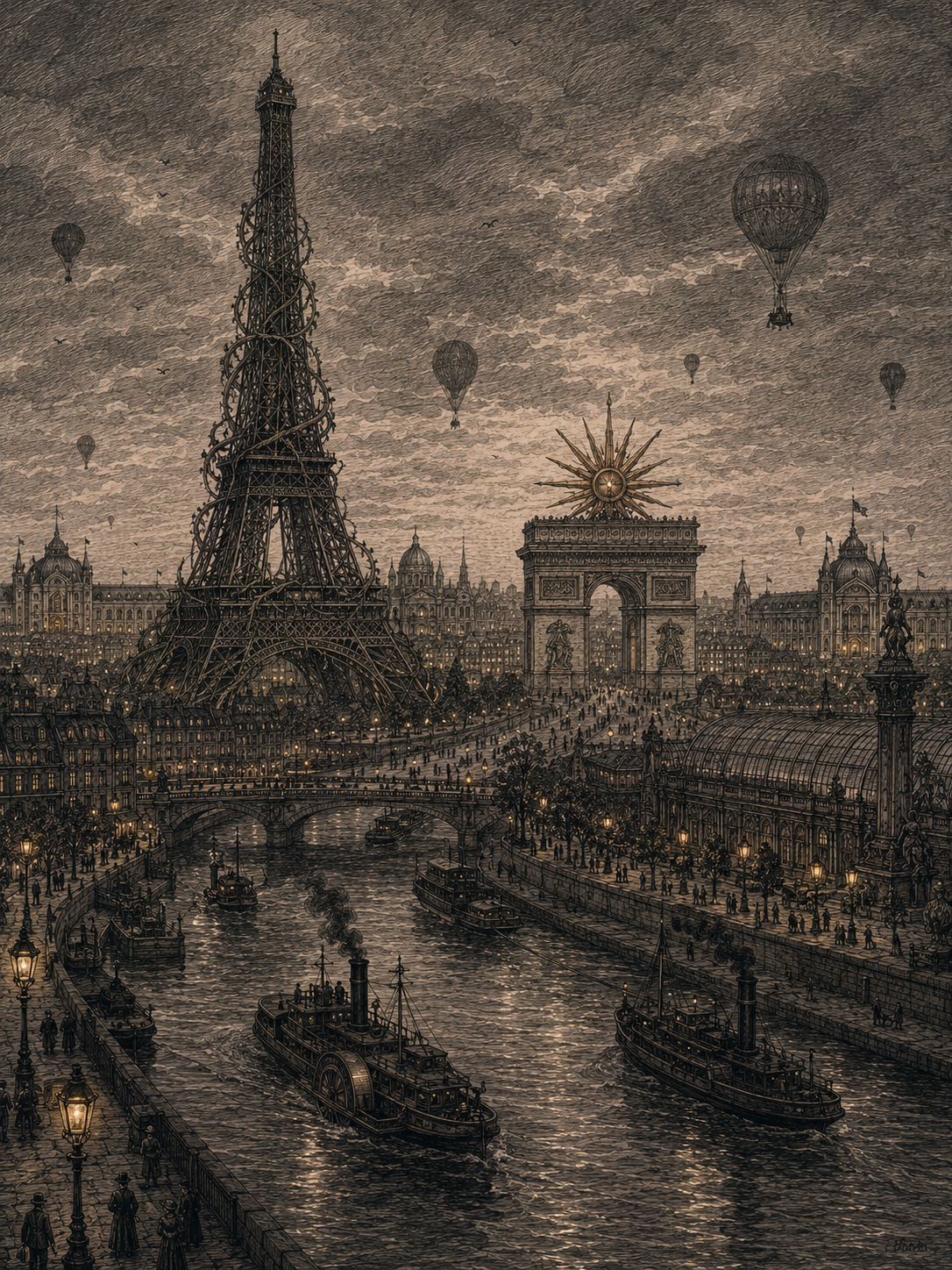
The city has its own Eiffel Tower, with clockwork details the common version lacks, and an Arc de Triomphe crowned by a twelve-rayed sun, sigil of the twelve radial avenues and the city’s cardinal cipher. Other landmarks are Notre-Dame and the Panthéon. By 1901, twelve years have passed since the Purge of Devils, when devils that were inside the city had to be driven out.
Cosmology
Antiterra and Terra are paired not by symmetry but by imbalance: one keeps what the other loses, one forgets what the other remembers. Uchronic Paris is where the difference shows most — same latitude, same curve of the Seine, same Haussmann boulevards, yet another city.
Its rank as Fourth Pillar comes from density of crossings, not age; other pillars are older. In 1901 the Band of the Dissolution drew near and held the city for one instant more. The hypothesis of Sinterra, a post-1901 synthesis in which the two worlds may converge, takes shape in these twenty-odd years. The Temporal Apocalypse of 1889 is a major earlier episode.
Time as economy
The Prefects of Time regulate access to administered chronomancy from the Palace of Time; Subprefect Iriarte signs individual contracts from his wheelchair. Crossing centuries means paying the right fare to the right Prefect.
Chronomantic trade counts in three metals: gold francs, platinum louis, and copper or silver centimes depending on the district. Whoever travels pays; whoever does not yet want to travel also pays. The Cronoboys overpaid: they wait at the tram stop with ninety-year-old faces above the dresses of well-bred daughters.
Time wrinkles, where a whole week folds over another, multiply in the old districts: the Suite Forgot (where events, sometimes even the reason for entering, are forgotten), temporal archipelagos in the lower Seine, and the cronoputas (“chrono-prostitutes”), who accept any metal so as not to state their real age.
Society
Workers and employers clash in strikes the common press plays down. The conspiracy of “the Serpent” works on the upper floors, unknown by name to the street. Dark magic is legal in some arrondissements — not authorized, merely left alone because prosecution is a nuisance. The Gnostic Church keeps temples parallel to the official ones. The bald viceroy, Lord Gaul, governs from offices where Baatezu serve as red-coated officials.
Archaeology drives events: the Panthéon ruins hide the Etruscan Ancestor, whose half-open sarcophagus radiates influences; the Black Octopus of the Bosphorus sends emissaries when the Seine grows too warm; and the Oreal Race, human–stone-genie crossbreeds, walks the arcades unrecognized.
The Time Bandits arc
The most thoroughly documented gesta (campaign-cycle) in the Archive: its companions began as investigators of a local matter and ended as rulers of Byzantium.
- They meet in the tavern of Cartouche, a legendary thief who died horribly but first had a great Thieves’ University: Claude Nauge, revolutionary and drinker, who speaks of Buenos Aires when drunk on absinthe; the composed Philippe; Swan, who says less than he knows; and Aby Warburgo, an academic who fights with his hands, investigating the brutal attack on his cousin Alexine.
- A failed poisoning in the tavern; a ritual of flour and curses at Les Halles; the death of Cornablue (blue skin, antlers, a strange stench), his skull split by Claude’s mallet amid burning flour.
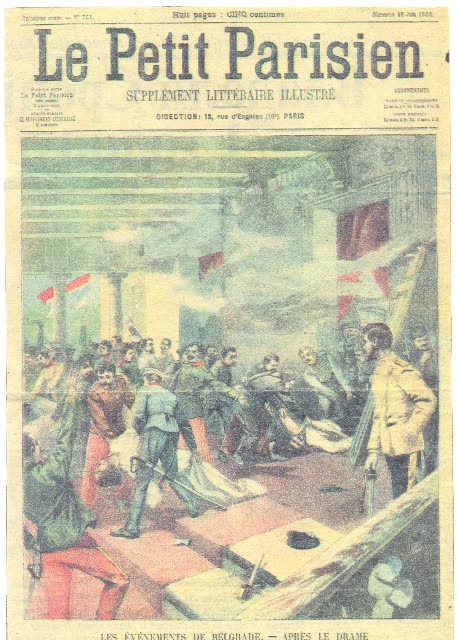
- The Orient Express to Bucharest and Serbian plots of the Circle of the Serpent. Draga Machine — on our Earth Draga Mašin, wife of Aleksandar Obrenović — is murdered, or disappears, or both; the despairing king of Serbia bargains with the Time Bandits to break up the rest of the conspiracy.
- Serpent Island, the turning point, where something ancestral works beneath layers of conspiracy. The Serpent is a function, not a serpent, as the Horsemen of the Apocalypse are functions, and has manipulated power since before Paris existed.
- Claude lives seventy-five years as Cvjetko Popović: he goes to Sarajevo in 1914, to the assassination of Franz Ferdinand, and stays; when he becomes Claude again he carries the memory of that whole life.
- A temporal shipwreck strands the group between empires in Byzantine Constantinople, 1055 CE; an FTL voyage takes them to Alpha Centauri.
- They commune with Chronomon, the god of Time — the same Chronomon that Ärsvan destroyed in Templars — who here sacrifices himself and ascends, taking the group with him (Mythic Ascension).
- They fight at Kosovo Polje in 1389 and at the Lighthouse of Alexandria. Abraxas is revealed: gematria 365, the whole year as an entity. Free Armenia and Kumal appear, names that mean something else in Antiterra.
- The Chronocide: the English Channel evaporates and millions die. No villain causes it; the Horsemen are a function, and the function executes. This revelation — the apocalypse as bureaucracy — is why the city is the Fourth Pillar.
- The cycle closes with The Submission of Indra, a ritual opera that is also a political and a cosmic act. The Time Bandits rule Byzantium in 1055. Claude returns to Buenos Aires in 1907 and finds Rosa, who had waited for him.
Later appearances
- A temporal detour to the Commune of 1870, after the main arc.
- After an implosion the city converges and is refounded on itself as NEO-PARIS.
Conflicting accounts
- One account has four men meet in Cartouche’s tavern (Claude, Philippe, Swan, Aby); another gives five companions, adding Corvino.
Gallery