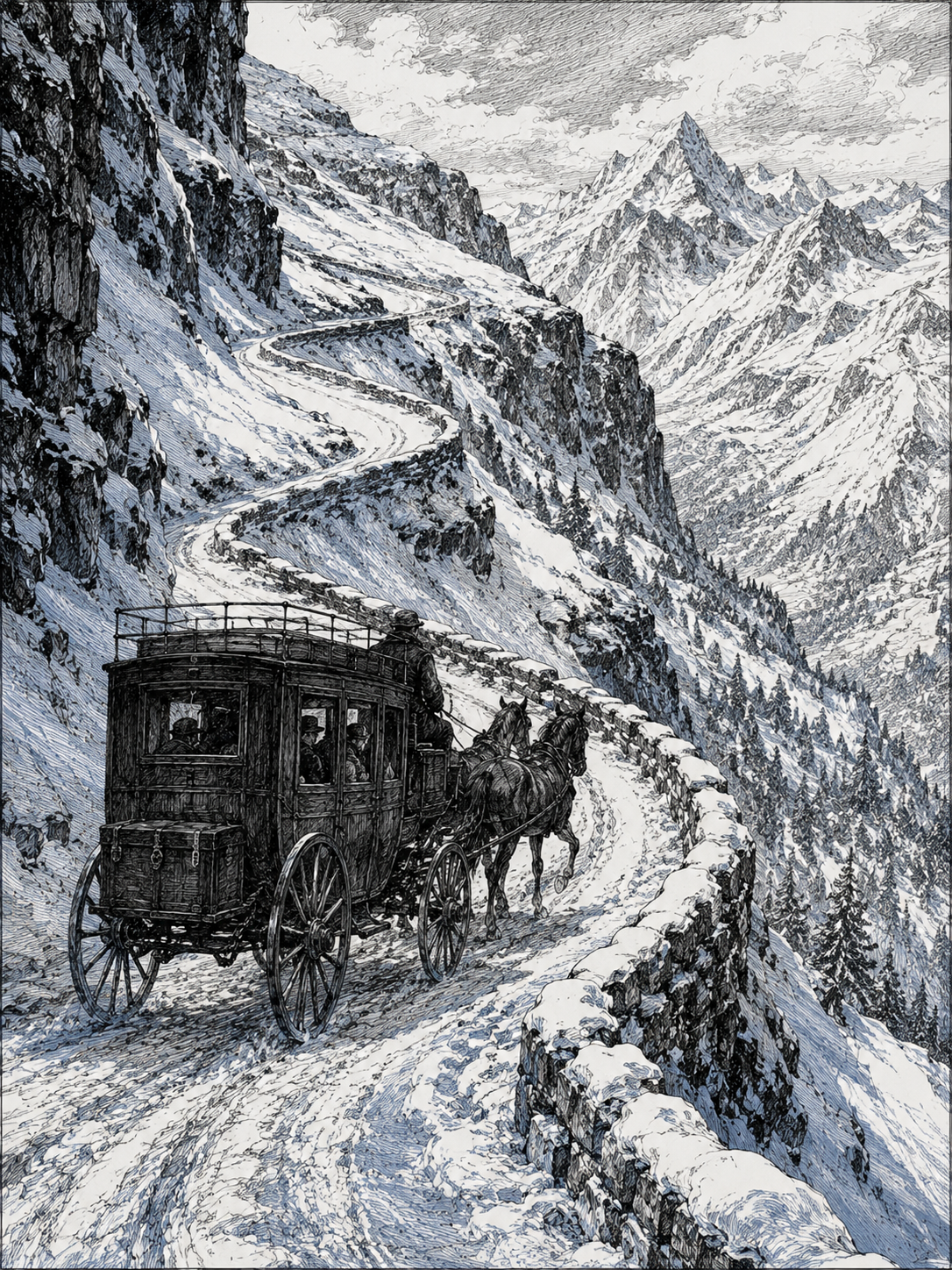
The Crossing of the Carpathians is a recurring winter route of the late Antiterran cycles for travelers going from Mitteleuropa to the Balkans — Vienna to Bucharest, Paris to the Bosphorus by land. “The range does not convert. It restores.”
| Type | Mountain route |
| Destinations | Bucharest, Belgrade |
| Spanish entry | El Cruce de los Cárpatos |
Description
A black four-horse carriage climbs a winding road cut into the mountainside: snow on one side, pines on the other, abyss before and behind; tiered white peaks close the horizon. The coachman is wrapped in dark furs. The Orient Express crosses through tunnels opened in the nineteenth century with alchemical explosives; the carriage crosses above, by old roads that snow closes three months a year. “The express is for those in a hurry. The carriage is for those who want to arrive as someone else.”
The three rules
- Whoever crosses in company arrives knowing their companions better than intended.
- Whoever crosses alone arrives knowing silence better than advisable.
- Whoever crosses twice in the same season is not the one who came back.
See also
- Natalia Petrovna’s Mansion, Black Mass of Bucharest — destinations of the crossing
- Sarajevo, 28 June 1914 — where its geography opens onto greater history