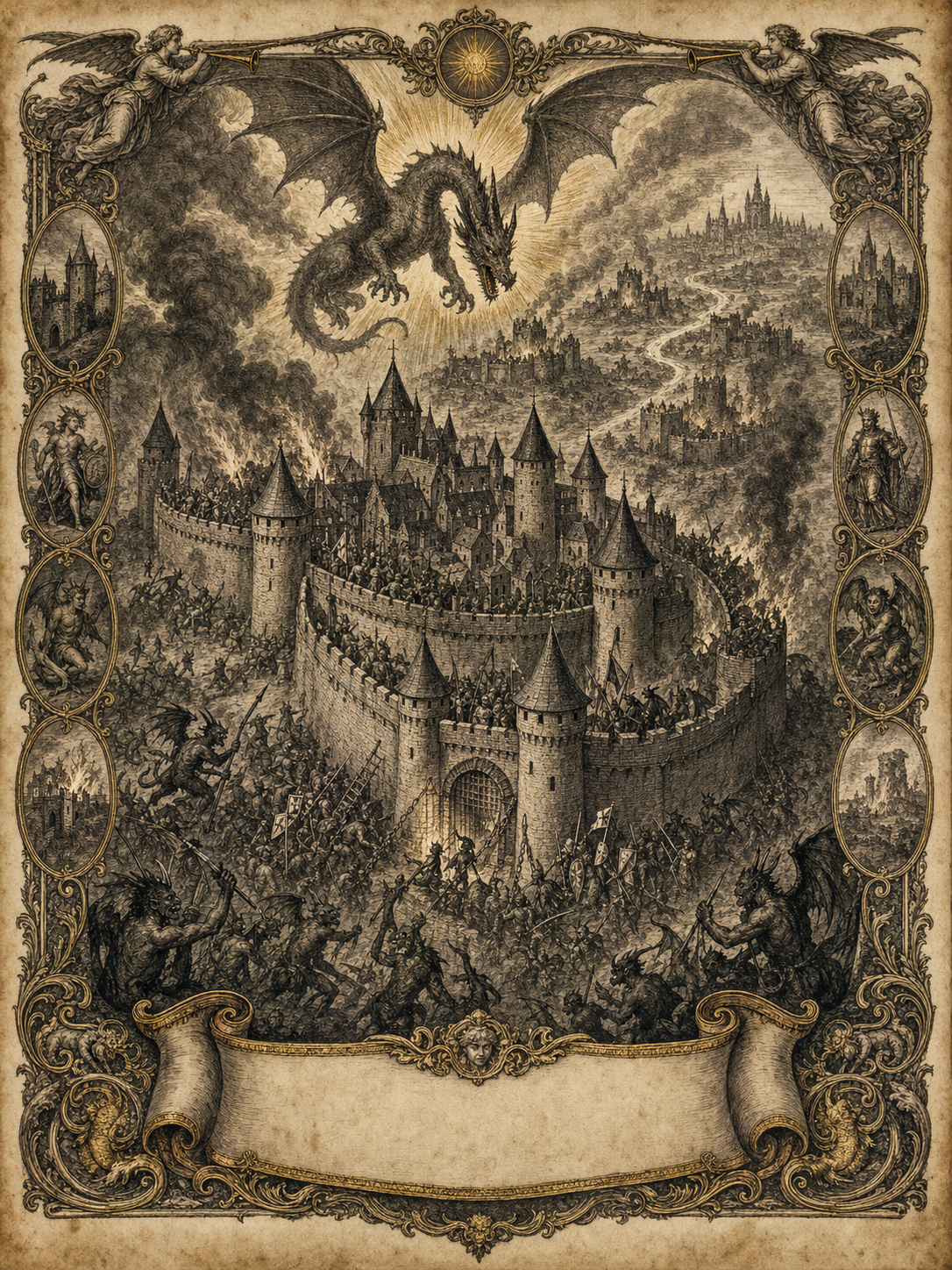
Carcassonne is the walled castle-city of southern France, near the Pyrenees, that in 1889 was a key stage in the chain of battles the Regulators fought on their way from the Uchronic Mediterranean to Paris. They found it held by devils, took it, and used it to defend themselves until a dragon came.
| Type | Place (castle-city) |
| Location | Southern France, Pyrenees |
| Era | 1889 and after |
| Spanish entry | Carcasona |
Description
A great reconstructed medieval fortress: double walls, crenellated towers and a main castle at the heart of the citadel — “a tremendous place of towers and walls”.
History
The landing and Scya
After the maritime closure of the Deep Ones on 21 December 1889, the newly formed Regulators put to sea with 300 Atlantean passengers — the rescued population of the fallen colony of the Elemental Plane of Water — on a ship flying the white elephant of Siam (a symbol associated with the Cakravartin, formerly the Nan-Shan). They landed on the coast of Gallia Narbonensis.
There the Greek curse awaited them in the form of Scya, brought by the Inevitables to punish the Atlanteans who 9,000 years earlier sought to enslave the Mediterranean. She appears as a woman lying among wolves; the wolf, Lupus, is the animal of Gaul and the emblem of Roman standard-bearers. With illusion magic she feigned a port; Charybdis appeared behind her. After her defeat the Regulators took her wolf standards and planted them as their banner.
The Inevitables’ ultimatum
The Inevitables arrived as dozens of drones that set metal knights on the deck. Their ultimatum: the Atlanteans’ descendants must cease to be such. The persecution would end only if the 300 took another citizenship, which required a decree from the Viceroy of Paris, Lord Gaul, who has a Baatezu legion and would want a show of strength. A Zelekuth, an iron centaur with a whip, tried to seize Maleika, whose name is “a nasty one on the list of Fugitives”.
Foix, Garuby and the cannon golems
From Foix, the regional capital, came the envoy of the Parisian authorities, Presbyter Garuby, a covert conciliator and “a sort of chief lawyer of the devils”. Carcassonne prepared cannon golems against the heroes; they were ultimately deployed at San Sebastian, the port from which the Atlanteans were to sail for their hidden homeland somewhere in the Bermuda Triangle.
Taking the castle
Advancing north, the group found the main castle held by devils, an outpost of the Viceroyalty’s Baatezu line, and took it. They then used the city to defend themselves from a dragon and other creatures that came for them.
Su-Zoro’s three wishes
During the confusion of the first battle, Su-Zoro — the traitor or double of Dr. Zoro — took one of the Atlantean sages hostage and fled toward the Pyrenean peaks. In the second, bloodier battle they caught up with him making three wishes:
- “I wish to remain in the body with consciousness”
- “Remembering all my past existences”
- “Assuming all the power of my ascetic-spiritual evolution”
After Carcassonne the road led against Lord Gaul in Paris.
The road to Paris
The Regulators pressed on to San Sebastian, laying waste to regions and fighting devil hosts that intercepted them. They had unwitting allies in brave Frenchmen who asked what use a monument to freedom won from the French monarchy a hundred years earlier was, if one is a subject of the English crown. An explicit ally was Kropotkin, a Russian libertarian, future author of Modern Science and Anarchism, who carries hidden in his coat a great mallet of the Parisian maillotins of 1381 and will become political commissar of the Sigil restored by the Regulators. The chain ends in Paris, with the attack on Notre-Dame, the Eiffel Tower Tournament and the close of the cycle in 1901.
Seat of the Boreal Bank
Carcassonne later became the seat of the Boreal Bank of El Fabuloso. Its later letters — including the communiqué on the repairs of Union after the betrayal at the Eiffel Tower Tournament — are signed EFBB-CSS (El Fabuloso Banco Boreal – sede Carcasona).
The Lady of Carcas
In the legend, the Lady of Carcas, a Saracen widow-regent, defended the city against the siege of Charlemagne. On the last day she fed the last pig the last grain and threw it from the walls so the emperor would believe the city still had provisions. Charlemagne lifted the siege, and she rang the bells: “Carcas sonne”, hence the name. The legend reappears at some point in the Paris chronicle; the exact connection is not established.
Relationships
The same walled city has a separate entry two centuries and a gesta earlier: Carcassonne in the Languedoc of 1648, a board of the peripheral Fronde under Cardinal Mazarin, on the route of wheat, salt and recruits to Paris. The two are kept separate.
Conflicting accounts
- The body describes the 300 Atlanteans as a civilian population, not an expeditionary force; the list of links calls them an “expeditionary force” of Atlantis.
- The landing is placed on the old Roman coast, “not Marseille or Narbonne strictly”; elsewhere Marseille or Narbonne is named as the landing coast (“one of the two ports”).