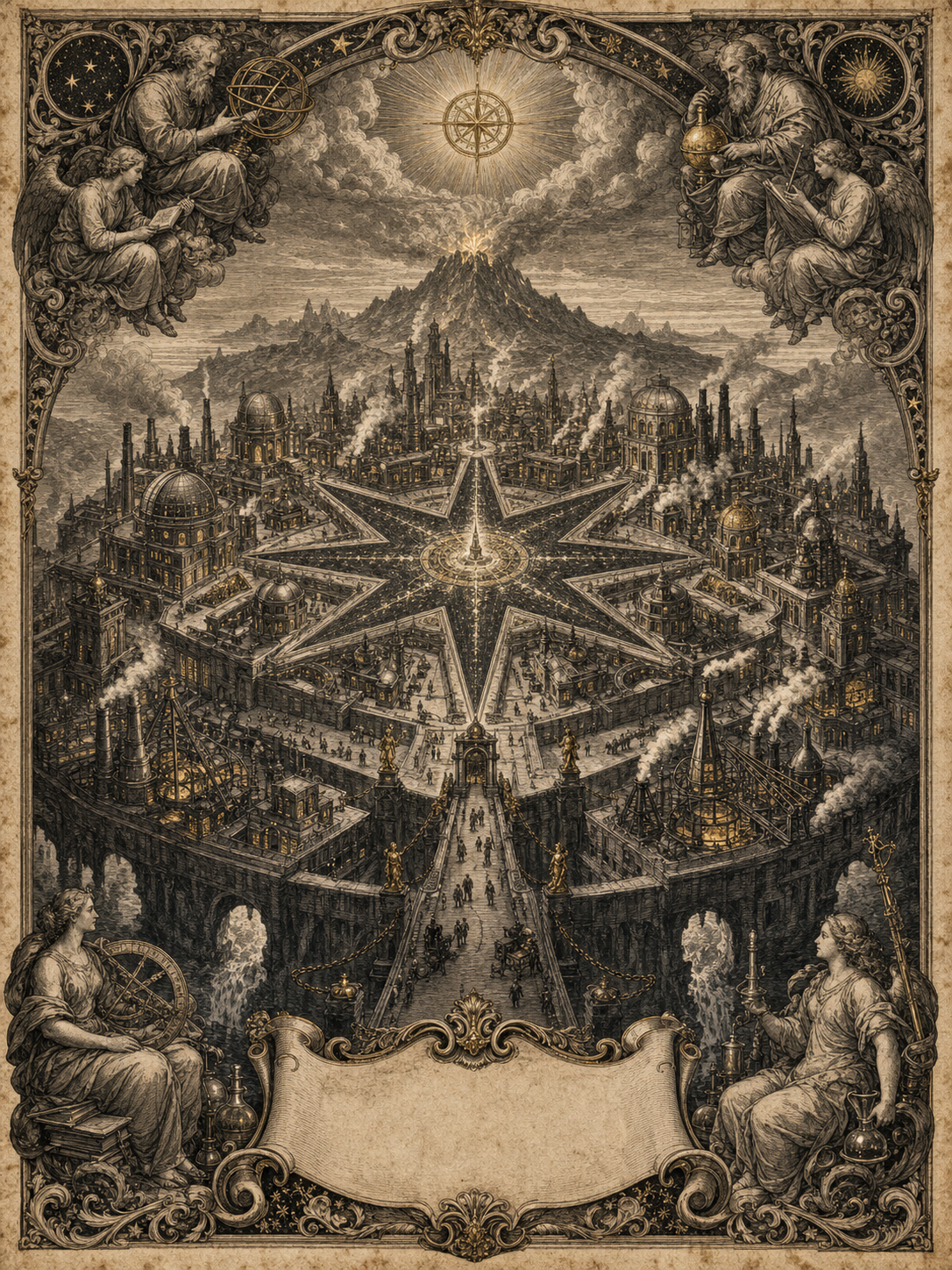
Star City is the capital of the gem-world Vala Cristalis, a star-shaped walled city on the north bank of the River Ucronos, center of a magical-industrial revolution and seat of an elected Pope. The world’s calendar counts from its founding.
| Type | Place (capital city) |
| Location | c. 100 km north of Caldero |
| Spanish entry | Ciudad Estrella |
Layout
A wall with seven gates traces a star over the hills, at least 10 km in radius, like Palmanova; it stands on the protected side of the river, unlike Caldero. The city sits on hills in a volcanic depression, with steep streets, four districts (South, North, East, West) and four avenues: Auxiliana, Magma, Lava, Ash. It has canals and bicycles; Pelinis fly overhead, as in Sogol.
Two centers overlap: the Palace of the Star, seat of papacy, families and election; and the geometric center, where a railway to the mines is being built. Beneath lie catacombs: the city is both aristocratic seat and necropolis.
Industry and trade
Steam and magic drive its revolution. It makes magic weapons and Brooms of Light, is the only sure source of prostheses for amputees, may offer advanced healing, and gives away Overpower gloves. Magic items worldwide are marked “Made in Ciudad Estrella”. As a city-state it requires import licenses; regional nobles supply its raw materials and depend on its purchases, and its merchants supply Caldero, a backwater by comparison. Its people suffer lung ailments from something in the air.
Papacy
A syncretic religion rules, with a pantheon from a solar to a stellar deity; it holds that the firmament has holes through which winds communicate. A Pope is elected in the Palace-Temple, and families maneuver over the succession. Twelve years ago came disaster, a scandalous election and insurrection; since then the clergy dominates. From that scandal comes a preacher accused of being a leech who took babies and drank their blood, killed after the accusation. Public doctrine admits that “certain bad popes” stained the religion.
Calendar and decline
The year is 1824 of the Founding of the Star (Year Estrela); the chronology of Amoria counts from the city’s supposed descent. Vitalis comes from here. Called an industrial paradise come “to save everyone from that hecatomb”, it is in decline: nobles grow more independent, papacies “have fallen”, and there is “a revolution of saints” in places. Its condition: «esta ciudad puede ser eterna siempre y cuando el bien de los ciudadanos esté listo» (“this city can be eternal as long as the good of the citizens is ready”).
Conflicting accounts
- Origin: the star came from Alpha Centauri; or sorcerer schools from Caldero founded and “called” it to build a new civilization, Amoria.
- Population: “almost 40,000”, “millions”, or “a town of three thousand”.
- Age: year 1824, but 1825 years since the founding, the hecatomb or the volcano’s end.
- The theocracy ends in 1812 AE, yet the clergy has dominated since the upheaval twelve years ago.
Open questions
- What the Pelinis are.
- Whether the ruin of the “two violences” of Sortians and Theosophists is this city.
- Whether Viz, its “clavelintic dungeons”, and an emptied “Seagill” (or Sokol/Sogol) are this city, districts or other places.
- Where the slums, metro, patched statues and the old ruined city with its strange tower lie.
- Prices of licenses, prostheses and train passage.