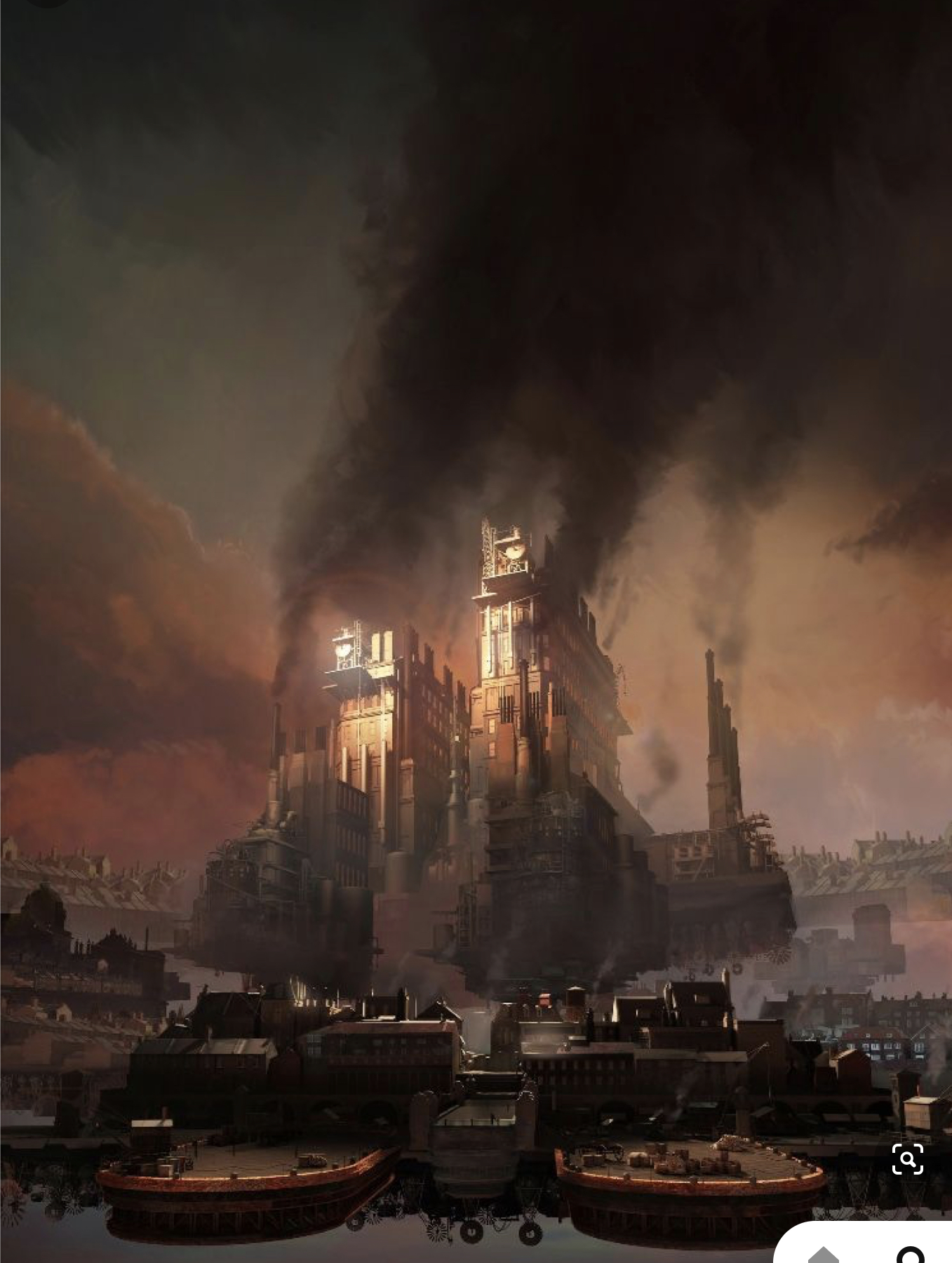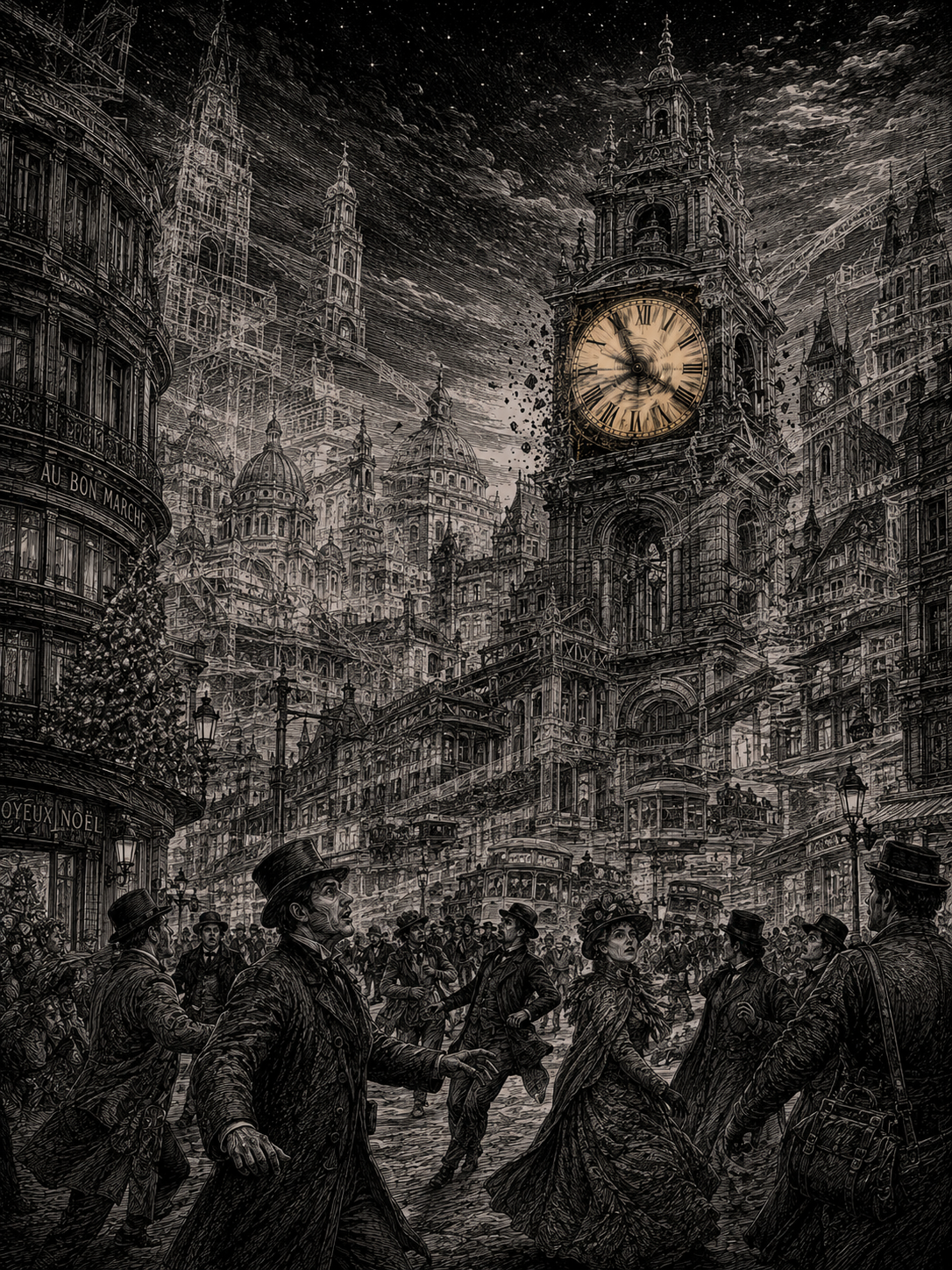
The Temporal Apocalypse of 1889 is the collapse of the temporal continuum that struck Uchronic Paris on 25 December 1889 A.D.A., when the administration of Time ended with the fall of Chronomon (Kronamon). Afterward the city was refounded as NEO-PARIS, City of Times.
| Type | Event |
| Date | 25 December 1889 A.D.A. (late Christmas Eve / early Christmas) |
| Place | Uchronic Paris |
| Other names | Apocalypse of Christmas 1889; Death of Time; Temporal Implosion (one event, per Arkos) |
| Spanish entry | El Apocalipsis Temporal de 1889 |
Symptoms
- All temporal dimensions collapsed simultaneously (“end of times”).
- Reincarnation cycles ended; travelers in transit were trapped in their last body.
- The living froze in an indefinite state, “like ceramic”, without perception of time.
- Buildings overlapped with their past and future versions.
- Clocks turned both ways; Kronamon’s clock-body no longer administered Time.
The archive defines it as the death not of a god but of the administration of Time; the god fell with the clock because he was the clock.
Causes
The archive does not settle the culprit. Active hypotheses:
- Kronamon / Chronomon: the chronomantic chain of 1050–1120 (Kronamon’s execution) unleashed the implosion.
- El Negro: demonic forces exploiting the administrative loss.
- Infernal Egg: the incubation of an apocalyptic creature as the mechanism.
- Paradox created by travelers: the Cronoboys and the Time Bandits, acting outside the legal administration of the Palace of Time, accumulated paradoxes to the limit.
The prevention mission
Michel said: “Dios me abrazó. Nosotros somos indicados.” (“God embraced me. We are the ones meant for this.“) He believes in a butterfly effect but does not know the original causal factor. The mission the group, with the Time Bandits, accepted is “to unravel the events that led to the destruction in order to modify or prevent them”.
Aftermath
Paris was refounded as NEO-PARIS on the site of the collapse, outside linear time, with temporal portals connecting eras. The cosmos kept counting, no longer by Kronamon’s hand. Cronomon Heredeth is a later titanic form of Chronomon.
Conflicting accounts
A parallel record, of the last Templar encounter on the night of the collapse, inverts the event:
- Canonical reading: the god of Time falls; the overlap of past, present and future versions of Uchronic Paris precipitates the end. The apocalypse is consummated.
- Inverse reading: the sacrifice of Ärsvan acts as a cosmological brake. The apocalypse stops and the world is saved, implying that free will exists and the group can alter the prefigured destiny.
Both are kept as a declared palimpsest. Decadian doctrine suggests the apocalypse was consummated in the main line and reversed in a line derived from Ärsvan’s sacrifice; the doctrine of the Chorus of the Descent (Ante-Inferno) suggests the sacrifice acted retroactively on the main line itself. Neither reading is closed.
Gallery