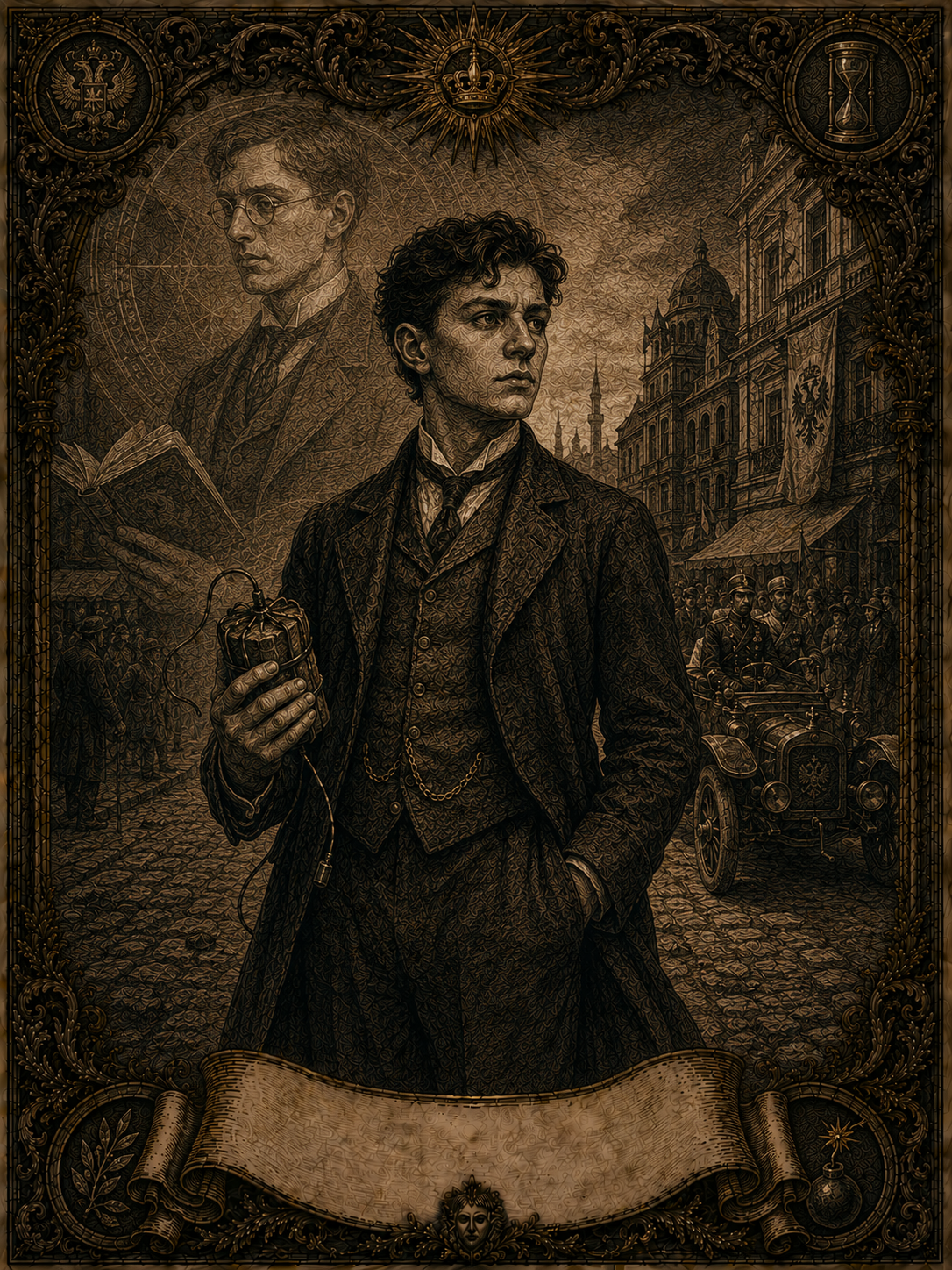
Cvjetko Popović is a historical conspirator of Young Bosnia in the Sarajevo assassination of 28 June 1914, whose body, in the uchronic version of the event, hosted the consciousness of Aby Warburgo.
| Type | Character (historical figure) |
| Organization | Young Bosnia; recruited by the Black Hand |
| Event | Sarajevo, 28 June 1914 |
| Spanish entry | Cvjetko Popović |
In common history
A Bosnian student of Serbian origin, he was the youngest of the conspirators against Archduke Franz Ferdinand, only eighteen at the time. The Black Hand recruited him through clandestine conspiratorial bodies. Posted on the route of the Archduke’s motorcade with an assigned explosive, he did not detonate it, for reasons common history records ambiguously. He was imprisoned after the assassination.
The fusion with Aby Warburgo
In the cosmology of Uchronic Paris, during the group’s time jump, Popović acted with a double identity on the day of the assassination: his own body received the consciousness of Aby Warburgo, the German-Italian scholar projected into the past.
- The non-detonation is explained retroactively as Warburgo’s decision: remembering from the future the consequences of a successful attack, he chose the lesser operation to preserve the larger causal chain.
- The fusion left traces in both. After 1914 Popović shows signs of “foreign memory”, which common historians record as psychological trauma and the uchronic archive as residue of the fusion.
- After the jump, Warburgo reported recurring dreams of Sarajevo, a city he had never visited.
Role in the uchronic assassination
The uchronic attack involves six historical conspirators plus members of the Uchronic Paris group, who inserted themselves with overlapping identities: Popović was inhabited by Warburgo, while Philippe and Claude Nauge took over other conspirators. The explosive was not detonated, and the attack was completed by Gavrilo Princip with a revolver. The causal chain leading to the First World War was largely preserved, with minor alterations, chiefly the fate of Popović’s consciousness after 1914.
See also
- Aby Warburgo · Sarajevo 1914 (Time Jump) · Gavrilo Princip
- Apis · Dragutin Dimitrijević — leaders of the Circle of Serbia that directed the organization
- Time Bandits