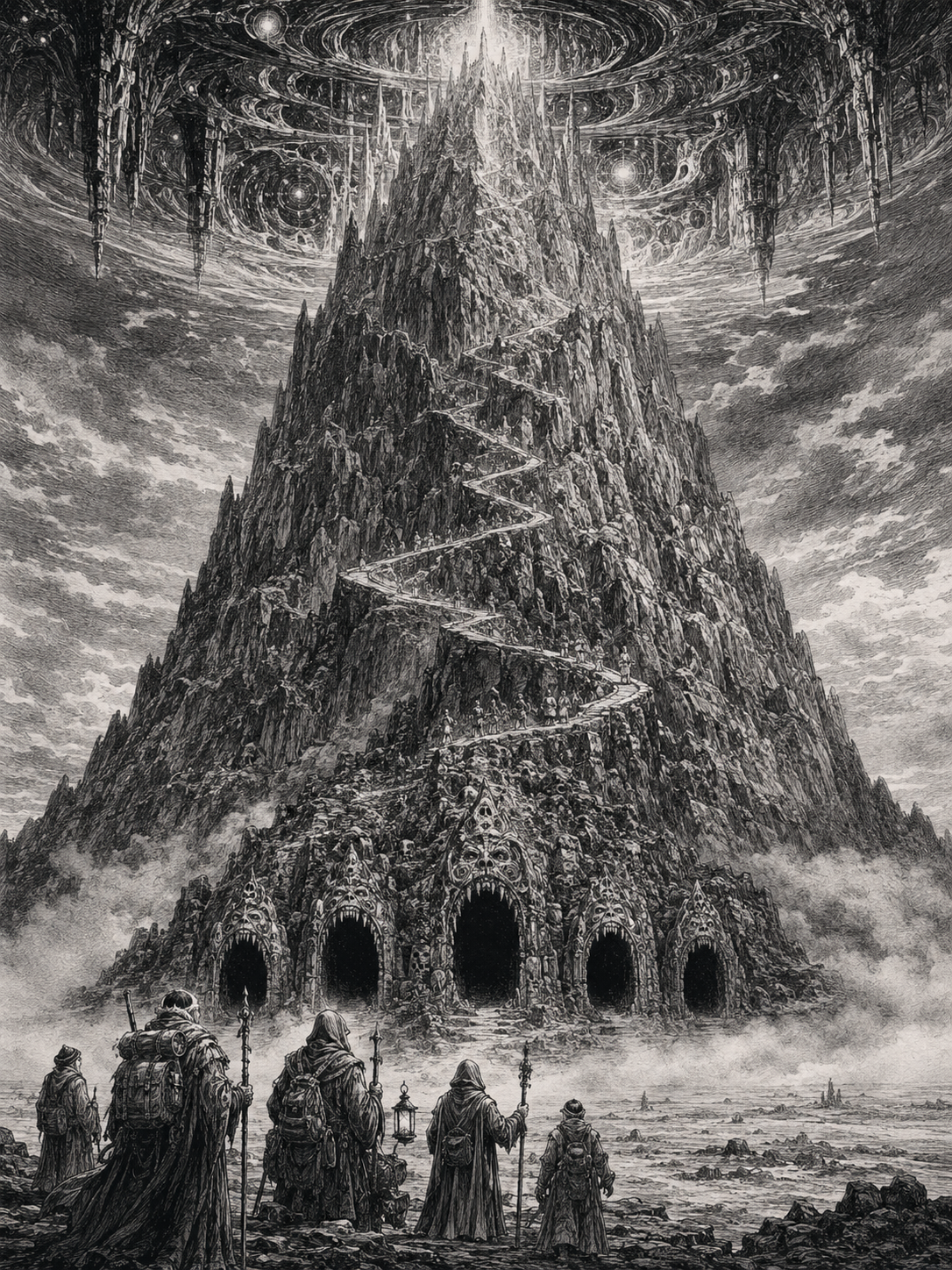
Mount Analogue is a seven-level mountain rising from the southern sea exactly opposite Jerusalem, “as if it were purgatory on the way to the earthly paradise”. It is the world’s spiritual beacon and is under siege from portals opened in its lower levels.
| Type | Place (mountain) |
| Spanish entry | Monte Análogo |
Nature
Its position follows the cosmography of Dante, taken as law in this world. It “arose in the water to balance the problem of hell”: when Dante wrote the three realms he opened Hell’s portals, and the world needed a counterweight. It is the analogue of the Celestial Mount, the seven-level plane where “healing is maximized”. Antiterra is “almost an extension, like the embassy” of it, or “a barely diluted form”. It resembles Mount Purgatory. “It is a beacon, like it or not.”
Access
By sea, “much farther than it looks”: about five kilometers from an anchored ship, half an hour or more. Travelers pass barreras planadas offshore, then customs. Facing it rises “a series of stars, like a containment net”. Built portals and teleportation also reach it. Supernatural flight fails: “a property of the plane: you turn into a bird”.
Levels and roots
Paths climb its terraces, a moral ascent and ladder of access. The seventh level cannot be climbed: “it is light”. Angels and “beings of Mount Analogue” dwell there. Below, caverns and “underground rivers that detienen the mountain” (hold up or block); one cavern toward the root holds the Fountain, and tunnels lead to the center.
Portals opened in the lower levels, and “from those doors come darknesses that will destroy the world as we know it”. Hosts of several planes come “from below”. The mountain is “full of Daemons” mining angels’ souls; “the whole mountain is on a war footing”.
Laws
Hunting commandments carry automatic sanction: “you will hunt, but you will also be prey”. The Contest of the Horseman of War is decided there. The proclaimed task is to deactivate the portals; if the mountain falls, everything “will be much darker”.
Other mountains
- Mount Olympus (Mount of the Muses) is distinct: “Mount Olympus is not Celestia”. It has muses, Greek gods, a temple for resurrection rites, nereids, ruins of the kingdom of the bears, and a sarcophagus with a petrified humanoid that wakes when Khalim arrives.
- The Italian Mount, where a sword was found, is separate.
- The Yatil and Altay mountains mirror each other as an anagram.
- Schools of the Celestial Mounts dispute redemption: “even devils can be redeemed”.
Conflicting accounts
- One account: the mountain “is now on earth”.
- Another: it is no longer there, or is far; “before you could reach it by sailing, now you cannot”.
Open questions
- What the net guards, and what the Fountain is, are unknown.
- “It is not the place of Anastasia, it is an invisible city”: the meaning is unresolved.
- Who runs the customs, and who “the pedlan” of the hunting rule are, is unknown.
- Who opened the portals and how to close them is not stated.