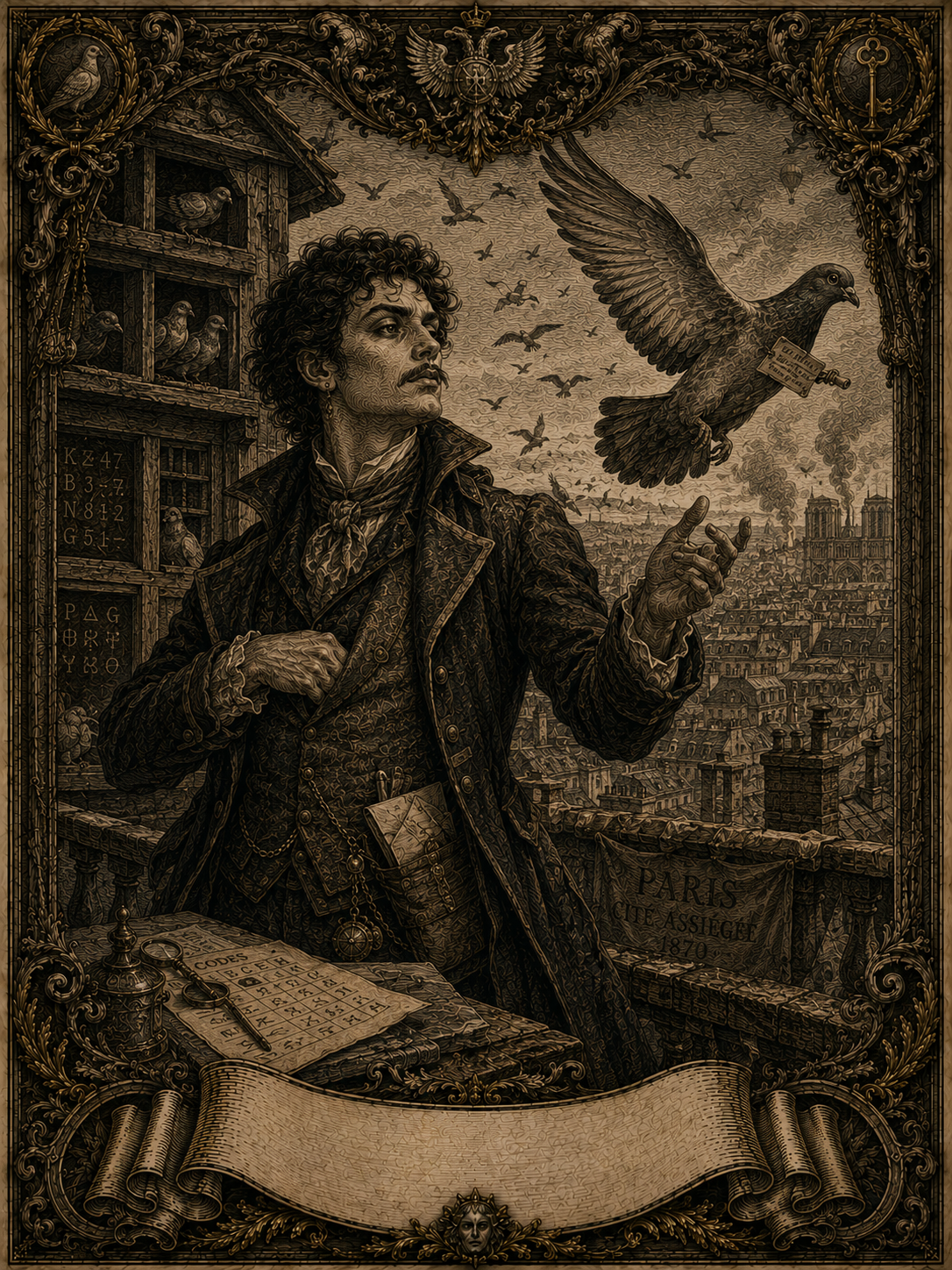
Corvino, alias Cuervo (“Raven”), is a recurring secondary figure of Uchronic Paris: master of the war dovecotes and conductor of the city’s network of ciphered communication by bird flight.
| Type | Character |
| Other names | Cuervo (“Raven”) |
| Occupation | Master of the war dovecotes |
| Spanish entry | Corvino |
Description
Corvino is not a member of the Time Bandits but a contact of the Right Bank bird clubs, which carry messages kept off the official telegraphs. He carries a live pigeon in his waistcoat pocket.
The war dovecotes
The “war dovecotes” are the Parisian dovecotes kept in service after the siege of 1870, when pigeons linked the besieged city with the outside: a parallel communication network, independent of telegraph and post. The uchronic state tolerates them because they serve when official channels are cut, and cannot control them because a dovecote passes from master to apprentice by unbroken line, not by administrative grant.
Corvino runs the central dovecote of the Right Bank, “behind the Passage des Princes, up two flights of stairs and a ramp that the owner of the shop below pretends not to know”. The pigeons leave at dawn and return at dusk with rolled papers only the recipient can decipher.
The bird clubs
The bird clubs of the 18th arrondissement are legal societies (canary shows, goldfinch contests, talks on swallows) that serve as cover; the war pigeons work in their cellars and rented roofs. Corvino belongs to three:
- Club Ornitófilo del Pasaje Vendôme (1872) — declared canaries; in fact long-distance dispatch pigeons.
- Cercle des Amis du Pinson (1881) — declared finches; in fact short urban transit pigeons.
- Société des Oiseaux de Paris (1894) — declared urban birds; in fact raven-type birds and ciphered-message pigeons.
The birds of Paris
Each species has a role: pigeons are the backbone; ravens, the higher intelligence, tell enemy from traitor and carry what no other carrier would (his alias comes from this branch, not from Latin); magpies recycle what is left on the roofs; swallows cross at fixed hours and date the messages; sparrows carry nothing but cover the others with noise. He knows the sparrows of Notre-Dame, the ravens of Père-Lachaise and the magpies of the Bois de Boulogne.
In 1899 a municipal regulation of the network failed when the pigeon carrying the draft to city hall reached Corvino’s dovecote instead; he keeps the draft.
The Raven line
At least three historical “Ravens” practiced the trade: in Byzantine Constantinople, in Rudolfine Prague, and Corvino in Paris — an operational kinship (same office, different bodies), not a blood line.
Relationships
- Time Bandits — occasional clients, notably during the Orient Express assault and before Bucharest.
- Estela — he coordinated her departure from Nice after the shawl operation; his pigeons beat the yacht.
- Claude Nauge — ideologically close to the trade.
- Iriarte, the Subprefect of Time — tolerates the trade with vigilance.
- The Ravens’ Club — a separate operation despite the deliberate shared name: its thirteen members keep a ledger in raven ink (archiving), while Corvino dispatches. Both work in the 18th arrondissement; cross-operations are suspected, not established.
Tangentially related bird entries: the Iron Doves (also), Club des Gorriones, Lady of the Ravens, Atlantean Sparrows, Princess Urraca (he knows her name, not her face), Iron Raven Token, Roc and the Train of the Laughing Vulture.