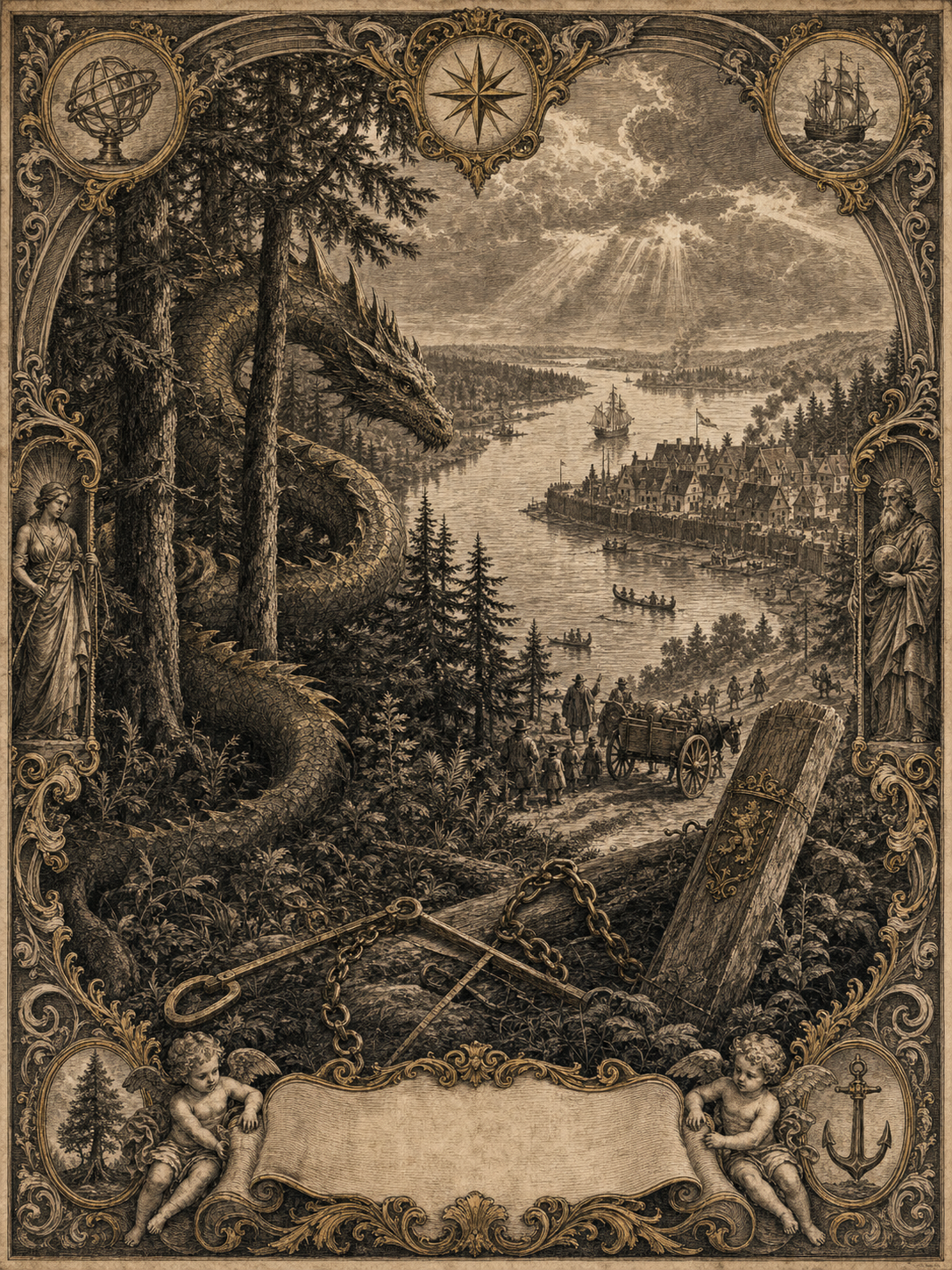
Indians and Dragons is a chronicle of alternative colonial North America, c. 1660, on the Hudson: a band of four from Abeto Rojo fights a stone-masked cult, in a plot of elemental cults.
| Era | c. 1660 (1663 is also given) |
| Base | Abeto Rojo (Red Larch) |
| Spanish entry | Indios y Dragones |
Setting
Pre-formed America (future Niagara falls; broad-brimmed hats, buckles, mules, wagons; strange new figures among the firs). The axis is the Hudson River (north–south near the east coast, up to almost five miles wide): New France to the north, Dutch New Amsterdam (future New York) at the mouth, and Albany, a Dutch grain and trade hub, upriver.
Abeto Rojo, a crossroads town of crops, livestock, wagons and smoked meats away from the river, has no governor; its nearest authority is the gray-haired butcher Harbrook “the Poplar” (four assistants), husband of meat-supplier Yalesa. Mother Yalanta keeps a tobacco den and “her girls” in a three-story house. Troublemakers hang a night from the butcher’s hook.
The peoples
- Spanish (oldest): the myth of Cabeza de Vaca of Pánfilo de Narváez’s expedition, cast up in Texas and Galveston, an Indian captive turned healer and wandering sorcerer, with Estebanico; southern lasso-and-cattle culture.
- French: blended with the Indians, kin to the elves; traders of furs, timber, mistletoe, spices and spell components. Jean Talon runs the economy, holds that Europeans must learn the land, and is pressed by newcomers (“the Philip Du Roys”, sons of the king) who cannot even farm.
- Dutch: mixed merchants wanting goods delivered.
- Northern Puritans: closed, internally democratic witch-burners who suspect forest-dwellers of Satanic dealings.
- Southern English: land-hoarding tobacco growers, future African-slave holders.
Grafted on: druids (Cabeza de Vaca among them), whispering elves, Fey-pact witches, mandrake, distant towers, latent dragons, and the stone-masked (curved blades, crossbows), forest ambushers linked to river piracy.
The band
Unnamed: three Indians or mestizos and a freedman (“the three diasporas”).
- Jürgen Meister: huge black-bearded mestizo, son of a learned, eccentric Dutch (partly French) father and an outcast Algonquin mother, raised by his grandmother. A mace-wielding barbarian from outside town, drawn in when three bandits rob him.
- Huichita (la Wichita, “Silver Cloud”): first-nation woman from Santa Fe and northern Mexico, who saw Aztec ruins and five-story pueblos. Peyote and huachuma visionary, Fey-pact witch singing like a bard (to inspire, freeze, strike, heal); Spanish crossbow, two daggers. She dreams of twelve brigantines aflame, and tends the hung Jaguar.
- The Jaguar (Indi the jaguar): French-Indian mestizo of about twenty-three, Jean Talon’s “wild card” sent to find who takes the cargoes. A druid (black panther or jaguar shape, entangling roots, healing). First seen drunk and brawling on the hook; he leaves before the last stretch for his forest moon rites.
- Lu (Brinston Lou, “Mister Voodoo”, the Freedman): Black freedman, voodoo-styled necromancer-mage (top hat, red cape, skull brooches, leeches, crow familiar Bertolo). He joins at the granite rock, saving the gravely wounded Huichita; the stone cult covets him as “the black earth”.
The hook
Cargoes stop arriving, attacked by night barges (pirates? cursed Dutchmen? Puritans punishing “pacts with the forest”?). Near Abeto Rojo: south-road bandits, stone-masked men, and a black granite rock fallen from the sky, whence no one returns.
Course of the chronicle
- The granite rock (Lance Rock) of the “leper hermit”: the animated robbers and colonial soldiers “who came with Champlain”; one arquebus kill shows someone else is clearing it. Lu saves Huichita.
- The necromancer (Jürgen’s father), in a laboratory-morgue in the cave: trained in Barbados, coveting the town, he mentions a Dutch colleague, Van Ende, and a “secret weapon” against the English. They kill him.
- The Stone cult under the town: summoned by quarry magnate Van Dornen to the “Dirty Dutch” wagon yard, they pass carved tunnels, stone sentinels and a cage trap, and are ambushed by stone-masked cultists. They burn the yard (Van Dornen dies); a prisoner names the cult of the black stone and its crypt under the quarry.
- Massacre and exile: accused of arson and murder, the band kills Constable Harbrook, armorer Lemmy Ironhead and the notables; the priest and “survivors” don stone masks, chant Malleus maleficarum and proclaim a “new order”. The band flees to the forest.
- The Marble Spire (Feathergale Spire): white tower of the knights of the air (griffon, hippogriff and giant-vulture riders), an anarchist, anti-slavery order of “free love” invoking the Queen of Air and Darkness and a “Duke of the Air” of the Antiterra pantheon. A manticore hunt wins a winged mount. The knights place the cult’s base at the Monastery of the Sacred Stone and want proof; fort Rivergate Keep “tolls” the barges.
- The Monastery: disguised as dealer and slaves, received by Father Carbo, they drop via a trap stair into a sacrificial crypt and kill an insectoid Umber Hulk of four quartzes. The blind abbot preaches the “thirsty stone”: monastery and town cult are one sect. Masked monks ambush them.
- The quarry: after a month’s initiation with the knights (test: three culprits taken alive), they storm the night conclave: Larraco (the new priest), a golden-bull-masked minotaur executioner, gargoyles and cultists lighting a cross of fire for the golden-calf rite. They kill minotaur and gargoyles and take three prisoners; Larraco escapes invisible; the knights airlift them out.
It stays open on the eve of the band’s initiation: Larraco at large, the town held by the cult, Jürgen’s grandmother’s fate unknown.
See also
- Abeto Rojo
- Crown of the North, another chronicle of an alternative colonial America