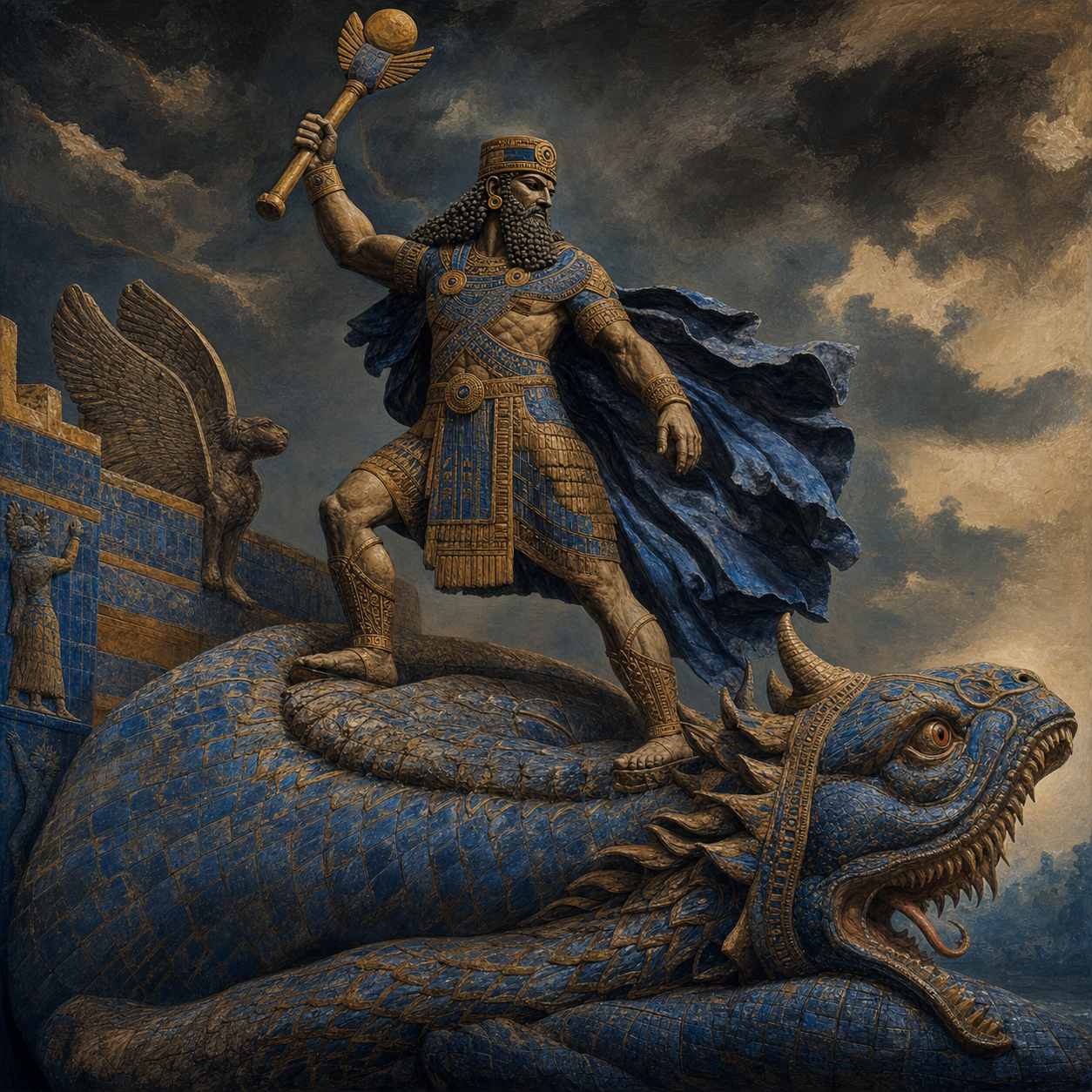
Marduk is, in Vala Cristalis, at once the dragon-slaying king god who defeated Tiamat at the origin of the world, a title one hero bears per cycle, and a gray-armored body now imprisoned in the underworld.
| Type | Entity |
| Location | Babylon; Esagila |
| Chronicle | VTC |
| Spanish entry | Marduk |
Origin
Marduk defeated Tiamat, the primordial dragon; from her death the earth was born, and he “destroyed chaos” and regenerated nature. Enlil, Gamayera and other gods helped, removing a constellation from the sky. He came to capture “the ring”, the Tablets of Destiny, and defeated the dragons for it. The gods then gave him their combined power, making him supreme sovereign. Kings reenact this rite, because “there is always a god who is the king who is the dragon hunter”.
Appearance
Gray plate armor under a half-open black poncho-like tunic, a gray shield on the back, a sheathed sword, black trousers, low leather boots. Black hair; eyes so black the iris cannot be told from the pupil.
The Lance of Marduk
A curved two-handed elven sword carried “as if it were a great lance”, its point “an ace of silver light”, made in honor of Dallandor and the dragons. It is also called dragolance and Lance of Babylon. Sheridan now wields it.
The title
Bearing the name means surviving a sacrificial ritual; in three hundred years only three did: Gilgamesh, Marduk, Ashur. Earlier cycles involved figures like Gilgamesh and, before that, Marduk. Ilgamesh “has the same attitude” and represents the hero over the bull.
The Morphic Magic Objects are “the regalia of the reigns of Marduk, Apal and Vina”; whoever bears the sword-lance and the regalia can be recognized as the cycle’s Marduk. He is “supposed to come” from Nivena and Lonia, and is declared male hero of Ibenaionia.
The title is now in dispute: the company must choose the Marduk, and the former gardener, the Cakravartin, is a candidate.
Conflicting accounts
- God, title and imprisoned man are all asserted, unreconciled.
- Lance of Marduk, dragolance and Lance of Babylon may or may not be one object.
Open questions
- Who imprisoned him, when and why; the place is known only by a doubtful name.
- What the ritual is, and what befalls those who fail it; how the lance reached Sheridan.
- Whether Ilgamesh holds the same office; how Nivena and Lonia relate to Ibenaionia; Apal and Vina may be misheard names.