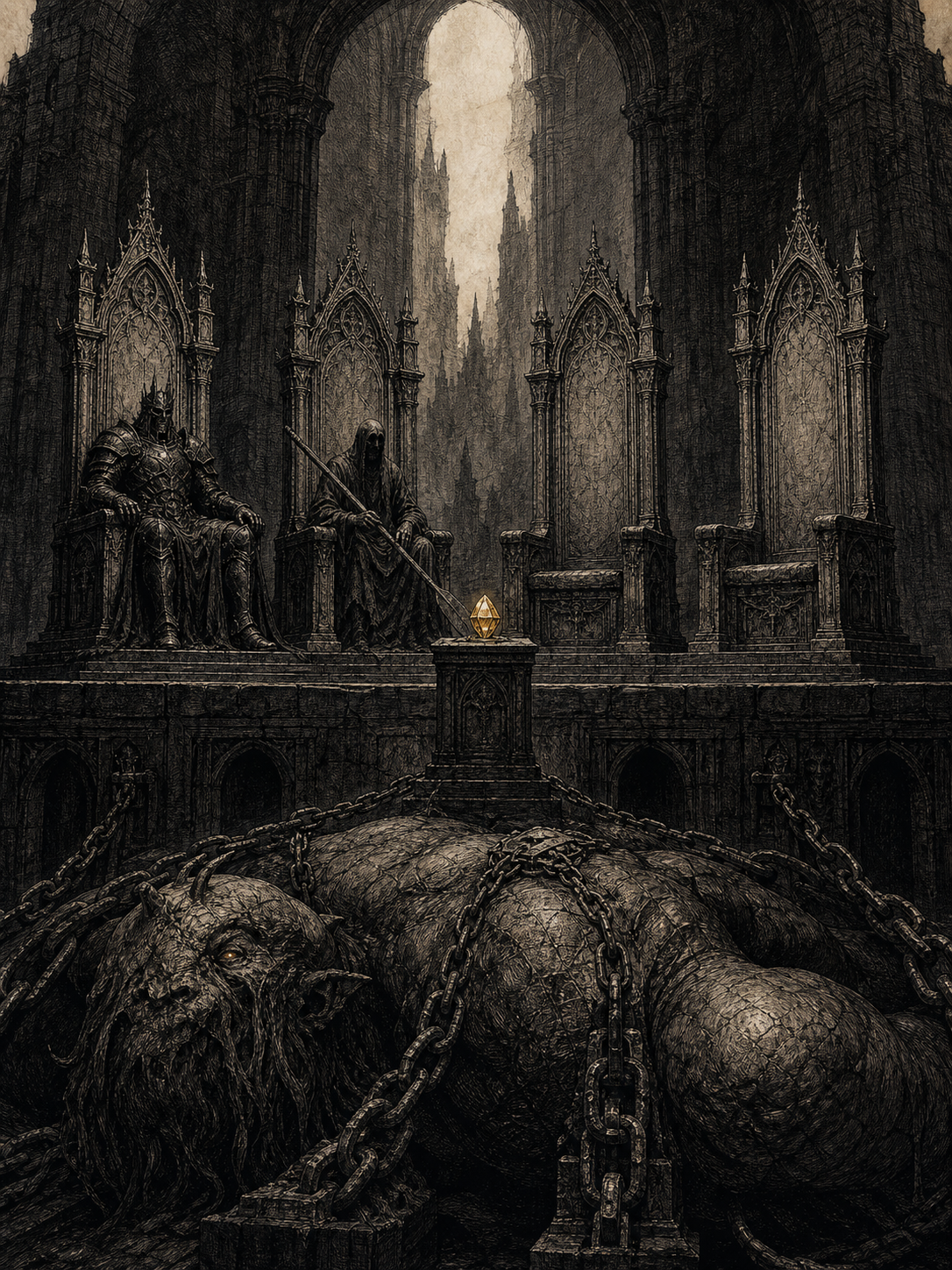
The Horsemen of the Apocalypse are four daimonic powers — Hunger, War, Disease and Death — who come to carry out the Apocalypse. According to Hecate, they come “to end the plan of God that no longer made sense” and to let the world re-emerge “as the true new entity that does justice to these times”.
| Type | Faction |
| Members | Hunger, War, Disease, Death |
| Emblem | Jeweled crown, scepter, scales, sword |
| Spanish entry | Jinetes del Apocalipsis |
Membership
- There are four and only four. Being a Horseman is an office, equal in rank to death itself.
- A vacancy is filled by co-option: “one is a horseman only when the other horsemen say yes”; a new Horseman must be accepted by the rest.
- Suriel is among those named with the dignity of daemonic Horseman. A damaged fragment shows Auro commanding them.
- Contest of the Horseman of War: a formal entry by written invitation. Luca de’ Medici received “a formal invitation, with a rather weak contract”, scrawled and signed or underlined in black ink or blood. Candidates need weapons and magic of a certain caliber, a vessel able to move quickly and reach these places, and some ability to avoid detection.
Emblem and image
Their biblical emblem has four pieces: a jeweled crown, a scepter, a scales and a sword. It is the only form in which the four appear together. Dürer’s “very beautiful” depiction of them is known. Their coming is described as “outside the windows the world was roasting like roasted apples”.
Mounts
- The Horseman of War rides a white pegasus, yet is called “the famous and well-known horseman without a horse”; he is expert in war and diplomacy.
- One Horseman rides a dragon and holds two swords — fused swords, not bastard swords.
- The other mounts are not recorded.
Methods
- A taboo rules them: “four of us never meet two together”. They travel apart, and their power acts as a sum at a distance.
- They work through binding contracts and delegation (“sign here, you relieve me of this contract, you take charge”), through invitations, signatures and feeders.
- They pursue the Stones of the Apocalypse, which others contract to deliver to them, and they have secrets they want kept.
- The Chronal Assassin is “basically a feeder of the horsemen”.
- Over a besieged zone, the joint power of several — hunger, war and disease — “produces death”.
- When an interview was once sought, the Horseman of Hunger appeared.
History
- In 1120 the Horsemen “did not yet have the power they have today”.
- The year 1348 is associated with the horseman of plague.
- The Horseman of War gains special power before 1870, “where war confronts revolution and the established powers are no longer indoctrinated”.
- They act on Terra, where Savonarola preaches that “the apocalypse is coming” and where the apocalypse “froze in a moment”. A warning said they were coming to Antiterra.
- A certain Lewis read four special horses as a reference to the four Christian Horsemen.
Opposing them
The Apocalypse is “the duel of steeds of God and the Devil, like a cursed metronome” that will arrive shortly; the Horsemen are its executing arm. They surpass even Stargazer in killing power: they can kill you “so that you do not come back”. One company “was not ready to face the horsemen”. The rule against them is «a la muerte le das vida» (“to death you give life”). One or two Horsemen have been killed; in other times, “they are the ones winning”.
Conflicting accounts
- In one tradition the four never meet, by taboo.
- Another places all four residing in a castle in Abaddon, and of 1120 says of the horseman of war that “the four would be together at that moment”.
Open questions
- Whether “the horseman without a horse” and the rider of the white pegasus are one figure or two.
- The mounts of Hunger and Disease, and which Horseman bears which emblem piece.
- What the Contest’s contract binds and grants, and what a feeder delivers.
- Which Horseman was killed, and by whom.
- Whether the Stones are their source, key or prey; what a frozen apocalypse means.
- Their faces, dress and voices are not recorded.