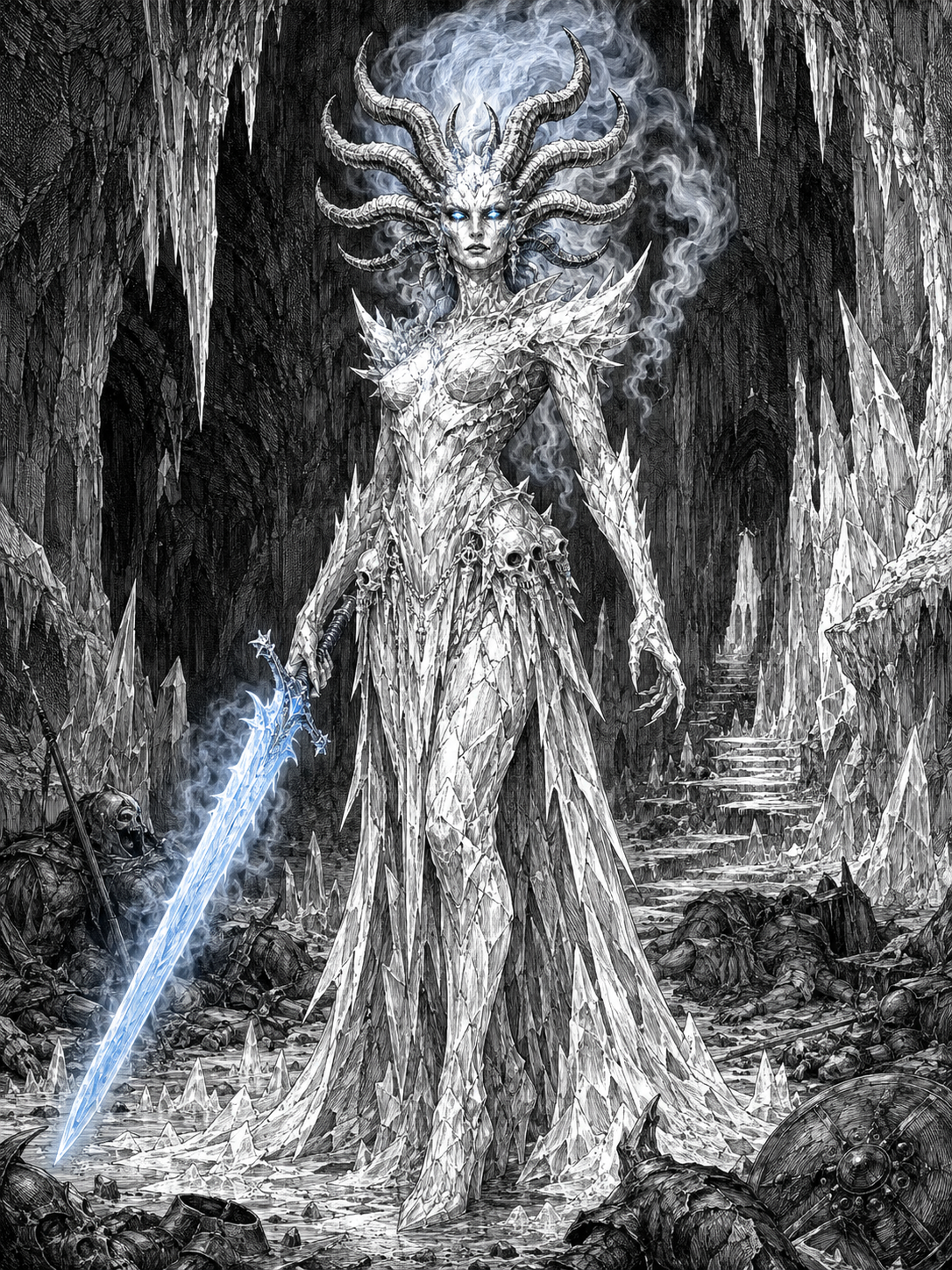
Sariel is a shape-shifting angel, probably fallen, connected to many planes and dispersed across many places, who acted as an imprisoned guardian whose release was the price of passage to a trial. “They call me in various ways, but the most pleasant for you will be Sariel.”
| Type | Entity (angel) |
| Other spellings | Ariel, Zayel, Sabiel, Zabiel |
| Spanish entry | Sariel |
Forms
- A humanoid upper body with long red-and-green hair and a serpent’s lower half.
- An aerial spirit that flies and watches events.
- A smoking eye in an eye socket, beside the hermit.
- An angel enclosed in fire, “like gremita, campichano” (words of unfixed meaning), bargaining from within the flames.
- An explicit female form, in which it spoke in the temple (“here is Sariel. Well, she is telling me that…”).
At Arty Hall “everyone gathered with a certain Sariel” — the angels who descended.
The price of passage
From within the fire Sariel blocked the way: “to do the trial you have to go in through here; I won’t pass if you don’t free me.” The release is triggered by stating the wish — “I wish that you be freed,” said to the dark one — and is instant and violent (“it got free, boom!”). It was freed “from loneliness and death.”
Dealings
It has a sword, with no recorded use, and “a marriage contract… or of another kind… a deal,” with an unnamed counterparty. It took part in the death of Adán, by means still unknown.
Conflicting accounts
- Sariel emerged as a result of Adán’s death.
- Sariel directly caused Adán’s death.
Open questions
- Whether “a kind of Sariel” names an individual or a class of beings.
- Whether the forms are successive or alternative, and whether the fire-prison came first.
- Where Arty Hall and the temple are, and whether they are one place.
- Whether “the dark one” is an entity, a place or an epithet.
- Who is the other party to the contract; what it fell from.