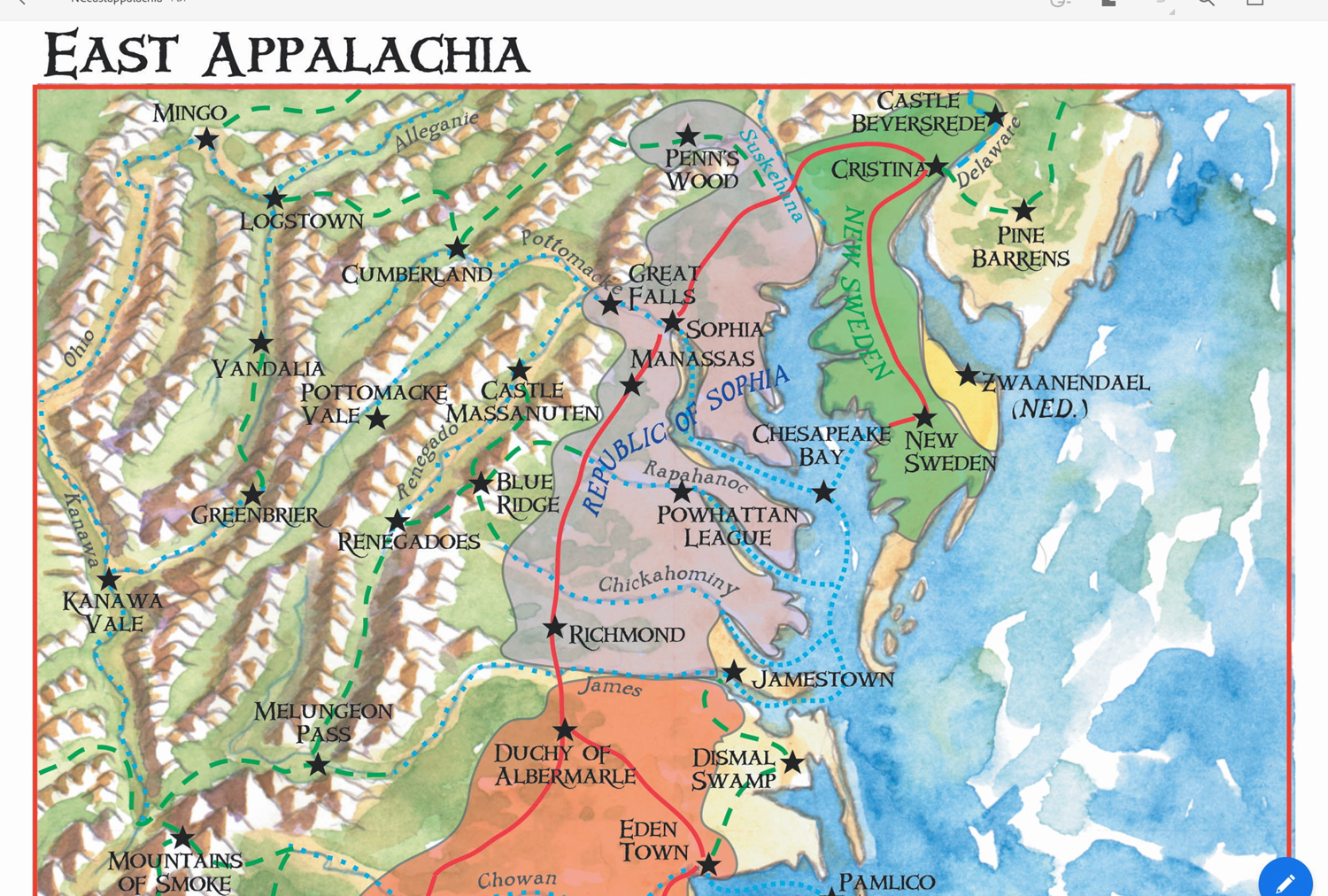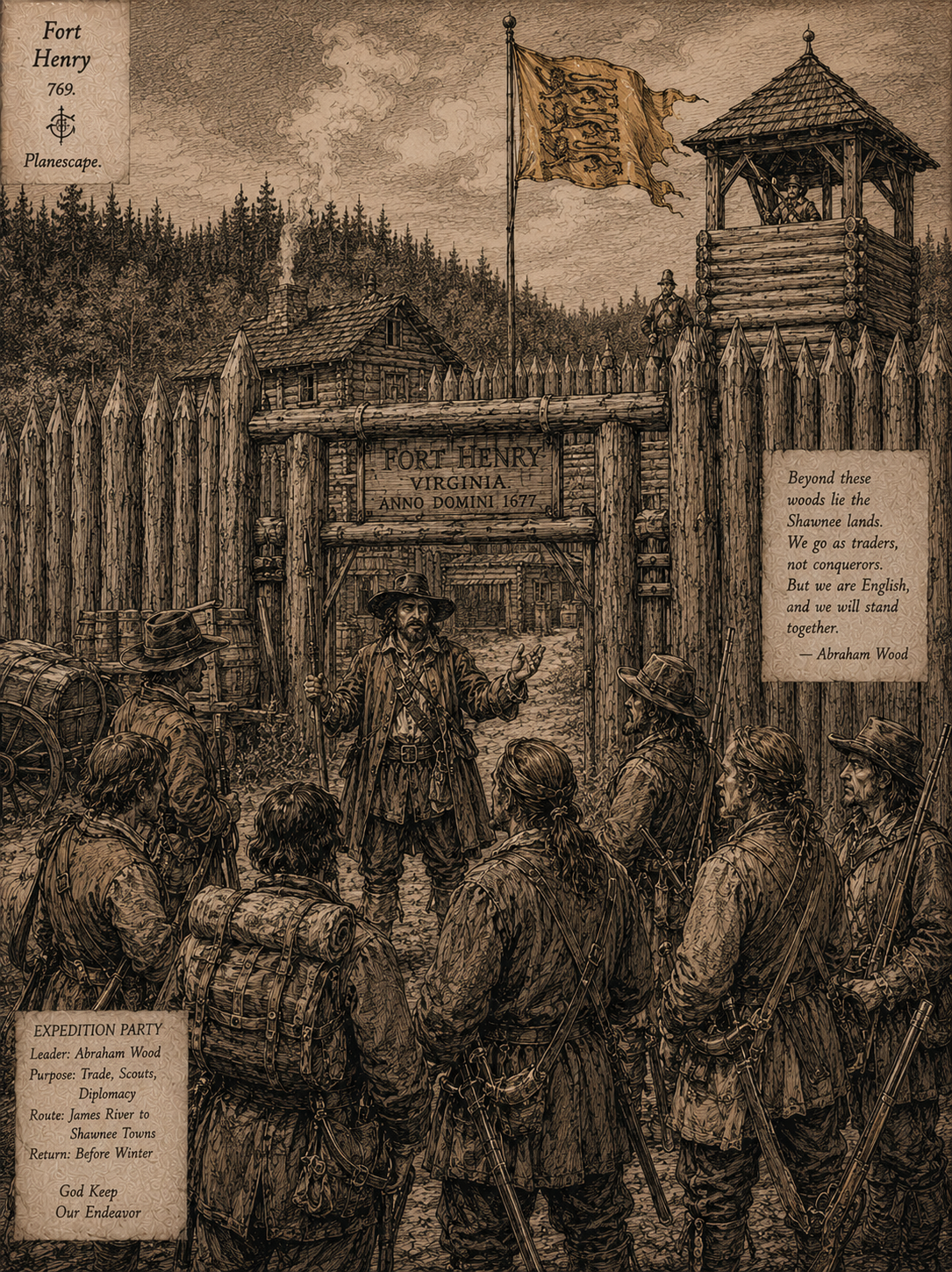
Fort Henry is a square wooden stockade on the northernmost frontier of English colonial territory: county and march, trading post, garrison and customs house, and the only legal gate between the colony and the west.
| Type | Place (fort) |
| Location | Near the James River, south of Richmond |
| Commander | Colonel Wood |
| Spanish entry | Fort Henry |
Description
It is the only point where an Indian may enter under license and, “supposedly”, the only authorized exit for any European (or at least carolingia) expedition toward the mountains: “we have to pass through Fort Henry”.
A replica of the first James-type forts, it has a perimeter stockade, sentry boxes and a falconet pointing outward from one embrasure. Defenders include Swedish mercenaries dressed in blue. Inside are “at most four or five big houses”: the Colonel’s house, stables, inn-like lodgings and a camp of twenty to thirty people.
Location
It lies near the James River, south of Richmond, on the frontier most connected with Sofía, perhaps a few kilometers from Scotsville. Colonial advances into Carolina start here, sent “on behalf of the people of carolingia, of their father Colonel Abraham”.
The gates
The gates close at nightfall. A red pennant lets one leave at will, but no one returns until morning. Colonel Wood commands “at this moment”; Edward invites visitors to a working breakfast at the Colonel’s house. The companions of the first gesta (campaign-cycle) set out from here.
Open questions
- Whether “county” and “march” name a territory larger than the post is unclear.
- “South of Richmond” and “northernmost frontier” are not reconciled; what Sofía is (region, city, or misheard echo) is not fixed.
- Who grants the red pennant, and what status it confers, is unknown.
- Whether Colonel Wood and Colonel Abraham are one authority, successive, or ranked is unknown.
- What is traded, on what terms an Indian enters, and who the camp’s people are, is not recorded.
Gallery