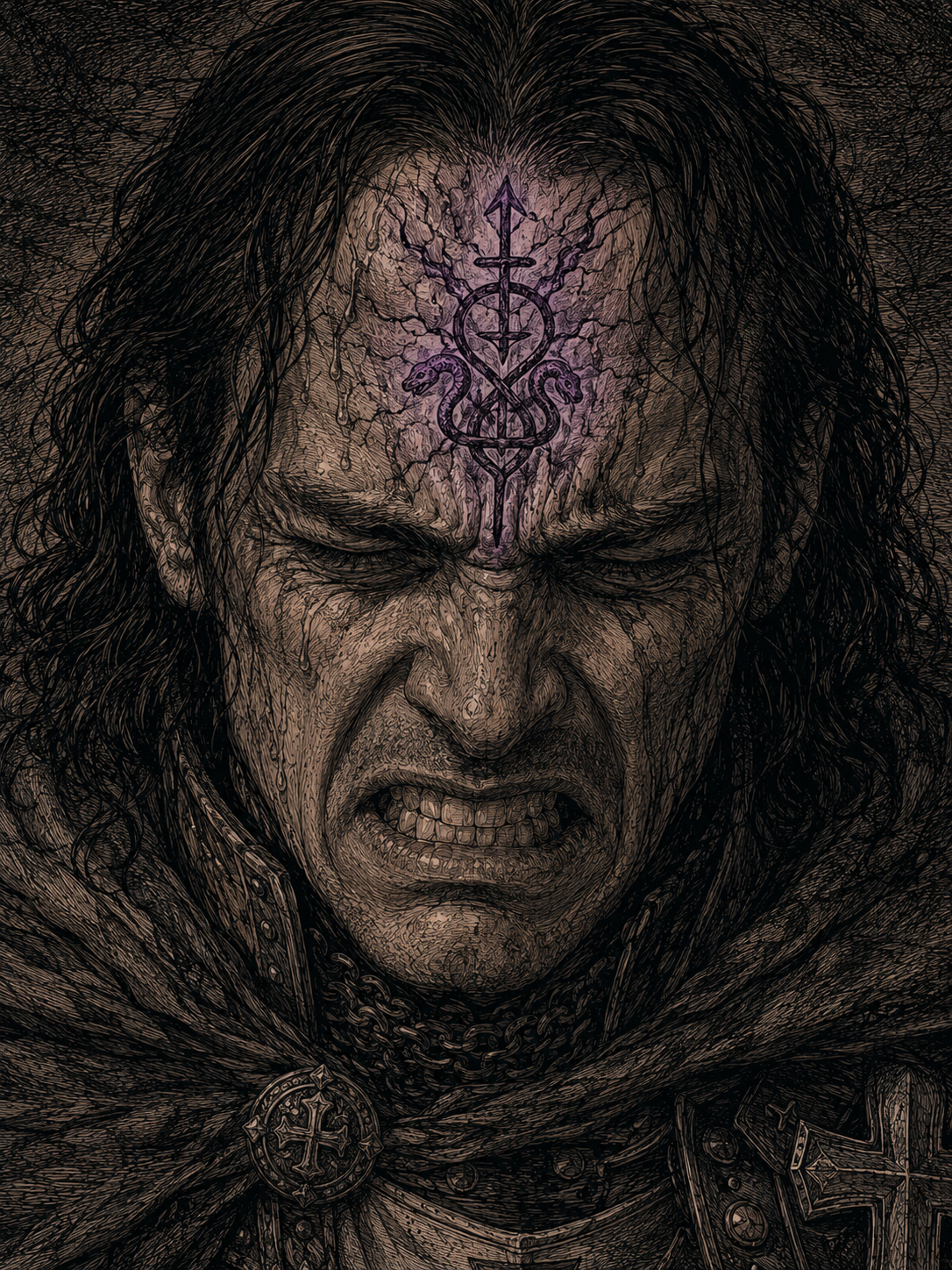
Lirio is a paladin from the kingdom of León, in Spain, who renounced the powers of his God and swore to protect Kronamon, son of the god of time. He later reappears in a land of ice and marches with the company of Sogol.
| Type | Character (paladin) |
| Origin | Kingdom of León, Spain |
| Spanish entry | Lirio |
Description
A “big, burly” man with a “good-natured face”, from the same region as Alexio. He wears brown leather, a “tremendous sword” at his left side and a greatsword across his back. The sword is blessed, but the blessing can be “active” or not. His cape holds gray spheres “to throw and explode”. At other times he wears full plate that molds to the body without hindering movement, the bull armor and the serpent belt; with the Helm of Opposite Alignment and gargoyle wings he has “a frog’s head and gargoyle wings”. Once he fought temporarily enlarged, like others of the company. A unique small animal, the pichicío (“a sort of little dog”), sleeps between his legs.
Rule and oath
Lirio never used the greatsword against other combatants, only against creatures that do not belong to the world. Of relics he holds: «No tienen que ser utilizadas para resolver cuestiones de los hombres» (“They must not be used to settle the affairs of men”). Among the Templars he has a voice in decisions (“let Lirio speak”).
He renounced his God’s powers and trains as a Paladin of Kronamon, having sworn to Kronamon’s father to protect his son.
The prayer of the sword
A prayer attributed to him survives only in stanzas tied to the sword of the Sancta Sanctorum in Jerusalorium, that city’s smith, the fall of the cursed helm outside Paris, and the clock of the end: «Que vuelva la chispa antigua, / que el acero vuelva a arder, / no por gloria ni por bronca, / sino por volver a ser.» (“Let the ancient spark return, / let the steel burn again, / not for glory nor for rage, / but to be once more.“) The fourth stanza says the sword “never stopped praying”. See Prayer of the Sword and Poet Paladins.
The mound in the land of Ice
His last memory of the Templar phase is the explosion of Notre-Dame. He later emerges from a snow mound near a dead temple’s tomb, frosted, burned and starving, as if from hibernation. Adriel, Lucio, Lem and, from afar, Dandy of Sogol sheltered and fed him. He serves a temporal deity heard as Cristocronamón (Christ, Cronos and Amun), “who chose to die in a given year”: the same oath to Kronamon.
In Ungarn, beyond the Mists, he alone crossed the crypt of deadly spores, fought a dead guardian and carried the seven White Roses of Rest. When the company chose to save a dead companion over justice, he stayed alone: he killed the mayor’s two chained winter wolves, fell among centipedes, and, offered a contract for Sogol’s Hall of Records by the village lords, asked only that the dead girl Eliza rest. He pinned her with a rose at dawn, ran her through and beheaded her. A fiery power claimed him (“this one is mine”); an angel held it back.
He now travels the Road of Mertylmane, tried for seven days to make the roses sprout, and gave Lem the crypt guardian’s sword.
The seventh day of the edge
In the Halls of Frost he sharpened his sword as a prayer and helped take the fortress. On the way to Karlstorf, on the seventh day, he asked that faith become an edge again; the black whetstone recalled the Black Obsidian Dagger, and a cut on his hand and an inner voice answered. The resonance of Dandy’s dream of the Hall of Orators reached him. At the Threshold of Aries he fought the figure of the chains. He has not yet reached Calíope, nor recovered all the relics of his Templar past.
The same soul
Lirio shares one soul with Edward and Novoyo: successive forms of a single soul that oscillates between service and ambition — Lirio serves without glory, Edward is the pole of ambition, Novoyo annuls himself.
Open questions
- His former God and renounced powers are not recorded.
- Which weapon holds the blessing, and what activates it, is unclear.
- What the pichicío is, and where the bull armor, serpent belt and wings came from, is unexplained.
- What counts as a “creature that does not belong to the world” is open.
- How and when he reached the snow mound, his contract’s terms, and the fiery power that claimed him are unknown.
- Whether he wrote the prayer himself is undecided.