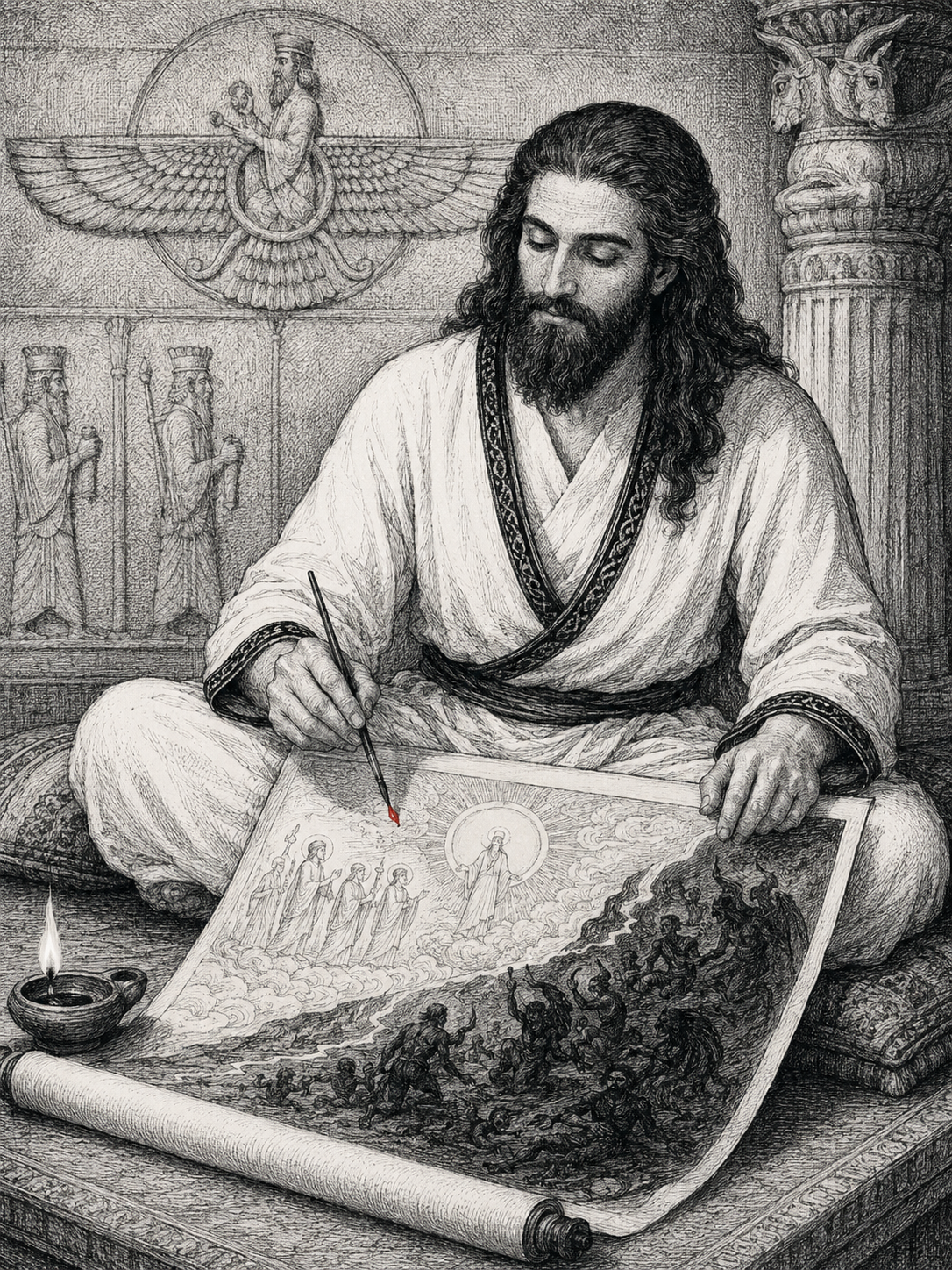
Mani is the prophet-founder of Manichaeism, born in Ctesiphon (Parthian Empire) in 216 AD and taught by the spirit Syzygos (“twin”).
“Mani” means “jewel”: a soul trapped in a gem, the body. He was the self-proclaimed “seal of the prophets” (after Buddha, Krishna, Zoroaster, Jesus) and the promised Paraclete. His father was an Elchasaite Gnostic (Ebionite subsect). Manichaeism has five elements (smoke, darkness, fire, water, wind) and two ranks: electi (vegetarian, fasting, chaste) and auditori.
History
Twin visions at 12 (228) and 24 (240); India/Afghanistan (240–241); court of Shapur I (242); possible meeting with Plotinus across a river during a campaign (242–243); friendship with Zenobia of Palmyra (243–270); clash with the Zoroastrian reformer Kartir (274); flayed alive and stuffed with tow (276–277).
Per Socrates of Constantinople, it passed from Scythianus (a Saracen) to Buddas/Terebinthus, hurled from a cliff by a daimon (likened to the end of Arcoms), then to Cubricus, a boy renamed Mani. Disciples: Thomas (Egypt), Addas (Scythia), Hermas. Revivals: Priscillian, bishop of Ávila (370; handed to civil justice 385; disciple of “Mark the Egyptian”), and the militarized Paulicians (7th century, deported to Bulgaria).
Graz’zt/GRDT, Zenobia’s vassals, follow duality; Paul of Samosata was her protégé; KAXA adopted the dual doctrine after captivity.