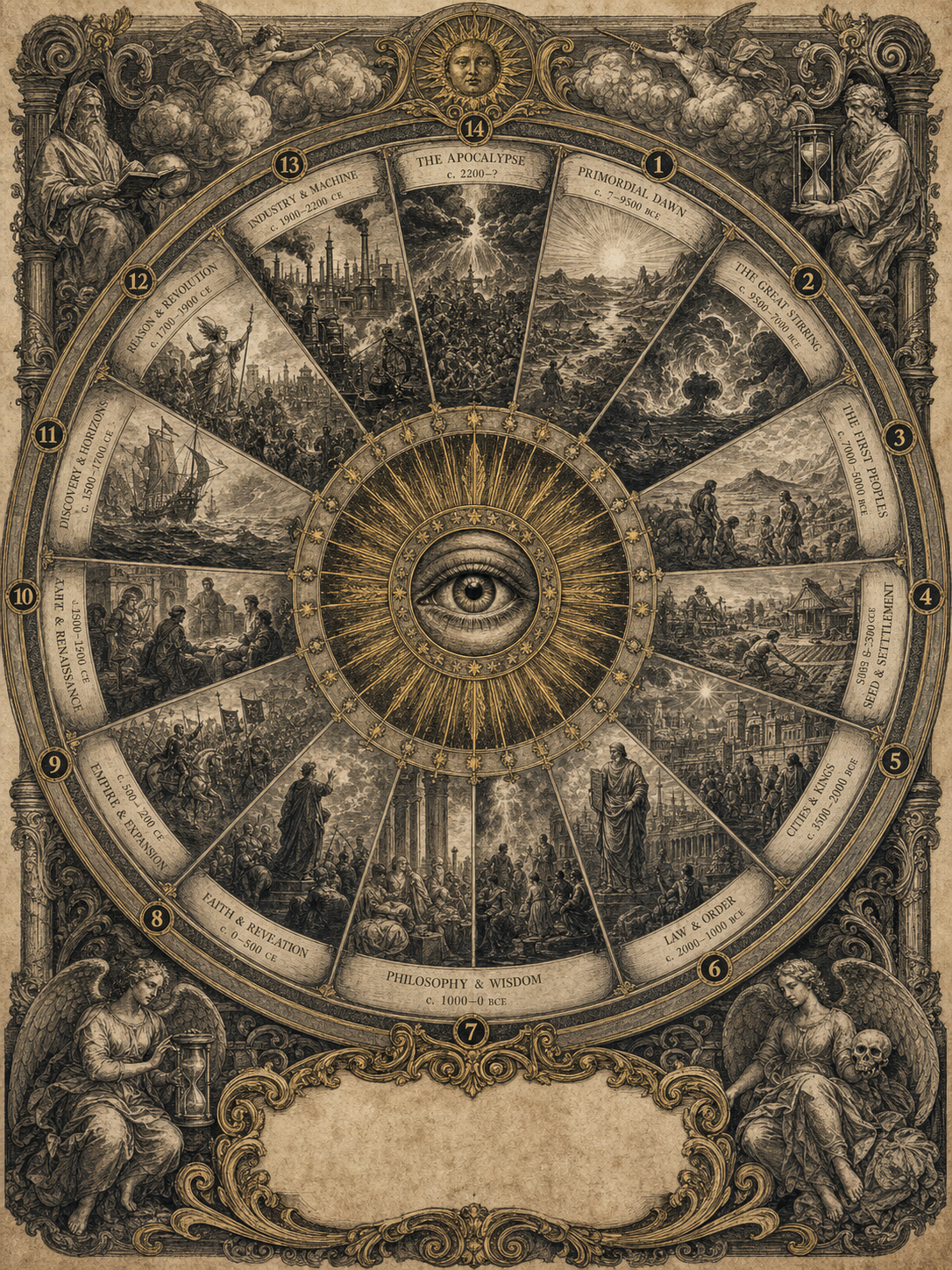
The Platonic eras are the fourteen eras (00–13) by which the Archive orders events across the shared cosmos without cancelling each subcosmos’s native calendar. Every glossary entry is placed in one era: the era is the form of time, the native year its local texture.
| Type | Chronological framework |
| Eras | 14 (00–13) |
| Ordered by | Akala |
| Houses of the Cycle | ☯ House of the Twin Cosmos · ☷ House of the Descent · ✒ House of the Chronicler |
| Spanish entry | Eras platónicas del archivo |
The fourteen eras
| # | Era | Frame | Native calendar |
|---|---|---|---|
| 00 | Primordial Era | before all record | none |
| 01 | Age of Empires | classical and late antiquity | AD, 270–378 |
| 02 | Age of the Forgotten Realms | cosmogonic era of the trunk cosmos | DR, 348–1375 |
| 03 | the Hiatus | the fifteen veiled years | no nominal calendar |
| 04 | Age of Crystal | Caldero, Vala, the gem-world | AE, c. 1824 |
| 05 | Templar Age | Constantinople to Tyre, Templar phase | AD, 1051–1120 |
| 06 | Age of the Renaissance | Invisible Cities, beginning of the open crystal | A.D.A., 1494–1520 |
| 07 | Age of Revolutions | Les Libertateurs, the passage of Aries | A.D.A., 1717–1820 |
| 08 | Belle Époque | the long nineteenth century, spread of the office | A.D.A., 1820–1888 |
| 09 | Age of the Apocalypse | the event of 1888–1901 | A.D.A., 1888–1901 |
| 10 | Sinterra Age | post-dissolution; Uchronic Paris, NEO-PARIS | A.D.A., 1901 onward |
| 11 | Age of the Descent | Inferno, Ante-Inferno, the choral voice | inverted time |
| 12 | Age of the New World | the Northern Crown, alternate America | own calendar |
| 13 | Age of Archontos | Archontean Empire, valley of Ardis Vala, draconic Pact | AEP, 1–2993 |
How an entry is assigned to an era
Each entry records its era and its date in the native calendar. An entry covering a range is ordered by its starting year; an undated one by an approximate figure.
- The era is declared, not described. The chronicler (Akala) chooses it; the entry records it.
- Border events go to one era. An event on the boundary of two eras (typically the Hiatus after the Last Judgment) is placed in the era where it weighs most narratively; the other is noted.
- Eras are unequal in length. The Primordial Era may span millennia, the Hiatus 15 years, the Age of the Apocalypse 13 years. Length follows density of events, not a linear scale.
- Native calendars are not converted into one another. 1375 DR and 1888 A.D.A. have no mechanical correspondence; they are times of parallel cosmoi brought together on the page.
- The Age of the Descent runs in inverted time. Events of the Ante-Inferno are counted from the threshold toward the circles; chronology there is topological, not arithmetical.
- No calendar has a year zero. A calendar anchored on a founding event counts that event as year 1. In AEP, the night of the Elías is year 1 AEP, counted up to 2993 AEP in the present cycle.
The Archive’s chronology, the Chronicle of the Archive, is written in the voice of Akala, scribe of the Chronicler of the Plata, in the retrospective tone of Chateaubriand’s Memoirs from Beyond the Grave.
Canonical examples by era
Primordial Era
- The Ancients — founding of the cosmos
- Gem of Creation — before recorded time
Age of Empires (AD)
- 270 AD — Néorex in Rome
- 378 AD — the Eisagogika signed by Paulus in Alexandria
Age of the Forgotten Realms (DR)
- 348 DR — the story of Natalio
- 1348 DR — Coyote arrives in the Forgotten Realms
- 1349 DR — birth of Elisteo
- 1368 DR — Dance of Knowledge
- 1375 DR — Last Judgment
the Hiatus
- The fifteen veiled years — The Fifteen-Year Hiatus
Age of Crystal (AE)
- 1824 AE — Mascor Blancarba in Caldero, on the gem-world Vala Cristalis
Templar Age (AD)
- 1051–1055 AD — Olaus Wormius translates the Eisagogika in Constantinople
- 1119–1120 AD — the Templars of Time receive the office
Age of the Renaissance (A.D.A.)
- 1494–1520 A.D.A. — Invisible Cities
Age of Revolutions (A.D.A.)
- 1717–1784 A.D.A. — Les Libertateurs close the passage through Aries
- 1820 — Revolution
Belle Époque (A.D.A.)
- 1886 — Henri La France receives the Eisagogika in Paris
Age of the Apocalypse (A.D.A.)
- 1888 A.D.A. — the Regulators face Aries and Taurus
- 1889 A.D.A. — Temporal Apocalypse of 1889 / Destruction of Notre-Dame
- 1901 A.D.A. — Antiterra destroyed; the great separation
Sinterra Age
- After 1901 — Uchronic Paris, NEO-PARIS
- 1914 — Uchronic Sarajevo
Age of the Descent
- The Ante-Inferno — matrix of the descent
- Bertrand, Lost Ones, Maristo the Condemned
Age of the New World
- Crown of the North and figures of the New World
- Zodiacal platforms activated on the alternate continent
Age of Archontos (AEP)
- Year 1 AEP — Pact of Enoch/Elías on Mount Ennio; founds the imperial calendar (no year zero)
- c. 2639 AEP — Juliana X Bellatrix renews the draconic alliances (Archontean Reconquest)
- 2993 AEP — present cycle: Drusus IX and the descent of the Seekers into Ardis Vala