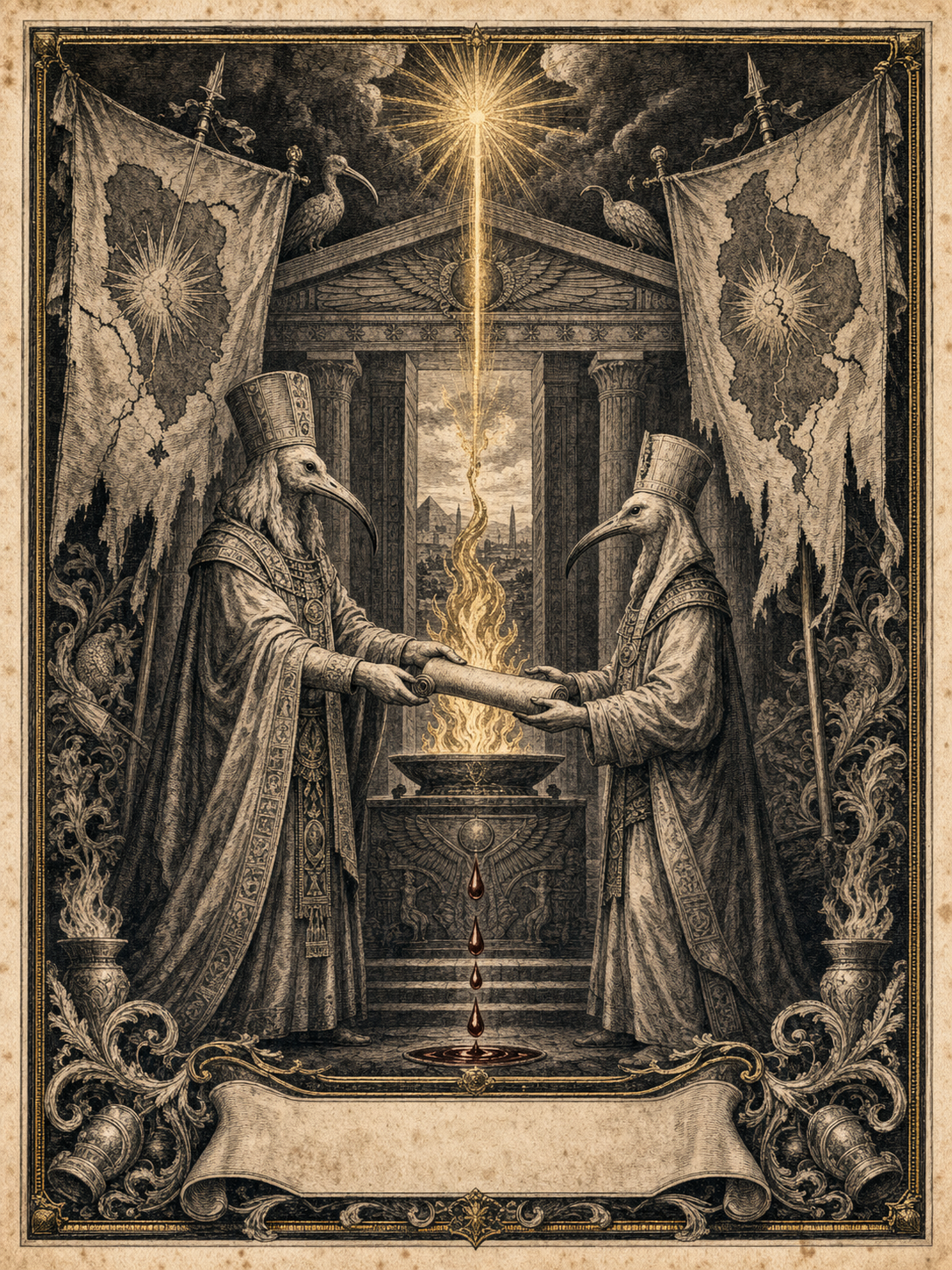
The theosophists (Theosophs in the cultured imperial tongue, from the old Archontean theosophus, “the sage of the divine”) were the faction of the Archontean clergy of Thoth in ancient Ardis Vala that, in the Magical Schism, reserved the magical spark to noble priestly initiates. They won the civil war in 1775 AEP and survive diffusely in the World of Archontos.
| Type | Faction |
| People | Archontean |
| Rival | Sortians |
| Founded | Magical Schism, c. 1900 AEP |
| Victory | 1775 AEP |
| Spanish entry | Teósofos — la facción del don sagrado |
Doctrine
Their formula:
“La chispa mágica es don sagrado reservado a los nobles iniciados sacerdotales. Su entrenamiento promiscuo corrompe el orden cósmico.” (“The magical spark is a sacred gift reserved to noble priestly initiates. Its promiscuous training corrupts the cosmic order.“)
Its two clauses are inseparable: the spark is a sacred gift belonging to the cosmic order, not personal property; and it must pass through noble priestly initiates, a double inheritance of family atrium and temple office, so that open training breaks the legitimate chain of transmission. This followed the late Egyptian tradition the Archontean priesthood had inherited. For the Sortians the spark belongs to whoever holds it; for the theosophists, to the order that grants it to the legitimate family. An Apologia ad Magos, attributed to an anonymous theosophist hierophant of the Schism, survives in a private library in Glastumville.
History
The Schism and the civil war
The Magical Schism (c. 1900 AEP) led to a long, devastating civil war, the War of the Sortians and Theosophists, or Civil War of Ardisvala. The theosophists won it around 1775 AEP:
- Sortian leaders were executed or exiled; Priscus Pulcher among them according to one tradition, a refugee in the ruins of the valley according to another.
- Sortian bases fell, including the compound of the Floor of the Great Chasm in the Mega-Dungeon, now held by their heirs, the Priscians.
- The priesthood of Thoth was reorganized as a closed hereditary caste.
The victory was Pyrrhic for the Empire:
- Agoreon, an Archontean city of Ostralios, was destroyed in the year the conflict ended.
- The Archonteans withdrew from Irthuin for centuries.
- Ardis Vala fell into ruin, reoccupied only in 2639 AEP, “about twelve hundred years” later.
- Magic was weakened: fewer mages, cut off from the populace, in an oligarchic craft.
The Drusian concession
Emperor Drusus V (c. 2400 AEP by some archives) imposed a theological peace by opening the Order of Thoth to anyone with magical talent, a structurally Sortian concession. The theosophists, by then diffuse, accepted it formally and kept closed transmission within the traditional priestly families. They ceased to be an institutional faction and permeated the Collegium of Cinders (the imperial academy of magic), the surviving priesthoods of Thoth and Set, old noble families with a private atrium ritual over their children’s spark, and the Decadian Orthodoxy: a “diffuse presence”, in the Decadian’s phrase.
The present cycle
Under Basileus Drusus IX and Pope Alejandro Sixto, the theosophists find a partial convergence with the centralized papacy (supreme pontiff, luminous custodes, judgment of the return), where the spark is legitimate only through an authorized body. The Decadian archive notes as a possibility that they may become the church’s arm of magical authority against the Priscians and Sortians, who defend the open spark, and against the Seekers.
Possible sites in the dungeon
The Decadian archive lists five hypothetical theosophist sites in the Mega-Dungeon, none confirmed as active:
- Halls of Thoth — public cult of Thoth, still active in some areas.
- Forum of Set — the theosophists tolerated Set as a dark aspect of the order, unlike the later Orthodoxy.
- Forgotten Secret Temple of Thoth — now corrupted by Oziman, a type III demon posing as Thoth’s avatar.
- The lich Syagria Aitón — possibly a theosophist archmage lichified in the Schism.
- Library of Thoth — theosophist texts, in varying proportion.
Conflicting accounts
- Imperial reading: they defended the cosmic order; the victory was painful but necessary, and the permeation is healthy continuity.
- Reading of the Chronicler of the Plata: they defended hereditary privilege disguised as theology and “won the battle and lost the Empire”, which withdrew for two centuries; the permeation is hidden ownership of the apparatus.
- The 2639 AEP reoccupation is placed in Ardis Vala in one passage and in Irthuin in another.